 Guide On Map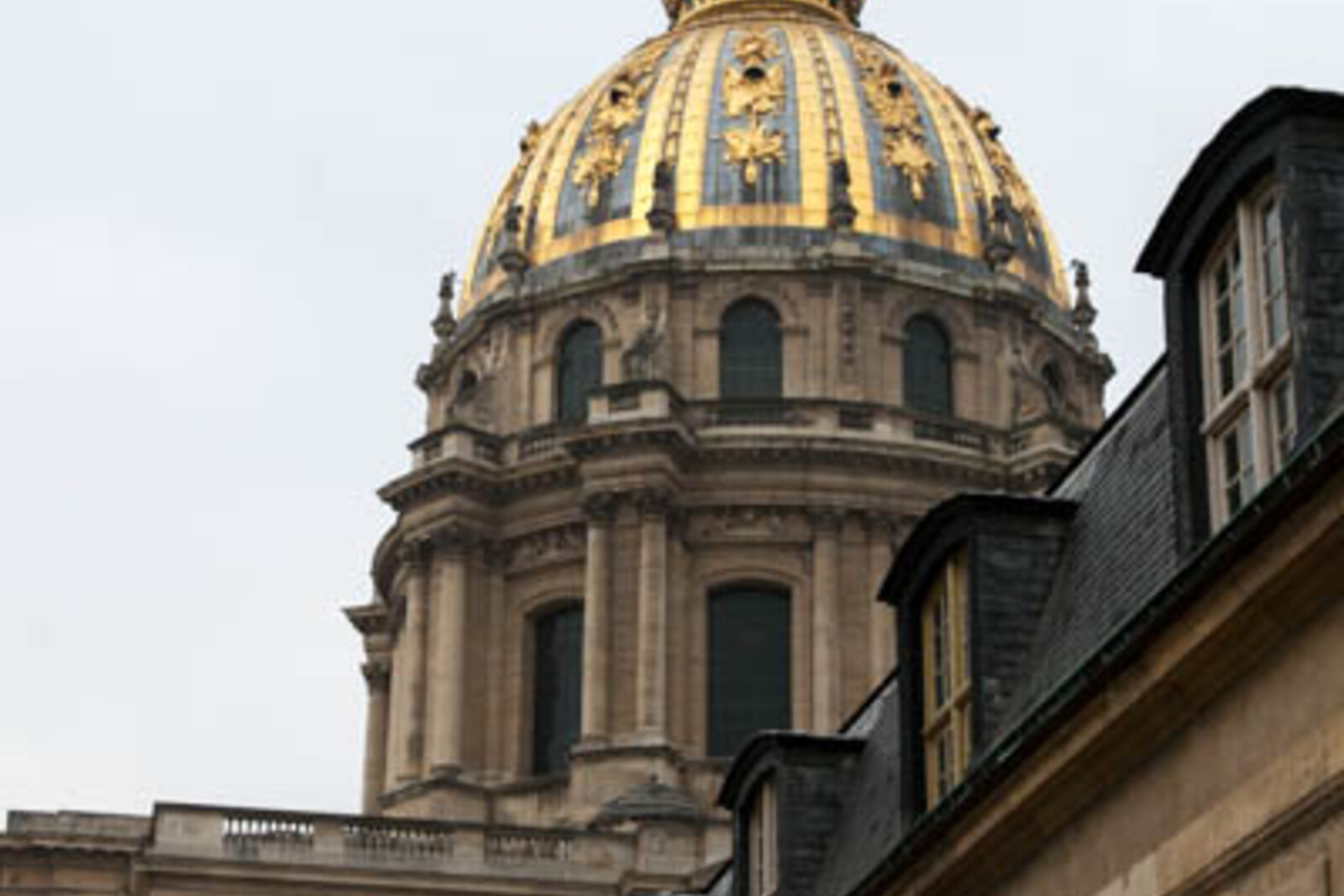
Look around first
What to notice
- Golden dome
- Red quartzite sarcophagus
- Circular crypt
- Gilded bees
The story of the place
The name “Dôme des Invalides” refers to the entire former royal church beneath the gilded roof. In the seventeenth century, “invalids” meant soldiers who could no longer serve because of wounds, illness, or age. In sixteen seventy, Louis XIV, a king recruiting a large standing army, ordered that they be treated and maintained at state expense. He wanted military service not to end in destitution, and new volunteers to know that after being wounded, they would not be abandoned.
Two parts of one church, with a shared altar, were arranged for the king and the veterans. Louis and his courtiers entered beneath the dome, while the soldiers entered from the side of the main courtyard. They attended the same Mass while remaining on opposite sides of the sanctuary: courtly order was preserved even before the altar. The present glass partition appeared later; beyond it is the former soldiers’ church, now the Cathedral of Saint-Louis des Invalides.
In eighteen hundred, Napoleon I, then First Consul and the future emperor, ordered the remains of the commander Turenne moved beneath the dome, and later the heart of the military engineer Vauban. The royal church thus acquired another function: celebrated military figures began to be buried here. Forty years later, that decision determined Napoleon’s own fate.
The deposed emperor died in eighteen twenty-one in British exile on Saint Helena. In his will, he asked to be buried on the banks of the Seine, among the French people. The British government long refused to release the body. Louis Philippe I secured its consent—the French king who had taken the throne after the revolution of eighteen thirty and was trying to reconcile supporters of his House of Orléans with Napoleon’s many admirers. The emperor’s return was meant to strengthen his fragile regime.
The king entrusted the expedition to his youngest son, the naval officer François d’Orléans, Prince of Joinville. On Saint Helena, the participants opened the grave and four coffins nested one inside another in order to verify the identity of the deceased. The body was transferred into a new lead coffin and an ebony sarcophagus. The ceremony was called “the return of the ashes,” although Napoleon had not been cremated.
On December fifteenth, eighteen forty, the funeral procession reached Les Invalides. The Prince of Joinville handed the coffin to his father; Napoleon’s sword and hat were placed on it, and it was then carried beneath the very dome where, at the deceased’s command, Turenne and Vauban’s heart already lay. No finished tomb yet existed, so the body was left in the Chapel of Saint Jerome.
Louis Philippe I wanted a prominent monument, but feared an excessively ceremonial glorification of the emperor. The architect Louis Visconti, who won the competition for the tomb’s design, proposed an exterior statue of Napoleon; royal officials rejected it. Visconti had to lower the burial inside the old church. The work dragged on. The return of the body did not make Louis Philippe I more popular: eight years later, a revolution overthrew him, and the king went into exile. Visconti died without seeing the tomb completed. Napoleon’s coffin lay in the temporary chapel for almost twenty-one years.
On April second, eighteen sixty-one, already under the deceased’s nephew Napoleon III, the body was moved into the completed crypt. For it, the floor beneath the dome was lowered by six meters and left open in a circle. The red quartzite sarcophagus contains five nested coffins, and words from the will about the banks of the Seine are engraved on the bronze door. The gilded bees in the Chapel of Saint Jerome mark the place where this coffin awaited the completion of the work.
Useful on site
Outdoor views are accessible as open urban space. Musée de l'Armée / Dôme: daily 10:00–18:00, closed 1 January, 1 May, and 25 December; on the first Friday of the month, late opening until 22:00, with ticket offices closing 30 minutes earlier. Access may change because of ceremonies or temporary technical closures.
Checked: June 28, 2026. Check the official source before visiting.The dome and the ensemble are easy to appreciate from outside. Napoleon’s tomb and the museum halls are inside and require separate time and a ticket.