 Guide On Map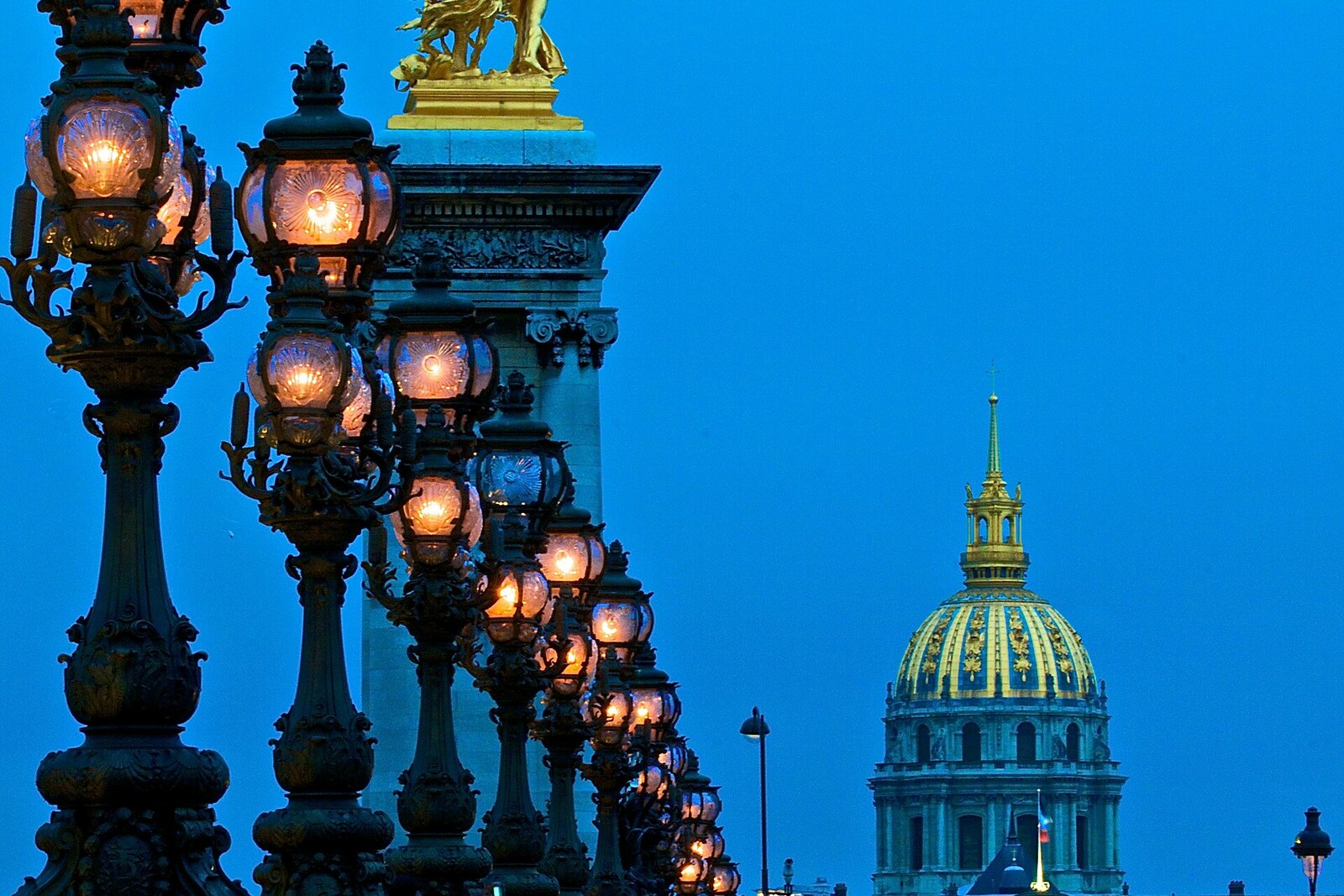
Look around first
What to notice
- Low steel arch
- Gilded figures on the pylons
- Nymphs of the Seine
- Nymphs of the Neva
The story of the place
Pont Alexandre III links the banks of the Seine between the palaces on the right side of the river and the Esplanade des Invalides on the left. The broad roadway rests on a single shallow steel arch: the river channel was left clear for ships, and the view of the Dôme des Invalides was not blocked by high supports. When the World's Fair was under way here, visitors moved across the bridge between its two large sections. At the middle of the span, you can make out the Nymphs of the Seine with the coat of arms of Paris and the Nymphs of the Neva with the coat of arms of Russia, while gilded figures rise on the pylons above them.
On October seventh, eighteen ninety-six, there is no bridge here yet. On the right bank, beneath a red-and-gold canopy, stands a granite block. A signed protocol is to be placed inside it, and beside it a gold trowel and a steel hammer have been prepared. The Russian Emperor Nicholas II takes the trowel, applies cement, and strikes the stone twice. The President of France, Félix Faure, repeats his actions. Empress Alexandra Feodorovna adds her signature beside theirs.
Nicholas came to confirm the agreement his father had left him. Alexander III—the Russian emperor whose name the bridge bears—agreed to a military alliance with the French Republic in the early eighteen nineties. France needed an ally after its defeat in the war with Germany. Russia had lost its former neutrality agreement with Germany, needed French loans for railways and industry, and was seeking a counterweight to Germany and Austria-Hungary. Under the military convention, Russia and France promised to act together if either of them were attacked by the states of the Triple Alliance—Germany, Austria-Hungary, and Italy.
The terms of the convention were not intended for newspapers. Instead, the rapprochement was shown to the public through receptions, fleet visits, and ceremonies. Alexander III ratified the treaty but died in eighteen ninety-four. In the same year, the French president Sadi Carnot, under whom the negotiations had begun, was assassinated. Their two successors had to prove that the agreement had not disappeared together with the people who signed it.
Félix Faure, the president seeking to strengthen the alliance, invited Nicholas to Paris. Two days before the foundation stone was laid, the French government gave the future bridge the name of Alexander III. Thus the son came to set in stone the name of his deceased father and his father’s principal foreign-policy decision. The protocol hidden in the granite block recorded the names of Nicholas, Alexandra, and Faure, as well as the purpose of the construction: the bridge was to be completed by the World's Fair of nineteen hundred.
The crossing was needed precisely here because the exhibition organizers were laying out a direct route from the new Grand Palais and Petit Palais on the right bank to the Esplanade des Invalides on the left. The engineers were instructed to leave the Seine without an intermediate support and not obstruct the view of the Dôme des Invalides. They placed the roadway on a single low steel arch. The bridge therefore turned out broad but rises hardly at all above the embankments: visitors flowed across it between the exhibition’s two major sections, while ships passed beneath the single span.
The Paris ceremony was continued a year later. Faure came to Saint Petersburg, where Nicholas II received him at the laying of Trinity Bridge across the Neva. The emperor and the president placed silver coins in the foundation, sealed the foundation slabs with cement, and again took up hammers. Construction was entrusted to the French Société de Construction des Batignolles. Nicholas answered the invitation to Paris with a bridge of French design, and Faure managed to make the return gesture himself.
Faure did not live to see the Paris bridge open. On April fourteenth, nineteen hundred, his successor Émile Loubet opened the World's Fair and put the crossing into service. This name and this date are inscribed on the downstream pylon of the right bank. Nicholas, Alexandra, and Faure remained in the hidden foundation protocol, while the name of Alexander III was given to the entire bridge. At the middle of the span, on the downstream side, sculptors placed the Nymphs of the Seine with the coat of arms of Paris, and on the opposite side, the Nymphs of the Neva with the coat of arms of Russia.
Useful on site
Open city bridge; temporary restrictions are possible for events, security, roadworks, or along the Seine embankments.
Checked: June 28, 2026. Check the official source before visiting.First look at the bridge from an approach where the entire span is visible, then step onto the sidewalk; do not block traffic by the railings for a photograph.