 Guide On Map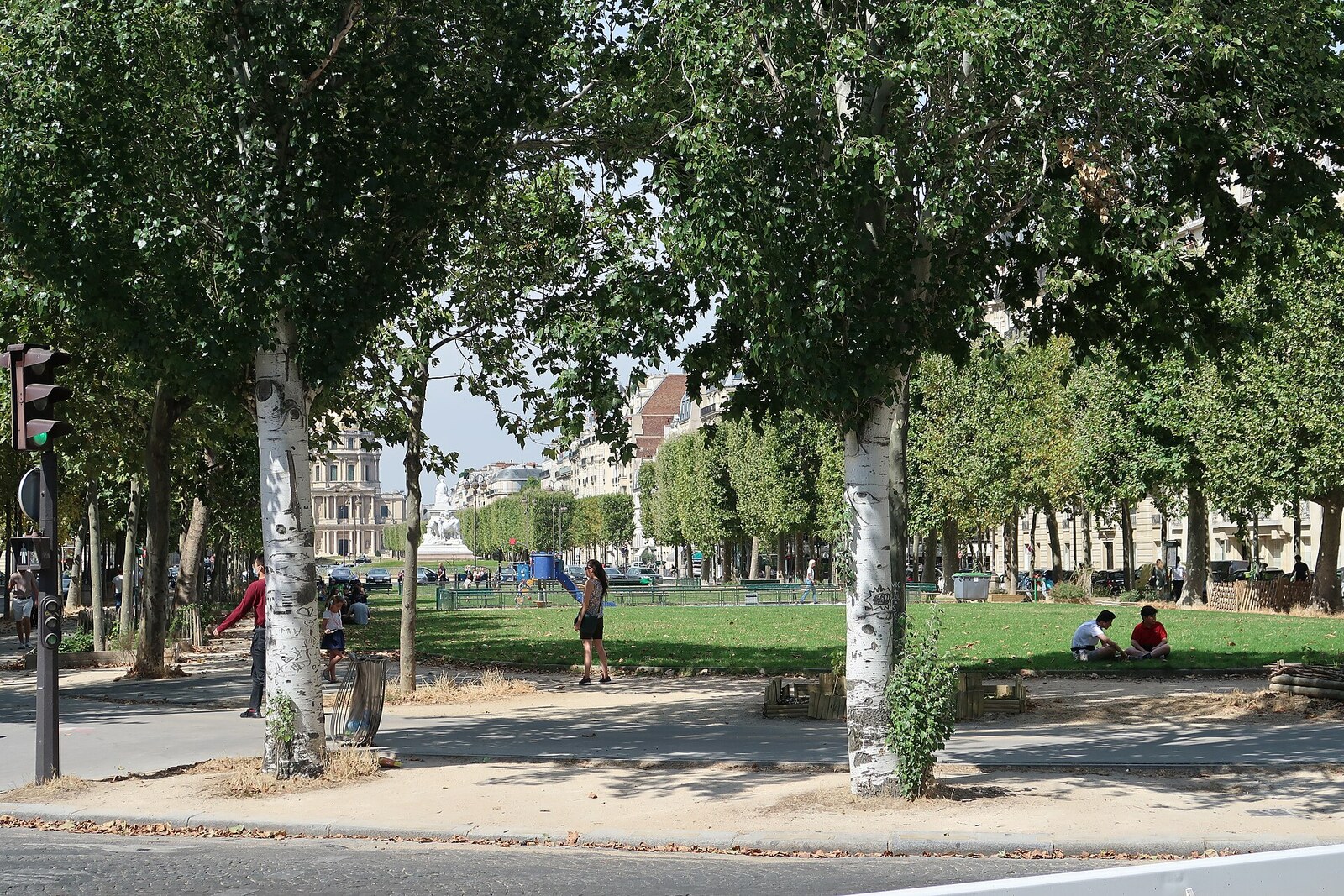
Look around first
What to notice
- Central promenade
- Pasteur Monument
- The golden dome of Les Invalides
- Place Georges Mulot
The story of the place
The avenue runs in a straight line toward the golden dome of Les Invalides, with a long central promenade running through its middle. At the southern end, a slaughterhouse once operated, needing so much water that this quiet cityscape became connected with work deep underground. The flow was diverted to a square in the middle of the avenue, where a cast-iron water tower raised the water farther on to the city reservoirs. The Pasteur Monument now stands in its place, and nearby the name of the person whose work changed this stretch has been preserved.
Breteuil in the name is Louis Auguste Le Tonnelier, Baron de Breteuil, a diplomat and later minister of the royal household and Paris under Louis XVI. This office combined responsibility for the royal court with city affairs. Contemporaries credited the minister with improving the capital, and his surname became attached to the road leading to Les Invalides. The route itself, across the fields of Grenelle, appeared long before his ministry.
The most hazardous work on this avenue took place at its southern end, on the grounds of a slaughterhouse. The slaughterhouse needed so much water that supplying five similar establishments cost Paris tens of thousands of francs every year. The physicist François Arago persuaded the municipal council to look for water underground. He expected to reach water-bearing sand beneath the layer of Parisian chalk and obtain a flow that would rise to the surface without a pump.
The drilling was entrusted to Louis-Georges Mulot, a contractor from a family of well diggers. In December eighteen thirty-three, he set up a winch in the slaughterhouse yard: at first, it was turned by ten or twelve men, and later the men were replaced by horses. Mulot was paid for each meter drilled and had to prove that Arago's calculation was worth something.
After three years, the drill had reached four hundred meters, but there was still no water. Then hundreds of meters of iron rods, together with the drilling tool, fell into the borehole. They were retrieved blindly for more than a year, hooking the fragments with threaded connections. The public laughed at Mulot's persistence; a theatrical review even introduced a comic character named “Mr. Mulot, father and son.” The municipal council paid for another hundred meters, but those too ended in dry rock. When the city's credit ran out, the contractor continued drilling at his own expense.
Arago was not willing to give up either. He compared elevations of the terrain and outcrops of water-bearing layers in other parts of France, arguing that green sands containing water must lie beneath the clay. On February twenty-sixth, eighteen forty-one, at a depth of five hundred forty-eight meters, the drill finally broke into this layer. Water at a temperature of about twenty-eight degrees rose through the pipe and poured into the slaughterhouse yard. Eight years of ridicule ended with Mulot's note to Arago: “We have water.”
The victory required new work. The water carried sand, and after several months the pressure crushed part of the pipe. Engineers repaired the borehole and diverted the flow to a square in the middle of the avenue. There they built a cast-iron water tower about forty-two meters high: through its pipes, the water rose high enough to continue on to the city reservoirs.
The tower was dismantled in nineteen oh three. The Pasteur Monument now stands in its place, and the spot where Mulot actually broke through the ground is marked by the small Place Georges Mulot a few steps from here. Nothing remains of the cast-iron tower that once blocked the vista toward Les Invalides.
Useful on site
Open promenade from Place Vauban to Place de Breteuil; local closures of playgrounds, pools, lawns, or crossings are possible because of works and city events.
Checked: June 28, 2026. Check the official source before visiting.The stretch is long and open; cross roadways only at marked places, and pause on the green strip without stepping into the bike lane.