 Guide On Map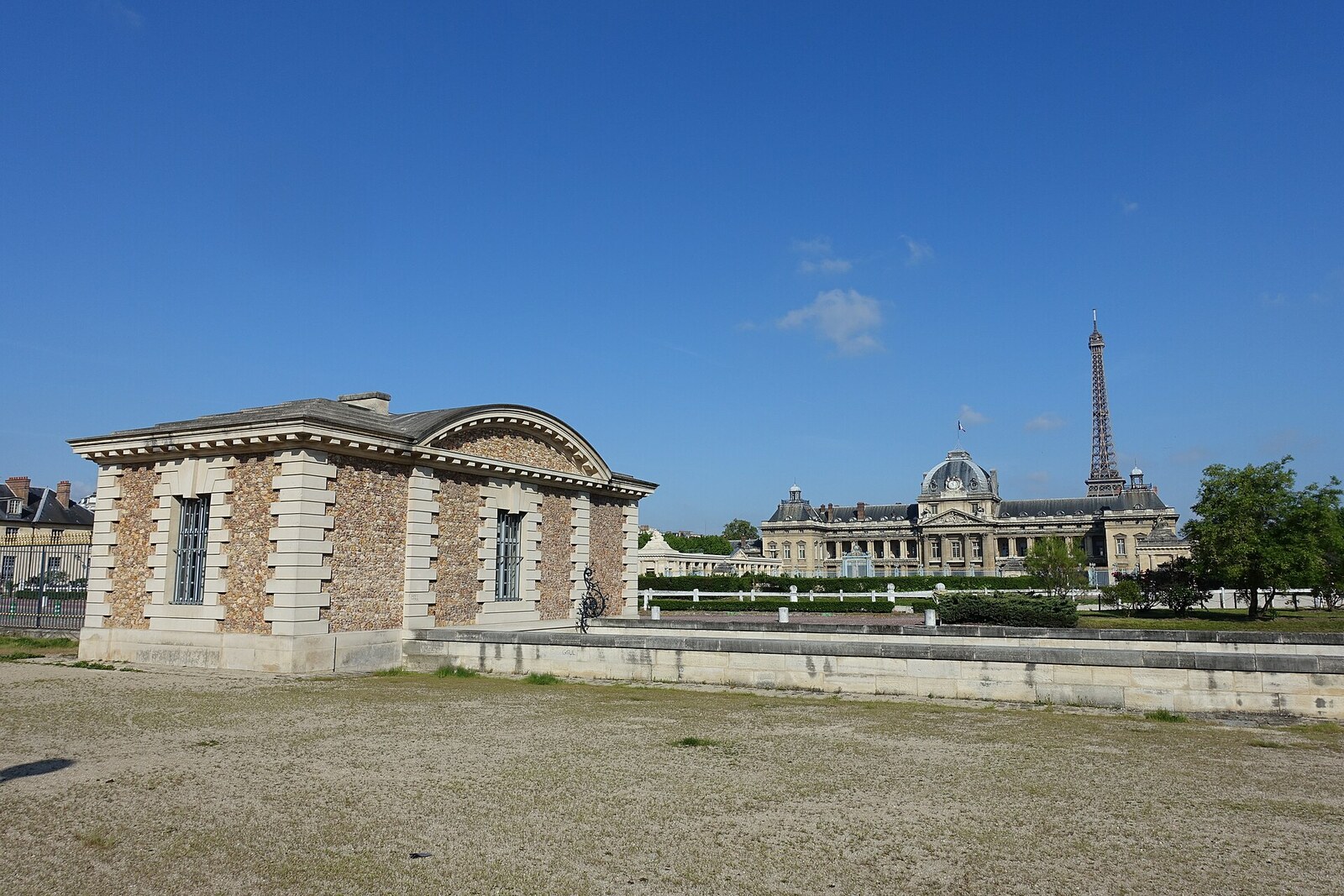
Look around first
What to notice
- The main façade of École Militaire
- Joffre’s equestrian statue
- The gates
- The inscription on the pedestal
The story of the place
Behind the grand façade of École Militaire lies a courtyard where, on January fifth, eighteen ninety-five, officers of the French army were to destroy the career of one of their fellow officers. This site was chosen for the ceremony precisely because the school was one of the country’s principal military institutions. Louis XV founded it to train five hundred young men from impoverished noble families; its buildings now provide higher education for staff officers.
Alfred Dreyfus, an artillery captain and trainee with the General Staff, was the son of an Alsatian family that retained French citizenship after Alsace passed to Germany. He graduated from École Polytechnique, then from École Supérieure de Guerre, and expected to live on an officer’s salary, raise two children with his wife Lucie, and continue his service. In the autumn of eighteen ninety-four, French intelligence received a note found in the wastebasket of the German military attaché. Its unknown author offered to pass on information about French artillery.
Investigators compared the handwriting with Dreyfus’s. The resemblance was questionable, and no other physical evidence was found, but a Jewish Alsatian made a convenient suspect for officers already convinced that the traitor was in the General Staff. The Minister of War, Auguste Mercier, sought a guilty verdict and ordered documents to be secretly handed to the judges—documents shown neither to Dreyfus nor to his defense counsel. The court sentenced the captain to life imprisonment with hard labor and stripped him of his rank.
Units of the Paris garrison were drawn up in the courtyard of École Militaire. Buttons, the red stripes on Dreyfus’s trousers, his epaulettes, and his braid were cut from his uniform. Then his saber was broken. He kept repeating that he was innocent, while the soldiers saw before them a traitor who had already been convicted. After that, Dreyfus was marched along the ranks and sent to Devil’s Island off the coast of French Guiana. There he was held in solitary confinement; for a time, he was chained to his bed at night. Lucie’s letters sustained his resolve to survive and secure his exoneration.
A year later, the new head of counterintelligence, Georges Picquart, discovered correspondence between the German attaché and Major Ferdinand Walsin Esterhazy. Esterhazy’s handwriting matched that on the note from the embassy. Picquart reported this to his superiors and demanded that the mistake be corrected. He was removed from Paris, then dismissed from the army and imprisoned; a court-martial acquitted Esterhazy, after which he left for England. But Picquart’s information reached the Dreyfus family and journalists. New proceedings began. A second court-martial again found Dreyfus guilty, and the president pardoned him, but the pardon freed him from punishment without overturning the verdict. Dreyfus continued to seek a review.
On July twelfth, nineteen hundred six, the Court of Cassation finally ruled the accusation unfounded. Dreyfus was returned to the army with the rank of squadron commander. A few days later, at his own request, he came back to École Militaire. In one of the small courtyards, he was awarded the cross of the Legion of Honour. His lost seniority was not restored: officers who had previously ranked below him had already moved far ahead. In nineteen hundred seven, Dreyfus retired, but when the First World War began, he returned to the artillery and served until the war’s end.
The mounted commander before the central entrance is Joseph Joffre, commander in chief of the French armies at the beginning of that war. After the severe defeats of August nineteen fourteen, he regrouped the retreating units and ordered a general counteroffensive on the Marne. French and British forces forced the German armies to withdraw from Paris. In nineteen thirty-three, the area before École Militaire was named after Joffre, and six years later his statue was installed here. The pedestal bears the order of September sixth, nineteen fourteen, to stop retreating and attack.
Joffre remains on horseback outside. Beyond the gates are two courtyards: in one, officers stripped Dreyfus of the insignia of a captain; in the other, eleven years later, they pinned the cross of the Legion of Honour to his uniform.
Useful on site
Place Joffre is open as an urban public space. École Militaire is an active military educational complex; public visits are rare and usually take place only during the European Heritage Days.
Checked: June 28, 2026. Check the official source before visiting.This account is intended for viewing from outside: do not try to enter the school grounds, and listen from the public space of the square.