 Guide On Map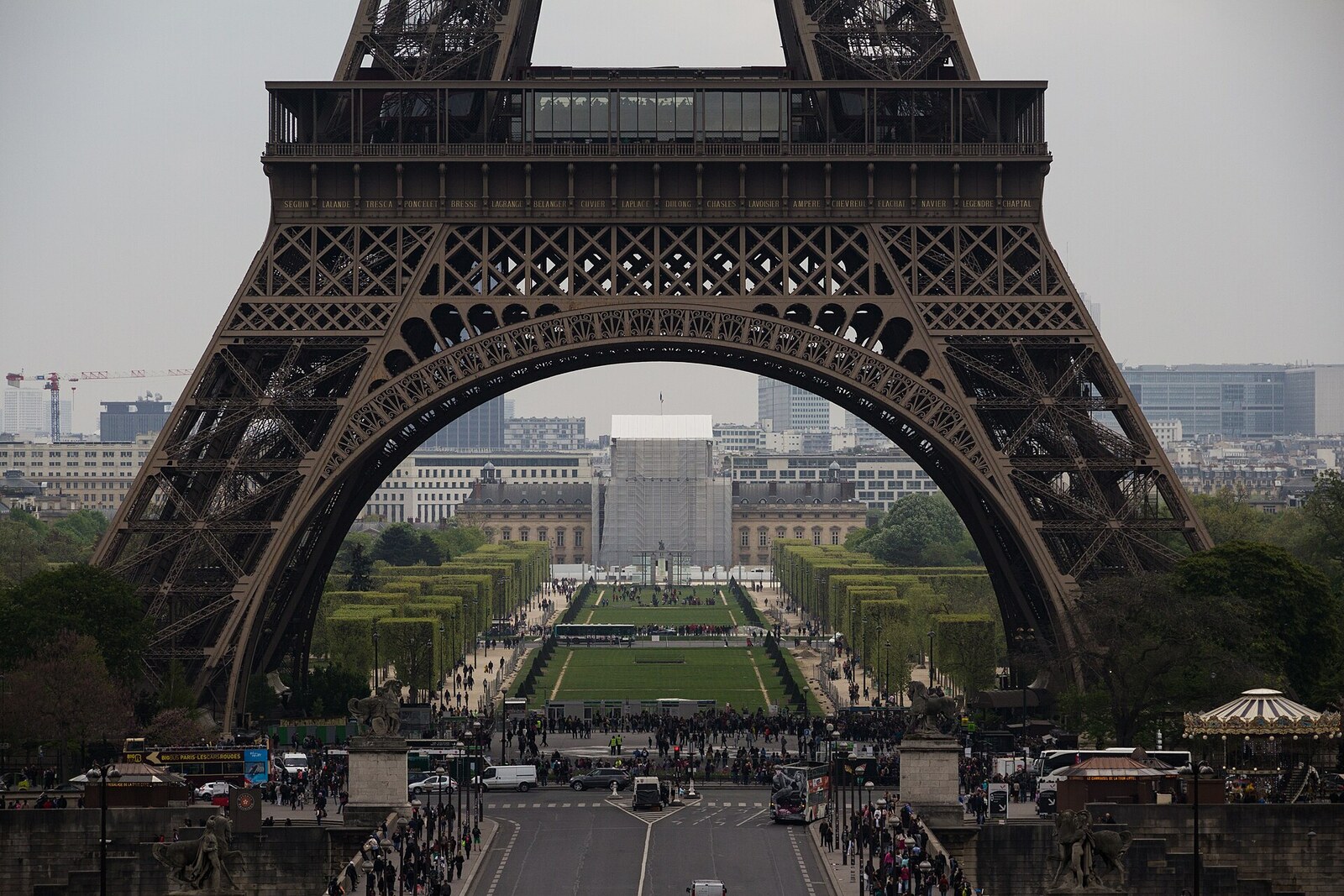
Look around first
What to notice
- Metal trusses
- North pillar
- Gilded bust of Eiffel
- Antennas at the summit
The story of the place
Eiffel’s surname became attached to the metal tower above the Champ de Mars, although the competition project was prepared by employees of his engineering firm. The firm built the structure and received the right to operate it. At the World’s Fair, the tower served as an entrance arch; the state subsidy covered only part of the estimate, so the costs were to be recouped through ticket sales over twenty years. A gilded bronze bust of Eiffel stands by the north pillar; money for the monument was raised only after the engineer’s death.
In nineteen oh three, Captain of Engineers Gustave Ferrié set up a workspace in a wooden hut beside the tower’s south pillar. The military authorities assigned him to test wireless telegraphy—the transmission of messages by radio signal. Ferrié needed a tall, stationary antenna. Wires raised by balloons depended on the weather, while a three-hundred-meter metal structure already stood above the hut.
The tower’s allotted term was then nearing its end. It had been erected at the riverbank edge of the Champ de Mars as the gigantic entrance arch for the World’s Fair of eighteen eighty-nine. The surname in its name belonged to Gustave Eiffel, head of the engineering firm that turned its employees’ project into a competition entry, built the tower, and received the right to operate it. The state subsidy amounted to one and a half million francs against an estimate of six and a half million; Eiffel had to provide most of the funds himself. In return, he retained the ticket revenue for twenty years.
On January first, nineteen ten, the tower was to pass to the city. No one was obliged to keep it after that. Visitor numbers were declining, and city officials wanted to redesign the Champ de Mars. In nineteen oh three, dismantling it was seriously discussed. Eiffel needed to prove that the tower’s height was useful even after the exhibitions had ended.
He offered Ferrié use of the entire structure and paid for the antenna to be mounted at the top. A wire ran from the summit to the Champ de Mars, and the equipment was placed near the south pillar. Ferrié first established contact with fortifications in eastern France—about four hundred kilometers away. Then the signal reached the naval base at Bizerte, Tunisia. By nineteen oh eight, the range had reached six thousand kilometers.
The experiments ceased to be a temporary undertaking of two engineers. The military installed a permanent radiotelegraph station beneath the Champ de Mars, and on January first, nineteen ten, the city extended Eiffel’s concession by another seventy years. Ferrié continued developing the communications network and later became a general. From nineteen twenty-one onward, civilian radio programs were broadcast from here.
The wooden hut by the south pillar has long since disappeared. A gilded bronze bust of Eiffel stands by the north pillar: after the engineer’s death, it was Ferrié who created the committee that raised money for this monument. The bust was installed in nineteen twenty-nine. Transmitters are still at the summit, and in twenty twenty-two engineers raised a new six-meter digital-radio antenna there.
Useful on site
The gardens and esplanade are free, but operate through a controlled perimeter. Hours for going up the tower vary by date; the official calendar warns that public areas may close and the top level may be restricted because of weather or peak visitor loads.
Checked: June 28, 2026. Check the official source before visiting.Allow for security screening when entering the grounds. Going up the tower is a separate visit, best planned and booked independently of the route.