 Guide On Map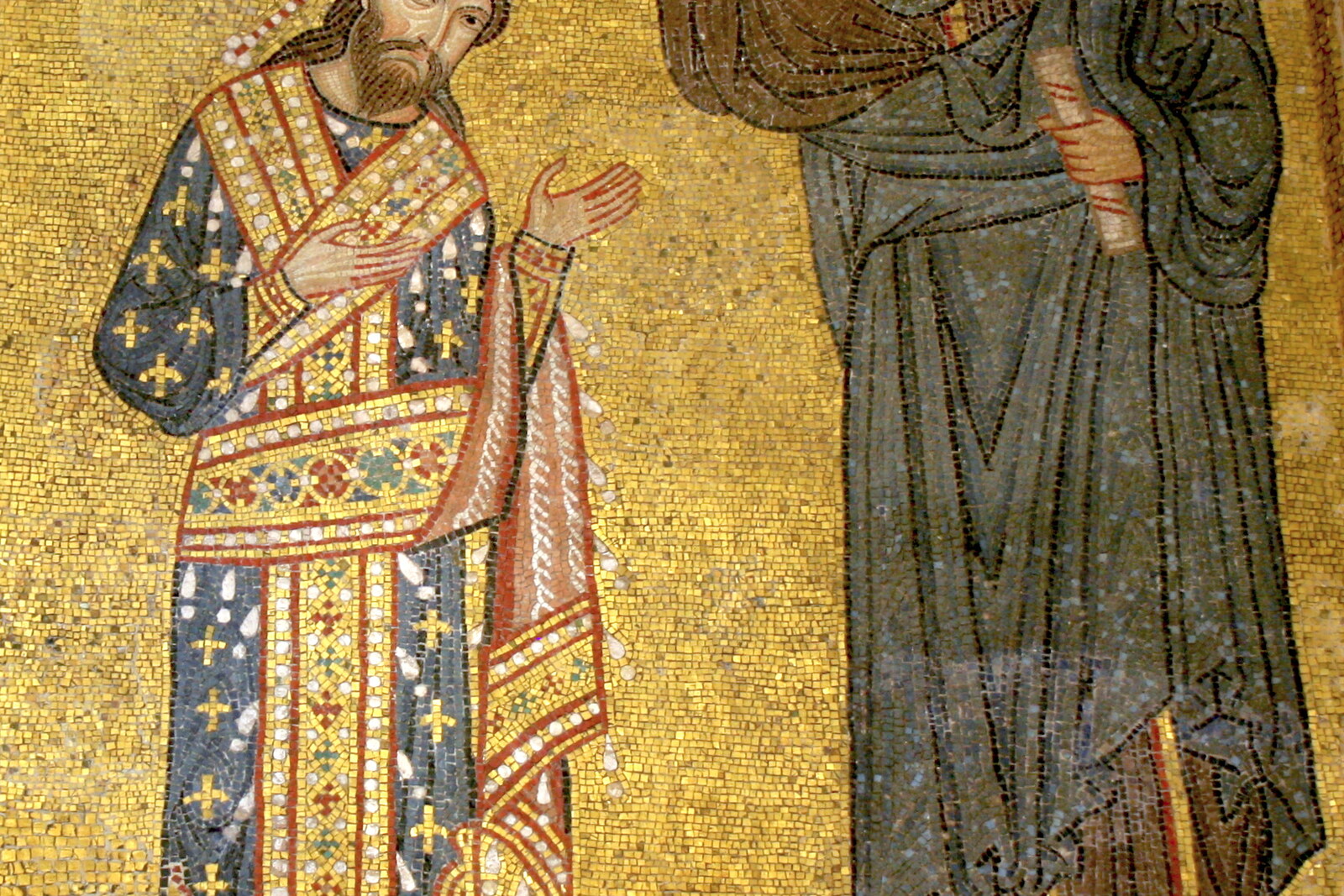
Look around first
What to notice
- The coronation mosaic of Roger II
- The mosaic of George of Antioch
- The medieval mosaic core
- The Baroque bays
The story of the place
Behind the Baroque bays, a small square core of the old church is hidden here: Greek inscriptions survive beneath the dome, and Arabic prayers from the Greek liturgy once ran along the wooden band. The church was established beside the home of an influential courtier for Palermo's Greek- and Arabic-speaking Christians, and also as a family burial place. Later, the nuns enlarged the church, dismantled the façade and narthex, roofed over the courtyard, and replaced the medieval apse with a large sanctuary. That is why the Baroque bays come right up against the compact mosaic center, and two very different periods are visible in one building.
At the entrance, two mosaics face each other. In one, Christ places a crown on Roger the Second. In the other, a man lies prostrate before the Virgin Mary; of him, only the face and hands survive from the original mosaic. This is George of Antioch—the very admiral after whom the Church of the Martorana is officially named, as Holy Mary of the Admiral.
George was a Syrian Christian and made his living by knowing how to count other people's money. He managed the treasury of the ruler of Mahdia, a city on the coast of what is now Tunisia. According to Arabic chronicles, after his patron died, George feared his successor, waited for a day when supervision was relaxed because of a ceremonial prayer, and fled to Palermo on a Sicilian ship. Historians consider the details of this escape not entirely reliable, but there is almost no doubt about his earlier service in the African treasury.
In Palermo, George offered his skills to Roger. He knew Greek and Arabic, could collect taxes, and understood affairs on the African coast. At first he was given a modest post as a district official; then he was entrusted with diplomatic missions, administration, and the royal fleet. Here, admiral was the title that grew out of the Arabic title emir; George was at once Roger's chief minister and commander of naval expeditions. His salary, position, and security depended on the benefit he brought the king.
At the height of his career, in eleven forty-three, George established a church beside his home for Palermo's Greek- and Arabic-speaking Christians, as well as a future family burial place. That is why Greek inscriptions run beneath the dome, while prayers from the Greek liturgy were written in Arabic on the wooden band. In one mosaic, George ordered his patron Roger to be shown in imperial robes, receiving a crown directly from Christ. Opposite, he placed himself: stretched out at the Virgin Mary's feet as she asks Christ to accept George's gift and forgive the donor's sins.
George died in eleven fifty-one. Tomb epitaphs existed for him, his mother, and his wife; their texts survive in an old parchment copy, but the tombs and inscriptions themselves are no longer in the church.
The name “Martorana” appeared later. In eleven ninety-four, the Palermo noblewoman Eloisa Martorana and her husband Goffredo founded a neighboring Benedictine convent for women. Its nuns laid claim to property that George had once given to his church, and in the fifteenth century they secured the transfer of the church itself. Alfonso V of Aragon, King of Sicily, attached it to the convent. The surname of the convent's founder passed to the church and displaced the admiral's name in everyday speech.
The nuns needed more space. In fifteen eighty-eight, they dismantled the original façade and narthex, roofed over the open courtyard, and extended the church to the bell tower. In the sixteen nineties, they demolished the central medieval apse, where another mosaic of the Virgin Mary probably stood, and created the present large sanctuary. This explains the sharp transition inside: Baroque bays of the former convent church adjoin George's small square core.
The convent was closed in eighteen sixty-six. Since nineteen thirty-seven, the Church of the Martorana has served the Italo-Albanian Catholic community, and the liturgy is once again celebrated here in the Byzantine rite. Eloisa's surname remains on the entire building, George's name in the official dedication, and of the admiral himself, only his face and hands folded in prayer survive on the wall.
Useful on site
Tourist visits Mon–Sat 10:00–13:00; standard ticket — 2 euros.
Checked: June 24, 2026. Check the official source before visiting.The interior matters more here than the façade; before your visit, check access and do not disturb the service if it is underway.