 Guide On Map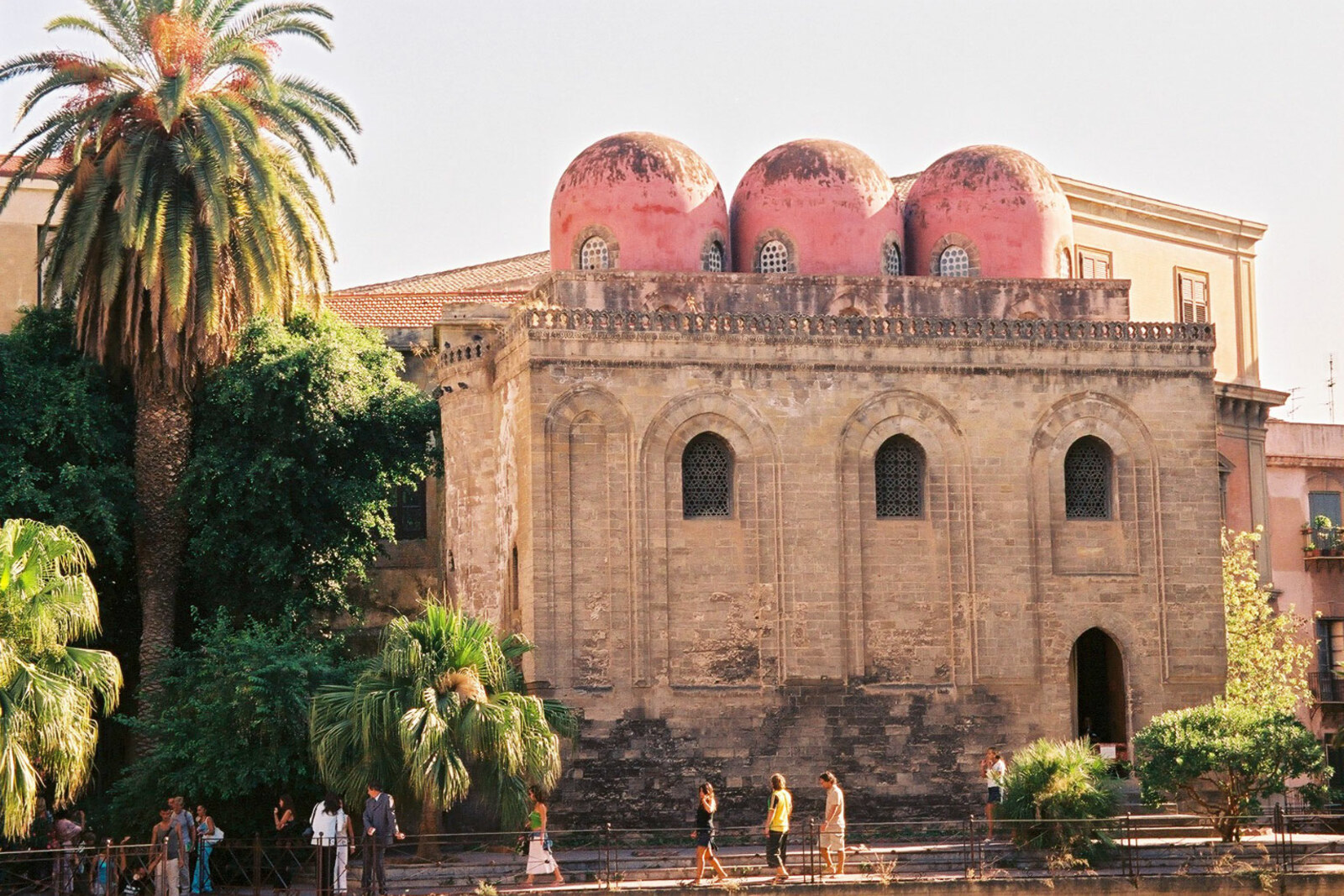
Look around first
What to notice
- Three red domes
- Severe stone façade
- Matilda’s epitaph
- Arched windows
The story of the place
On the wall opposite the entrance, the name of a girl who lived for nine months is carved. Matilda was the daughter of Count Silvester of Marsico, the second owner of the Church of San Cataldo. Her epitaph states that she was born on a Tuesday and died on a Tuesday. To understand why the child was buried in this small church, we must reconstruct the fate of the palace that no longer exists around it.
In the middle of the twelfth century, the houses of Maio of Bari stood here. The son of a city judge made a career in the royal chancery and, under William I, received the title of grand admiral. The title was administrative: Maio conducted state affairs and remained the king’s chief adviser. His position depended on the trust of one man; unlike the great barons, he had neither ancestral estates nor an army of his own.
The Church of San Cataldo was built within the palace complex as a private chapel. No direct order from Maio to build it has survived, so historians speak cautiously of the attribution. But documents written after his death list among the houses that belonged to him a chapel “built inside these houses.” Its dedication is also linked to Maio’s origins. Saint Catald was bishop and patron saint of Taranto in Apulia; a native of Bari probably brought to Palermo the name revered in his homeland.
Maio kept the feudal nobility away from royal decisions and placed court-appointed officials over the cities. When the Calabrian barons rebelled, he sent Matteo Bonello—a young Sicilian aristocrat to whom he had promised his own daughter in marriage—to them. Bonello was to bring the rebels back to obedience and hoped to strengthen his position through this marriage.
The barons offered him another bride—Countess Clementia of Catanzaro. Such a marriage would immediately admit Bonello into the circle of the comital nobility; the price was the murder of Maio. Bonello agreed. On November tenth, eleven sixty, the conspirators lay in wait for Maio as he returned from the Archbishop of Palermo, and Bonello mortally wounded him with a sword.
The king ordered the arrest of the murdered adviser’s wife, children, brother, and sisters, and confiscated his property. A few months later, Bonello himself was in prison: he was blinded and mutilated, after which he soon died. The king gave Maio’s houses near the Church of San Cataldo to his relative, Count Silvester. Already in eleven sixty-one, Silvester buried nine-month-old Matilda here.
Later, Silvester’s son put the houses up for sale together with the chapel located inside them. The palace eventually disappeared, while the Church of San Cataldo survived and serves once more as a church. From the first change of owners, Matilda’s epitaph remains inside; from Maio himself, the chapel and the name of the Apulian saint above it.
Useful on site
From March 1 to October 31, daily 10:00–13:30 and 14:00–18:00; from November to February 09:00–13:30 and 14:00–17:00.
Checked: June 24, 2026. Check the official source before visiting.Walk around the building from the outside, and remember: the unobstructed view appeared after the buildings surrounding the chapel were removed.