 Guide On Map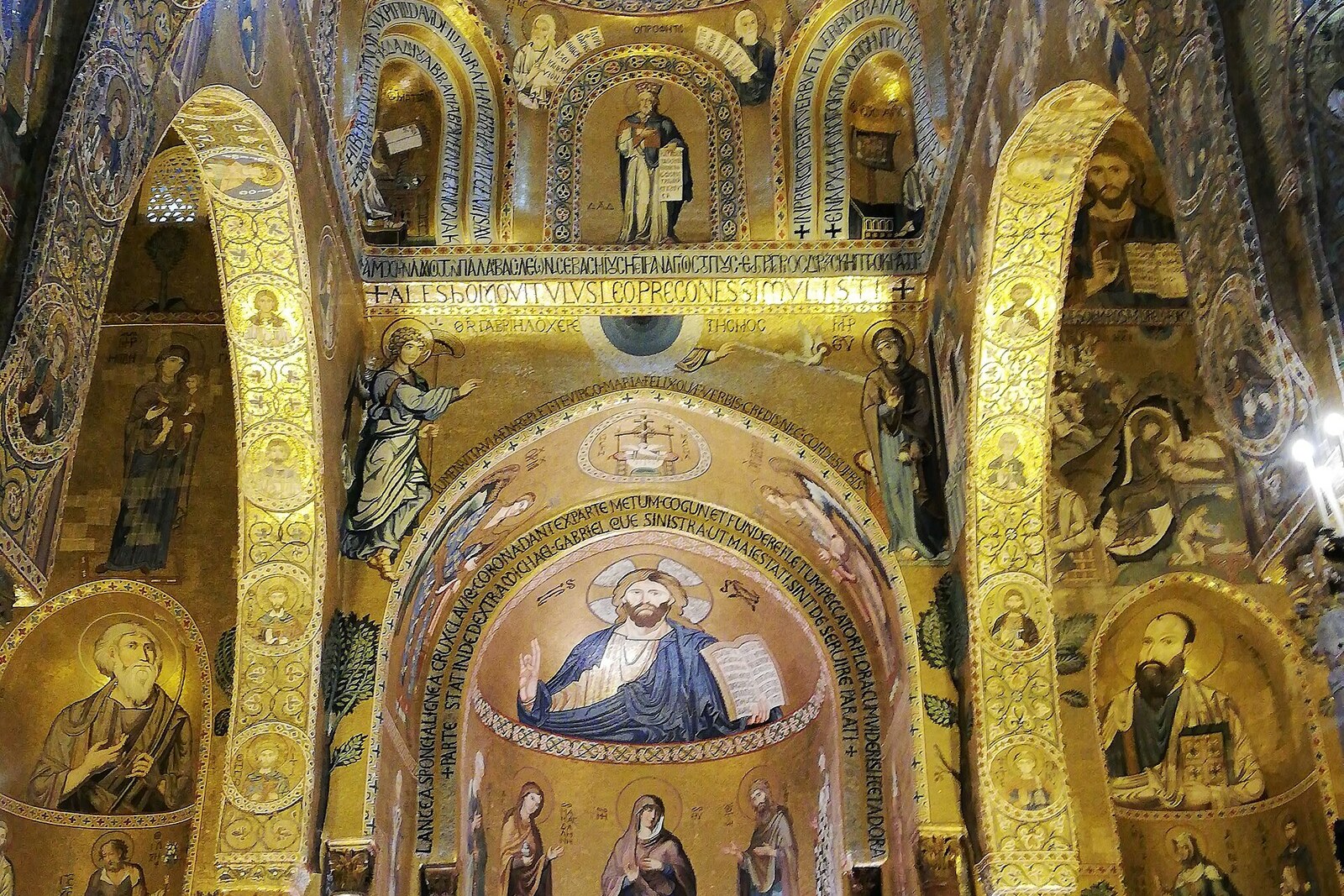
Look around first
What to notice
- Mosaic of Christ Pantocrator
- Wooden ceiling with muqarnas
- Greek inscription at the base of the dome
- The ruler's place on the west side
The story of the place
The name Palatine recalls the palace: the church occupies part of the royal residence, and it once had its own priests and revenues so that services would not cease. Inside, a Western basilica is joined to a Byzantine-style domed sanctuary, and the ruler's place is on the west side opposite the altar. A wooden ceiling with muqarnas cells survives above the central nave: its painted decorations include musicians, hunters, animals, and Arabic blessings, while golden mosaics of Christ and saints shimmer at the dome.
When Roger II ordered a palace church to be built here, his royal title was still disputed by a pope recognized by most of the Western Christian world. Roger ruled Sicily as a count, then inherited lands in the south of the Apennine Peninsula and sought to turn them into a single hereditary kingdom.
In eleven thirty, two popes were elected simultaneously in Rome. Pope Anacletus II, who needed a strong ally in southern Italy, recognized Roger as king. Later, the Catholic Church regarded Anacletus as an antipope—that is, an illegitimate rival to the legitimate pontiff. Roger's coronation took place in Palermo Cathedral. The Palatine Chapel did not yet exist.
The other elected pope, Pope Innocent II, wanted to strip Roger of his new title. He was supported by the emperor and many rulers of Western Europe; mainland barons who did not wish to submit to the king of Sicily also rose against Roger. The dispute over the crown became a war. When Anacletus died in eleven thirty-eight, Roger lost the pope who had granted him the title. Innocent excommunicated him and led an army south.
The outcome was brought about by Roger's son, the Duke of Apulia and heir to the throne. In eleven thirty-nine, his men defeated the papal army at Galluccio and captured Innocent. Three days later, the captive pope recognized Roger as king of Sicily, Duke of Apulia, and Prince of Capua. Innocent returned to Rome having confirmed the title he had fought against; Roger kept the crown and passed it on to his descendants.
Construction of the chapel had begun even before this outcome. Here, the word “Palatine” means “of the palace”: Roger placed the church within his own residence, assigned it a staff of priests and revenues for continuous services. He dedicated it to the apostle Peter—the same Peter whose successors both rival popes considered themselves to be.
Roger needed a space both for worship and for ceremonies at court. The builders combined a Western basilica with a Byzantine-style domed sanctuary. Greek-speaking craftsmen laid golden mosaics of Christ Pantocrator, prophets, and saints. Carvers and painters of the Islamic tradition made a wooden ceiling of stepped cells—muqarnas—above the central nave. Musicians, feasting courtiers, hunters, animals, and Arabic blessings survive among its painted decorations. Roger entrusted people from different court cultures with creating one Christian royal church, without making them abandon their customary techniques.
In eleven forty, the chapel was consecrated, although the decoration continued. After Roger's death, his son and grandson added new mosaic cycles. Catholic services are still held here, and the purpose of the royal church can be read in its very layout: the ruler's place was on the west side, the altar on the east, beneath the image of Christ.
At the base of the dome, a damaged Greek inscription from eleven forty-three survives. In it, Roger calls himself a mighty bearer of the scepter and dedicates the church to Peter, the first of the apostles. Innocent's name is not there. Roger ordered the title that the pope first rejected and then confirmed while still in captivity to be inscribed in mosaic as an accomplished fact.
Useful on site
Follows the opening schedule of the Norman Palace; Sunday liturgy closes tourist access from 09:45 to 11:15, and baptisms sometimes delay reopening.
Checked: June 24, 2026. Check the official source before visiting.Once inside, let your eyes adjust to the half-light; view the ceiling separately from the mosaic cycle.