 Guide On Map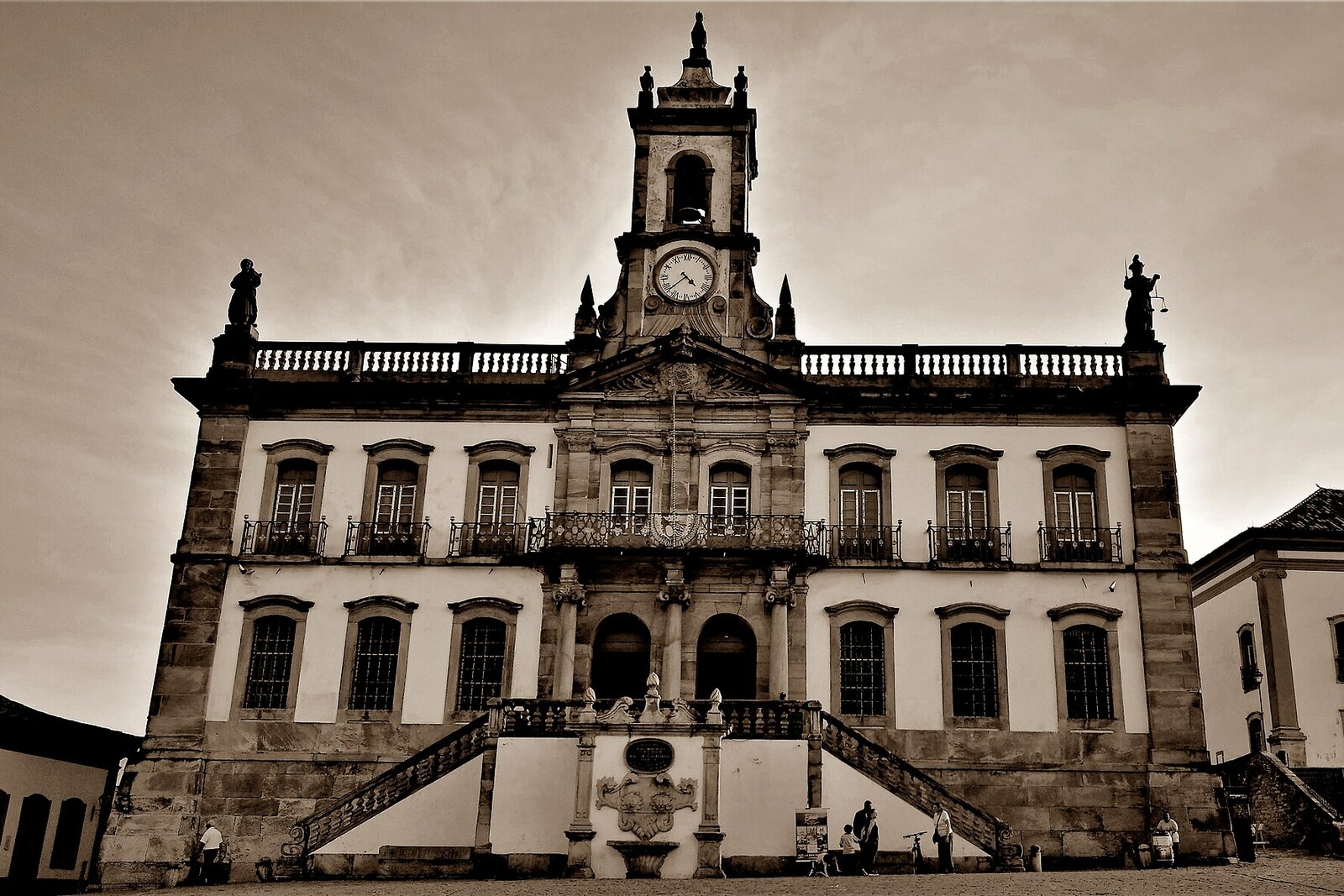
Look around first
What to notice
- Stone façade
- Upper floor of the former town council chamber
- Lower floor of the former prison
- Pantheon tomb slabs
The story of the place
The stone façade on the square rises two stories, and behind it museum rooms stand beside tombstones. Around the pantheon are gathered court papers and objects connected with the life of the mountain town and with the people whom the Crown court declared traitors to the monarch. Their names are carved on the central slab, while the remains of those found in African graves are buried nearby.
In seventeen eighty-five, Governor Luís da Cunha Meneses ordered a new town council chamber and prison to be built here. The upper floor was intended for officials, the lower one for prisoners. For the work, the governor brought about five hundred people out of the old prison. Enslaved Black people and those whom officials registered as “vagrants” were forced to quarry stone, burn lime, and carry materials under supervision and the lash.
Tomás Antônio Gonzaga oversaw the construction—an ouvidor, or Crown judge, and one of Vila Rica's finest poets. His salary and career tied him to the Portuguese administration that he mocked. In the satirical Chilean Letters, the governor became a tyrant ready to torment people for the sake of an enormous prison. Gonzaga's authorship was established later: the poems circulated anonymously because openly accusing his superior could have cost the judge his position and freedom.
A few years later, Gonzaga joined a circle of conspirators who planned to separate Minas Gerais from Portugal and establish a republic. In the language of Crown judges, “inconfidência” meant treason against the monarch; those accused in the conspiracy were called Inconfidentes, though they had not chosen that name for themselves. For Gonzaga, the affair ended with a death sentence, commuted to ten years of exile in Mozambique. He left Vila Rica as a prisoner, and in Africa he became a lawyer and official again, married, and never returned.
By the middle of the twentieth century, the building he had condemned in verse was occupied entirely by a prison. In nineteen thirty-eight, the prisoners were transferred to a new penal colony near Belo Horizonte. At almost the same time, President Getúlio Vargas ordered the graves of the exiled Inconfidentes to be sought out in Africa and any remains found to be brought to Brazil. The vacant stone building on the square was given over as their resting place.
On April twenty-first, nineteen forty-two, Vargas opened the Pantheon of the Inconfidentes here. The names of all those convicted were carved on the central slab, bones found in Africa were placed beneath the side tombstones, and one slab was left blank for those whose graves had disappeared. Around the pantheon, staff gathered court documents and objects linking the conspiracy to the life of the mountain town. This is how the Museu da Inconfidência came into being. It opened on August eleventh, nineteen forty-four—exactly two hundred years after Gonzaga's birth.
The transported remains immediately raised an uncomfortable question for staff: exactly whom did the individual bones belong to? Several sets were kept out of the pantheon for decades because of doubtful labels. Since the nineteen eighties, museum researchers had been tracing the path of these remains from African graves, while forensic dentistry specialists studied the age and condition of every fragment. In two thousand eleven, they confirmed the identities of three exiles, and their bones were finally buried here—more than two centuries after their deaths in Africa.
Beneath the slab bearing the name Tomás Antônio Gonzaga lie remains attributed to him, but their authenticity has not been conclusively proved. An empty tombstone remains beside it. The governor built a prison on this site, Gonzaga denounced its construction, and the museum opened on his birthday and still separates the Inconfidentes who were found from those who received here only a carved name.
Useful on site
Tue–Thu 10:00–18:00, admission until 17:00; Fri–Sat 10:00–20:00, admission until 19:00; Sun 10:00–18:00, admission until 17:00; free admission.
Checked: June 24, 2026. Check the official source before visiting.Do not expect a quick visit: the key objects are unobtrusive and require reading their labels. If admission is closed, examine from the square the division of the former building between authority and imprisonment.