 Guide On Map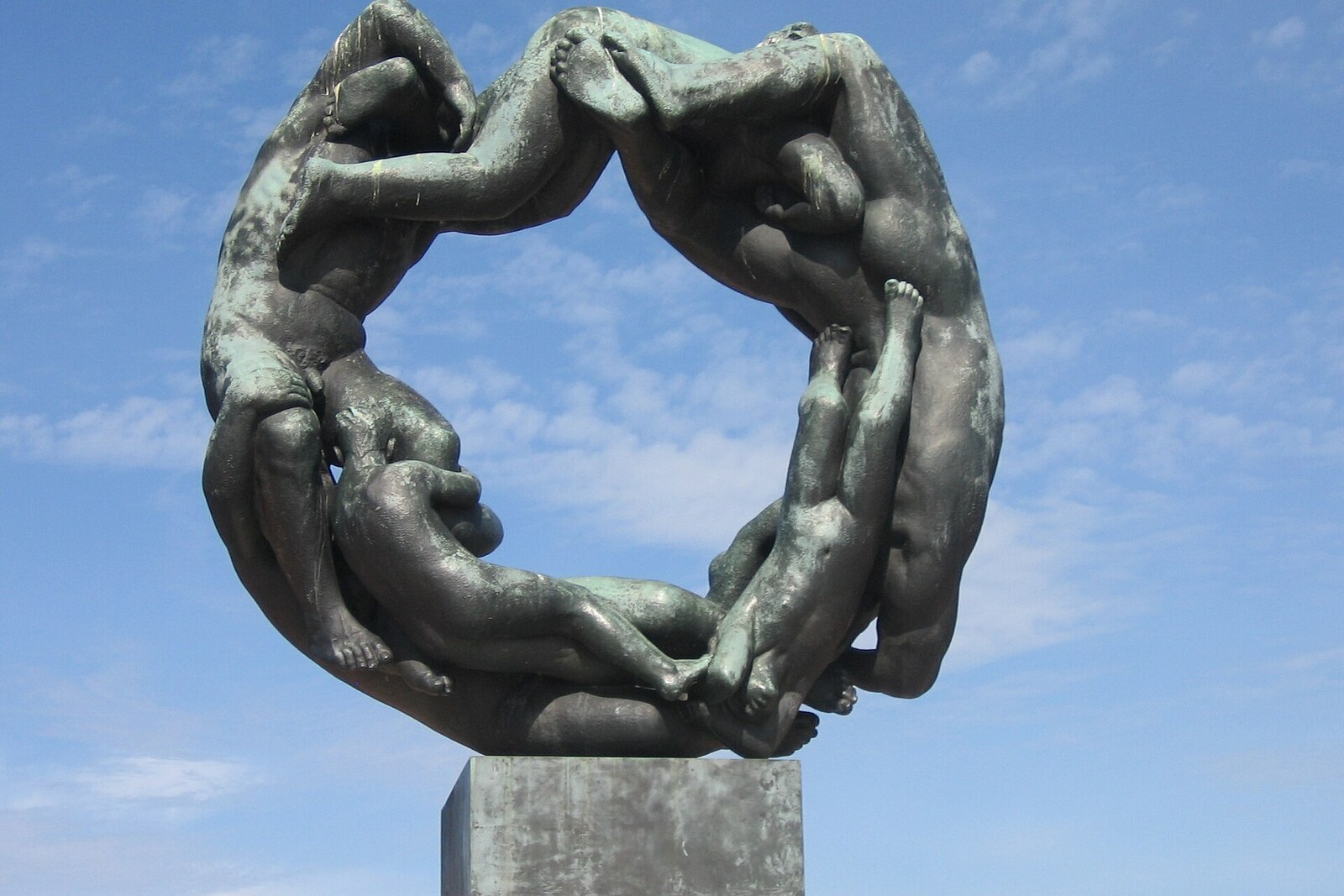
Look around first
What to notice
- Bronze ring
- Adult figures
- Child figures
- Sundial
The story of the place
Beyond the sundial, at the western end of the park axis, bronze human figures join together in a circle. Adults and children hold on to one another so that this movement can be assigned neither a beginning nor an end. The different ages turn the path from birth to death into a recurring circle. The clay version of the sculpture disappeared when the mold was made, and the plaster master model taken from it is kept in the Vigeland Museum.
In September nineteen thirty-three, sixty-four-year-old Gustav Vigeland instructed the blacksmiths in his workshop to assemble a round iron armature three meters in diameter. The sculptor planned to enclose seven human bodies in a ring—four adults and three children. This wheel has no rim: it was to be formed by the figures' arms, legs, and backs.
Vigeland first made a small plaster model. The blacksmiths enlarged it using a grid, attached wooden crosspieces to the iron framework, and wrapped them in wire so that the heavy wet clay would not slide off. The sculptor then transferred points from the sketch onto the large model, checking them with a meter-long ruler and a compass, and finished the surface with his hands and small tools. The work continued until February nineteen thirty-four.
The result could be preserved only by destroying this clay version. Mold makers inserted thin metal plates into the still-moist surface and covered the figures with plaster. Once the mold had hardened, they scraped the clay out of it, removed the iron framework, and rejoined the separate parts. A new layer of plaster was poured inside. After it dried, the outer mold was broken with a chisel and a wooden mallet. This produced an exact master model, suitable for bronze casting, in place of the fragile clay.
As early as nineteen twenty-one, Vigeland had given his works to the city in exchange for a workshop that was to become a museum after his death. The plaster model therefore remained in Oslo's possession, even when the sculptor himself died in nineteen forty-three. The bronze The Wheel of Life was installed here only in nineteen forty-nine—six years after his death.
Vigeland chose its place at the western end of the long park axis, beyond the sundial. Men, women, and children hold on to one another so that no first or last figure can be identified in the ring. That is the source of the name: the circle is a sign of eternity, and the different ages turn the path from birth to death into a recurring movement.
The bronze before us appeared only after Vigeland's death. The clay he touched while working no longer exists; the plaster master model made from it is kept in the Vigeland Museum. He completed the westernmost sculpture in his ensemble, but never saw it in its intended place.
Useful on site
Always open, free access.
Checked: June 25, 2026. Check the official source before visiting.In sunny weather, compare the bronze circle with the moving shadow of the sundial; without sun, the instrument remains a silent stone.