 Guide On Map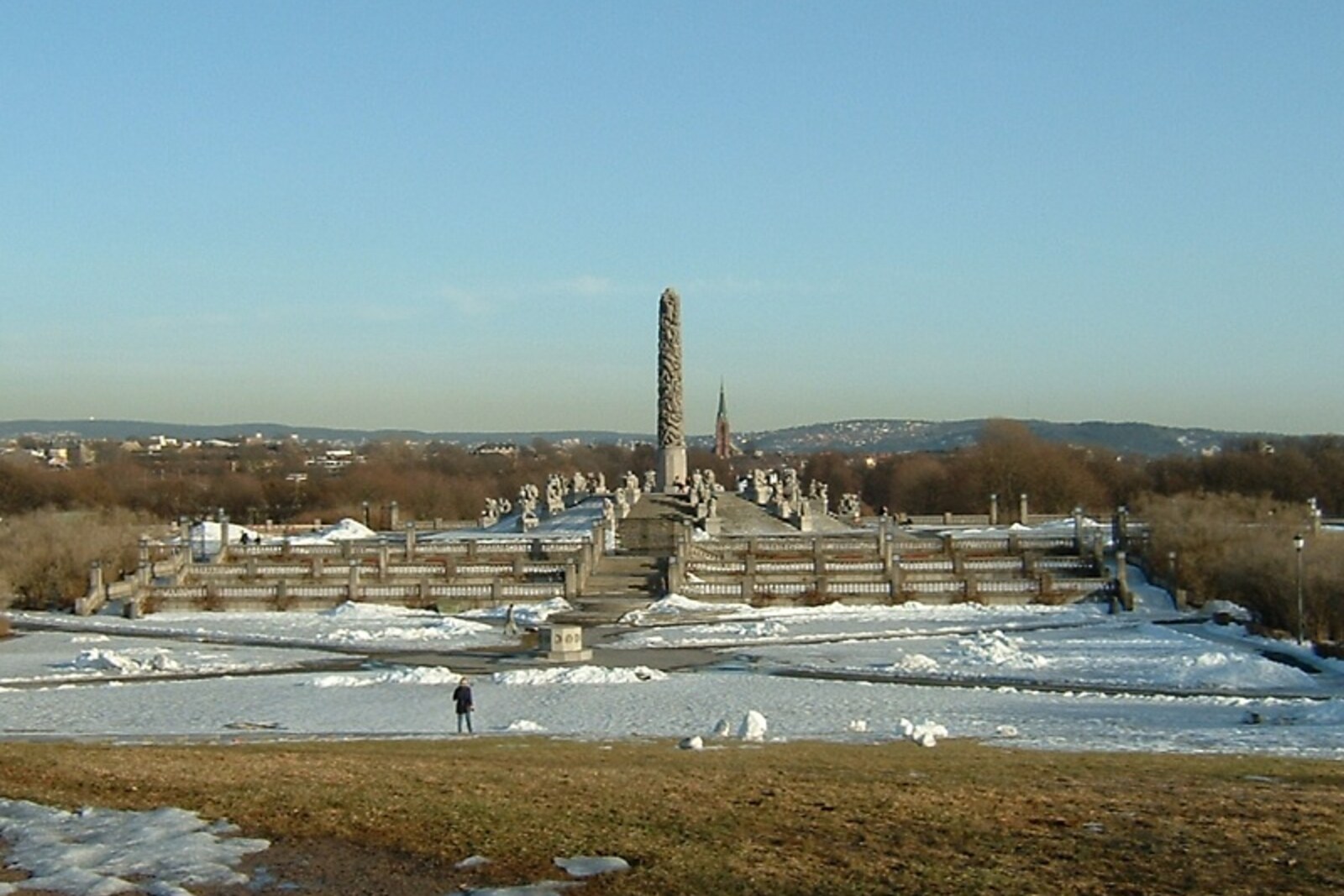
Look around first
What to notice
- The Monolith
- The intertwined figures of the column
- Thirty-six granite groups
- Circular steps
The story of the place
At the top of Tørtberg hill is a plateau with circular steps and a central granite column. It began as a solid blank separated from the rock at Iddefjord, then delivered to Oslo and raised up this hill. Inside a temporary wooden building, stonemasons spent thirteen years transferring a full-size plaster model into stone. That is why the column stands without seams or attached details: every body emerged from a single boulder.
At the highest point of the plateau stand thirty-six granite groups: adults hold children, men and women embrace, argue, and support one another. Above them rises a fifty-six-foot column of one hundred twenty-one intertwined figures. Gustav Vigeland deliberately kept these parts separate. The groups below show recognizable human relationships, while he left the column open to free interpretation. The artist refused to give it a single explanation; among the possible readings, he named resurrection and striving upward.
The column's name is literal. The Monolith is carved from a single stone. To pursue this plan, Gustav Vigeland took a risk even before the city had finally approved the present site. In nineteen twenty-two, on his initiative, a granite blank was separated from the rock at Iddefjord. The sculptor assumed financial responsibility. After rough shaping, about two hundred sixty-six tons of granite remained, which had to be delivered to Oslo and raised up Tørtberg hill—here, where the plateau now stands.
City officials doubted that this was possible at all. The history of the contracting firm preserves an episode about Håkon Eeg-Henriksen, an engineer who needed a major contract for his four-year-old company. At the next table in the engineers' club, he overheard a conversation about the unmovable stone and suggested not pulling it, but tipping it forward little by little with hydraulic jacks. His bid was the cheapest of twelve, and Gustav Vigeland, tired of waiting for a decision on the expenses, personally guaranteed part of the sum.
In the autumn of nineteen twenty-six, the blank was loaded onto two barges and delivered by fjord to Bestumkilen. For the overland section, Håkon Eeg-Henriksen built a frame with jacks. Workers lifted one end of the stone, moved it about five feet along the rails laid down, then moved the rails forward. On a good day, they managed to cover about one hundred sixty feet. Progress stopped in a soft field; they could continue after the ground had frozen. On August fifteenth, nineteen twenty-eight, the block was set upright on exactly this spot.
A tall wooden building with scaffolding was immediately erected around it. In the summer of nineteen twenty-nine, three stonemasons began work inside: the Swede Nils Jönsson, the Dane Carl Kjær, and the Norwegian Ivar Broe. They were hired to transfer into granite the figures that Gustav Vigeland had previously sculpted life-size in clay and cast in plaster. The plaster model was placed beside the raised block. Using an adjustable measuring device, the craftsmen transferred about one million points from it, then used hammers and chisels to remove the stone between them. This work took thirteen years.
The result was not an enlargement of a small statuette, but a granite reproduction of a full-size model: the bodies emerge from the very boulder that Håkon Eeg-Henriksen delivered here intact. That is why there are no connecting seams between the figures and no separately attached parts.
In the summer of nineteen forty-two, the carving was completed. The following year, the public was allowed inside the wooden building for the first time to see the column up close. Gustav Vigeland died on March twelfth of that same year. In December nineteen forty-four, the structure was dismantled, and The Monolith was fully exposed for the first time. The sculptor saw the completed work under a roof, but never saw it as it stands now: above the circular steps, without walls and scaffolding.
Useful on site
Open 24/7; the stairs may be snow-covered in winter.
Checked: June 25, 2026. Check the official source before visiting.Walk all the way around the column, and do not try to read all the figures from one side; the surface reveals itself as you move.