 Guide On Map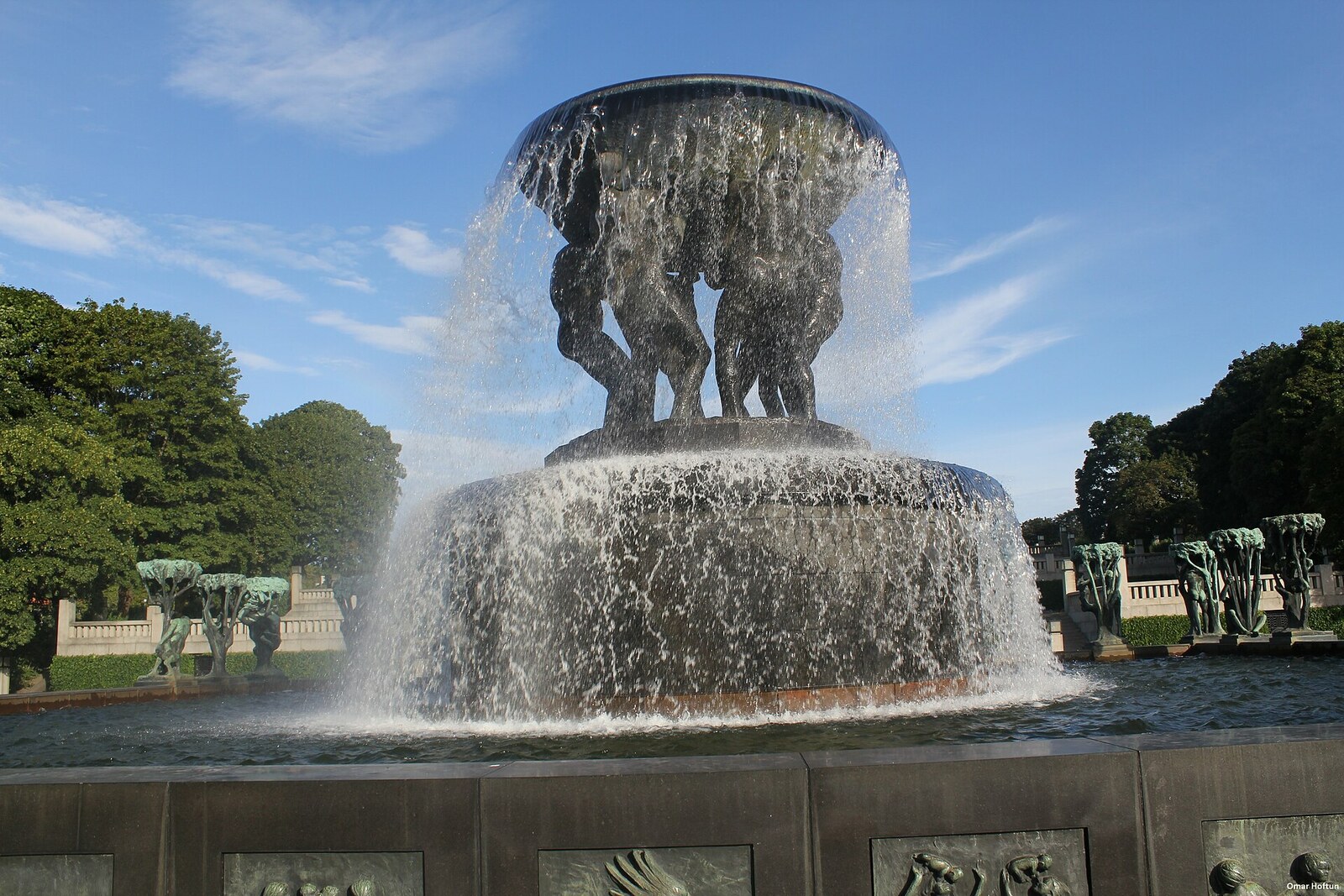
Look around first
What to notice
- Six bronze men
- Broad bowl
- Twenty bronze trees
- Reliefs around the edge of the basin
The story of the place
West of the Frogner Ponds in Frogner Park lies a large basin for which the earlier city sites proved too cramped. The plan long sought a place by Parliament and near the Royal Palace, but here it first received the space it needed. Installation came during wartime shortages of materials, so the water was turned on only after all parts of the composition had taken their places.
Six bronze men of different ages hold a broad bowl above the basin. Some have straightened beneath its weight; others are bent over or have put a shoulder under it. Around them stand twenty groups with trees and people: childhood, youth, maturity, old age. The same course of human life recurs on sixty reliefs around the edge of the basin. In one group, a tree is filled with infants; in the last, a human skeleton almost merges with the branches.
It all began with six men and a bowl. In nineteen hundred, the sculptor Gustav Vigeland proposed the first version of the fountain to the city and was refused. It was a risky project for him: free-standing sculpture did not yet provide him with a steady income, and to earn money he took commissions to restore Nidaros Cathedral. Still, Gustav Vigeland continued modeling the fountain without a contract or a buyer.
Six years later, he exhibited a new plaster model at the Museum of Decorative Arts and Design. About thirty thousand people saw it—roughly one in every six residents of Kristiania. After that success, Oslo City Council commissioned the fountain for Eidsvoll Square in front of Parliament. Of the entire future ensemble, this would remain the only part for whose sculptures Gustav Vigeland received a fee.
The commission did not stop the work. Gustav Vigeland added trees with human figures, reliefs, and stone groups until the square in front of Parliament became too cramped for the project. The sculptor sought another site: first Abel's Hill by the Royal Palace. In nineteen sixteen, he opened his studio to the public to show the figures already completed and the large model. Visitors stood in line, supporters formed a committee to raise money, but there was still no agreed site.
By the early nineteen twenties, the city was building Gustav Vigeland a new studio in Frogner. The fountain was proposed for a site beside it, and in nineteen twenty-four Oslo City Council set aside its present site west of the Frogner Ponds. Here, the enormous composition finally fit in its entirety. Conceived as a separate decoration for a square, the fountain had, during the wait, become the starting point for the entire sculptural ensemble.
But even this decision was not enough for Gustav Vigeland to see the result. He died in March nineteen forty-three. The following summer, workers installed the bowl and the six giants here. The twenty groups with trees took their places in May nineteen forty-six. Because of wartime shortages of materials, the installation was delayed, and the water was first turned on only in nineteen forty-seven.
For more than forty years, Gustav Vigeland changed, expanded, and moved this fountain, but he never saw water spill over the edge of the real bowl. The present jets appeared here four years after his death.
Useful on site
Always open, with free access; the structure is surrounded by water and may be closed in winter during severe icy conditions.
Checked: June 25, 2026. Check the official source before visiting.First look at the group from a distance, then come closer to the reliefs: the overall silhouette and the small scenes require different distances.