 Guide On Map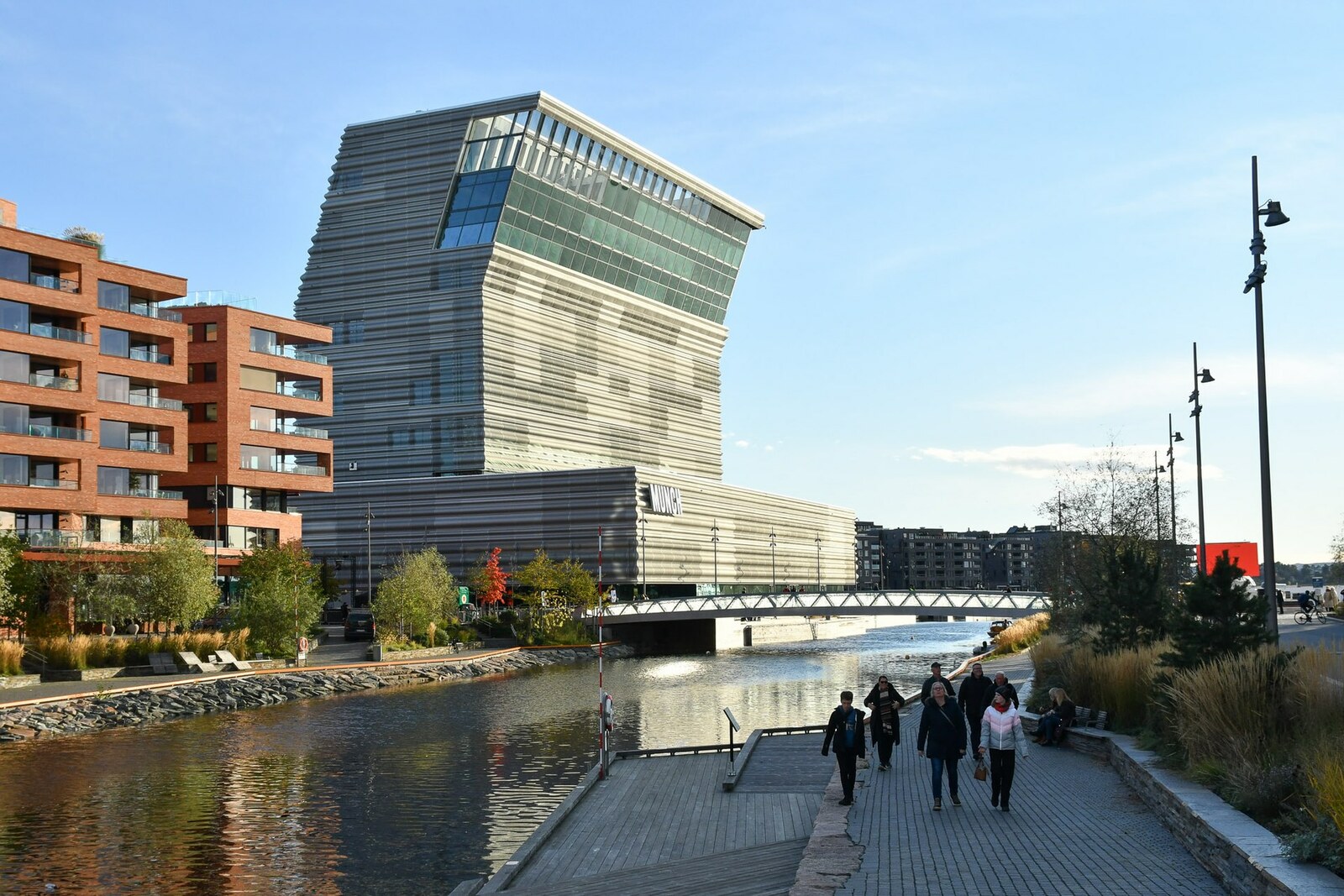
Look around first
What to notice
- Large letters on the façade
- Thirteen-story tower
- Transparent circulation zone
- Sea wall
The story of the place
In Bjørvika, on the site of a former port area by the Opera and Oslo’s main transport hub, a new museum for the artist has risen. Its galleries are assembled one above another in a thirteen-story tower: an enclosed concrete section protects the collections, while transparent passageways run between them. By the sea wall, there is now enough room to display a much larger part of the city’s artistic legacy.
The large letters on the façade spell out the artist’s surname—MUNCH. Inside, tens of thousands of his works are stored, studied, and displayed, and exhibitions of contemporary art, concerts, and lectures are also held. The museum is founded on the legacy that Edvard Munch left to Oslo under circumstances in which the safety of his paintings could no longer be taken for granted.
In April nineteen forty, German troops occupied Norway. Seventy-six-year-old Munch lived at the Ekely estate on the outskirts of Oslo and worried about the fate of the works that filled the house, studios, and outbuildings. The Nazis had already removed his paintings from German museums as “degenerate art.” Nine days after the invasion, the artist summoned two witnesses and changed his will.
Munch earned money by selling paintings and prints; impressions that could be printed from stones, wooden blocks, and copper plates brought especially good income. These printing matrices remained the artist’s working capital: they could still produce new copies of familiar images. In his will, Munch left the municipality of Oslo paintings, drawings, prints, and the printing matrices themselves, but prohibited new impressions from being made with them. He also restricted the sale of the remaining sheets. The city received the works and the tools, but not the right to reproduce the legacy endlessly.
Munch had no children. He left money and letters to his sister Inger, and almost everything he had created and kept at Ekely to Oslo. In January nineteen forty-four, the paintings were taken to Dikemark Hospital and hidden there from the Nazis. A few weeks later, the artist died. After the war, the municipality accepted his legacy and in nineteen forty-six decided to build a separate museum. The first building opened in Tøyen seventeen years later.
Over time, it became too cramped. Bjørvika, a former port area beside the Opera and Oslo’s main transport hub, was chosen for the new museum. Architects Juan Herreros and Jens Richter stacked the galleries one above another, creating a thirteen-story tower with an enclosed concrete section for the paintings and a transparent circulation zone. Far more of Munch’s legacy can be displayed here, but two canvases required a separate solution even before the opening.
“The Sun” and “The Researchers” cover tens of square meters. Munch kept them in an open studio; the thin canvas and heavy paint layer did not tolerate vibration well. Conservators spent several months securing the flaking paint. Then workers lifted the crates through the roof of the old museum, placed them at an angle on a long truck, transported them beneath tram wires, and transferred them to a barge at Sørenga.
The paintings reached the sea wall of today’s MUNCH by water. A crane raised them more than twenty-six meters and brought them through a specially left opening on the sixth floor—more than seven meters high and only sixty centimeters wide. Both canvases now hang in a two-story-high gallery. Their entry point cannot be distinguished from outside: once Munch’s legacy was inside, the opening was sealed permanently.
Useful on site
The museum operates on a weekly schedule and exhibition program; evening hours can be longer than usual, so check the schedule and tickets for the day of your visit.
Checked: June 15, 2026. Check the official source before visiting.The façade and the museum’s position in the panorama can be viewed without entering. The collection is inside, so consider your visit, exhibitions, and possible queues separately.