 Guide On Map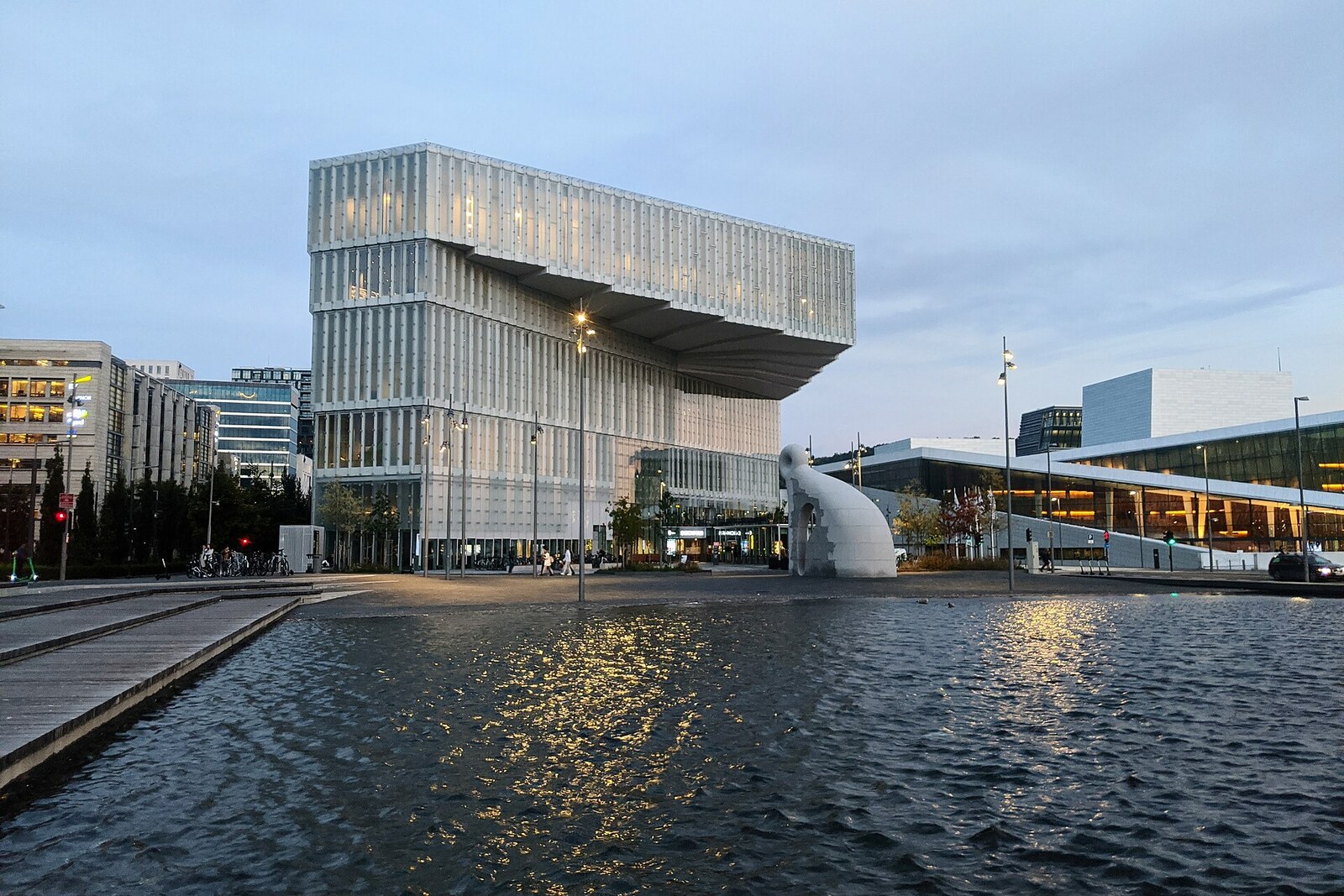
Look around first
What to notice
- The wooden room
- Glass boxes
- Bust of Carl Deichman
The story of the place
Downstairs stands a bust of Carl Deichman, whose name is borne by Bjørvika’s main library. Deichman owned ironworks, traded, and collected books; in his will, he gave Christiania six thousand sixty-nine books, two hundred sixty-one manuscripts, and money to expand the collection. Staff spent five years sorting through this gift, and in seventeen eighty-five the city opened its first public library. Deichman’s original collection is now kept on the fifth floor of the present building.
On the library’s top floor, there is a small wooden room with one hundred glass boxes. Inside the boxes lie manuscripts that may not be read. Only the authors’ names and the texts’ titles are known. They will be allowed to be opened in twenty-one fourteen.
Scottish artist Katie Paterson conceived this Future Library in twenty fourteen. She wanted to create a work that would be completed by people not yet born when it began. For the project, one thousand spruce trees were planted in the Nordmarka forest outside Oslo. In one hundred years, they are to be made into paper and used to print one hundred texts—one from each invited writer. The trees cut down before the planting were used for the room itself: its walls are made up of one hundred wooden layers, each with a box for one year.
Canadian writer Margaret Atwood was the first to agree. Her work and reputation depended on books that are bought, read, and discussed, but here she accepted the opposite condition: to write a text and receive no reader response whatsoever. In twenty fifteen, Atwood submitted a manuscript titled Scribbler Moon. She disclosed nothing about its contents. By the time of publication, the writer herself will long be dead.
The first manuscripts did not yet have a permanent repository: this room was included in advance in the plans for Bjørvika’s new main library. In June twenty twenty-two, the first eight texts were moved here. Four of the participating writers came in person and slid their manuscripts into the glass boxes. After that, they lost the ability to retrieve or publish these works: a special foundation took on their storage, undertaking to carry the project through to twenty-one fourteen.
The name above the entrance belongs to Carl Deichman, an eighteenth-century ironworks owner and book collector. He lived on income from businesses and trade, studied mining, and knew well how difficult it was to obtain specialist literature in Norway. By the end of his life, Deichman had collected six thousand sixty-nine books and two hundred sixty-one manuscripts. In his will, he gave them to Christiania, as Oslo was then called, for public use, and left a financial endowment whose interest was to be used to buy new editions.
It took staff five years to sort through the gift. In seventeen eighty-five, the city’s first public library opened and took the donor’s name. Deichman’s original collection is now kept on the fifth floor of this building, and his bust stands downstairs. Above, in the wooden room, visitors can for now read only the names of the new donors and the titles of the manuscripts; the pages themselves will remain closed for almost ninety more years.
Useful on site
Admission to the library is free; the opening hours of public areas and event spaces vary, so it is best to check Deichman’s schedule on the day of your visit.
Checked: June 15, 2026. Check the official source before visiting.Inside, keep the usual pace of a public library, and bear in mind that individual studios, workshops, or events may have their own access conditions.