 Guide On Map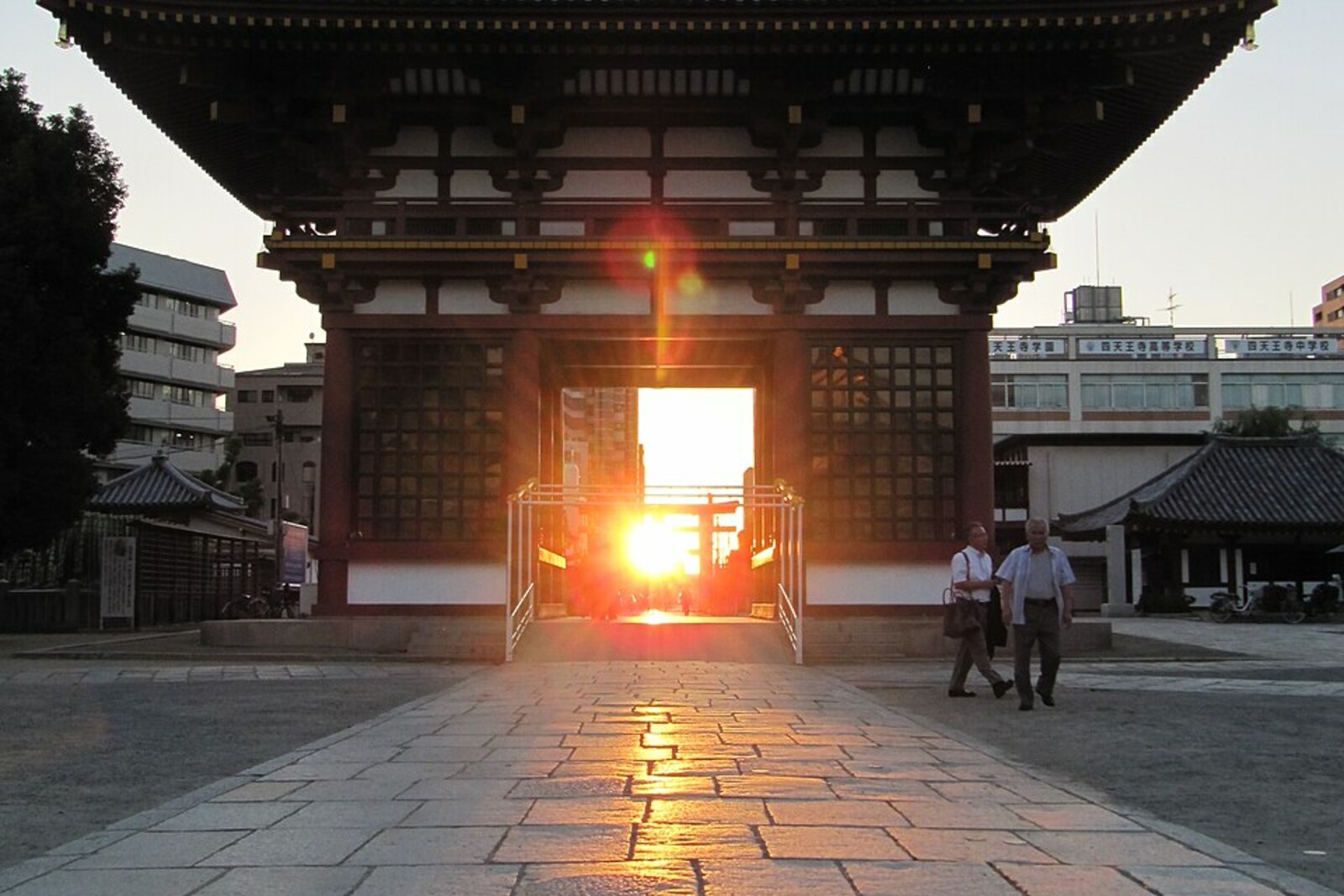
Look around first
What to notice
- Middle Gate
- Pagoda
- Golden Hall
- Galleries of the central courtyard
The story of the place
The name Shitennoji Temple literally means “Temple of the Four Heavenly Kings.” Jikokuten, Zochoten, Komokuten, and Tamonten are Buddhist guardians of the four directions of the world. Their names appeared in Osaka after a war that decided whether Buddhism would remain at the imperial court.
In the sixth century, this faith was only beginning to enter Japan. When an epidemic began, Mononobe no Moriya, head of a military clan, blamed the misfortune on the worship of foreign gods. With the emperor's permission, his men burned a Buddhist prayer hall and threw the statues into a canal. The chief defender of the new religion was Soga no Umako, a courtier and head of a rival clan.
After Emperor Yomei died in five eighty-seven, the dispute merged with a struggle for the throne. Moriya wanted to place Prince Anahobe on the throne. Umako supported Prince Hatsusebe. Defeat threatened Moriya with the loss of all his holdings: lands were cultivated by people dependent on his clan, while the Mononobe position at court rested on hereditary military duties.
Umako first eliminated the rival claimant, then led an army to Moriya's estate in Shibukawa, east of present-day central Osaka. Moriya's men fortified themselves behind a fence of bound rice sheaves and repelled the attackers three times. The master of the estate himself shot from a tree.
Among Umako's troops was the young son of the dead emperor, Prince Umayado, whom later generations would call Prince Shotoku. His position at court now depended on the victory of this coalition. The chronicle Nihon Shoki, written down more than a century later, tells that the prince carved small images of the Four Heavenly Kings from wood and vowed to build them a temple if his side won. This episode is known from legend, not from the testimony of a participant in the battle.
During the next assault, the archer Tomi no Ichii struck Moriya with an arrow. Moriya was killed, the army scattered, and Prince Hatsusebe, supported by Umako, took the throne as Emperor Sushun. The Mononobe clan lost its former position. The lands, household members, and dependent people of the slain man were divided: Umako received one half, and the other was given to the future temple.
In five ninety-three, Prince Umayado fulfilled his vow and founded Shitennoji Temple here. Thus, the sanctuary of the victors was supported by the confiscated holdings of the defeated man. The Four Heavenly Kings were revered here as protectors of Buddhist teaching and as patrons of the very victory after which the temple received its name and resources.
The ancient wooden buildings of the central courtyard have not survived. The present pagoda, Golden Hall, and the galleries surrounding them were mostly rebuilt in reinforced concrete by nineteen sixty-three. Archaeologists found the old foundations, and the builders again placed the Middle Gate, pagoda, Golden Hall, and Lecture Hall on one line from south to north—where the creators of the early complex had placed them.
Beside Shoryoin, the memorial pavilion of Prince Shotoku, stands the small Moriya Shrine. In the temple built in honor of the victory over Mononobe no Moriya and given part of his holdings, the defeated man himself was left a separate place of veneration.
Useful on site
A city route stop; if you plan to go inside, check the schedule and visiting rules on the site's official website.
Checked: date not specified. Check the official source before visiting.Explore the active temple without rushing, speak quietly, and do not cross the path of ceremonies. Access to individual parts of the complex may differ from a free walk around the grounds.