 Guide On Map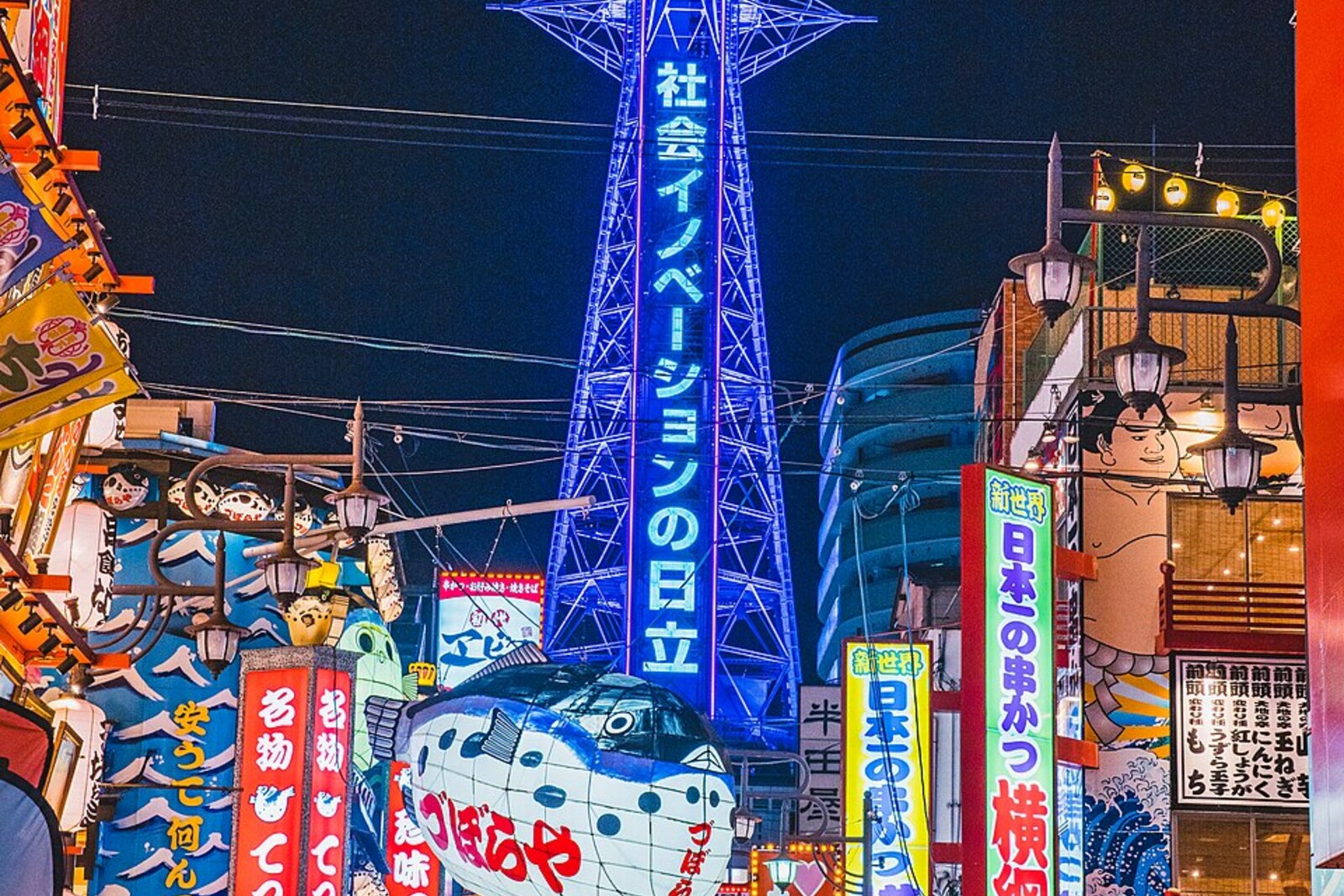
Look around first
What to notice
- The tower’s metal silhouette
- The viewing platform
- The large Hitachi letters
The story of the place
The metal silhouette of Tsutenkaku Tower rises one hundred three meters above Shinsekai; a viewing platform operates at the top, and large Hitachi letters glow on its sides. Another tower once stood slightly farther south, welcoming guests at the entrance to a district created on the grounds of a former industrial exhibition. Its base resembled the Arc de Triomphe, its upper section the Eiffel Tower, and nearby an aerial tramway carried people to Luna Park. That is how this commercial and entertainment district acquired a sign visible even on the approach.
In nineteen fifty-four, seven merchants from Shinsekai decided to restore the vanished tower to the district. They had no suitable plot, no construction company, and not enough money even to begin the work. There was another reason to act: shops, movie theaters, and snack bars depended on people coming here for entertainment, but after the war visitors increasingly chose Namba and Abeno.
The first Tsutenkaku Tower stood about thirty meters south of the current one. In nineteen twelve, entrepreneurs turned the former site of an industrial exhibition into a new entertainment district—Shinsekai, meaning “New World.” At its entrance, they combined a base resembling Paris’s Arc de Triomphe with an upper section modeled on the Eiffel Tower. A viewing platform operated at the top, while an aerial tramway carried visitors to the neighboring Luna Park. The tower was meant to be visible from afar and lead customers to the entertainment beneath it.
The name “Tsutenkaku” means roughly “tower leading to the sky.” Its author is now considered to be the Confucian scholar Fujisawa Nangaku, from whom Osaka entrepreneurs commissioned names. However, his name does not appear in documents from the time of construction, and Nangaku himself left no such record. Much later, his grandson reported the authorship, citing family memory; the management company accepted this version.
In January nineteen forty-three, the Ohashi-za Theater at the tower’s base caught fire. The blaze damaged the metal supports. Tsutenkaku Tower was not repaired: it was dismantled, and about three hundred tons of steel were handed over for military use. Two years later, air raids destroyed almost all of Shinsekai. After the war, merchants rebuilt the pavilions and movie theaters, but their former landmark no longer stood above them.
Jasuno, chairman of the association of local neighborhoods and an ordinary shopkeeper from Shinsekai, set his neighbors a straightforward goal: “Without restoring Tsutenkaku Tower, there will be no restoration of Shinsekai.” The seven initiators surveyed residents and at the same time offered them shares in the future tower. Applications totaled one hundred million yen, but only about half that amount was paid in. Even so, more than four hundred local residents became shareholders in Tsutenkaku Kanko Co., Ltd., established in nineteen fifty-five.
Major contractors estimated construction at more than four hundred million yen. Taihei Okumura, owner of the Osaka company Okumura Corporation, agreed to build the tower for three hundred ten million and invested another sixty million of his own funds. For comparison, the capital of his entire company at the time was about one hundred forty million. Bank loans covered the remainder. The project was commissioned from engineer Tachu Naito, a specialist in tall structures; the merchants separately asked him to make the Osaka tower taller than the recently opened tower in Nagoya.
On October twenty-eighth, nineteen fifty-six, the new Tsutenkaku Tower, one hundred three meters tall, welcomed its first visitors. Already the following year, about one and a half million people went up to the viewing platform. The neighbors who had risked money for a flow of customers got that customer flow back—along with queues at the tower entrance.
A steady advertising income was needed to repay the loans. Hitachi had just begun producing household television sets and wanted to establish itself in the competitive Kansai market. In July nineteen fifty-seven, its neon sign was lit on the tower. Under the contract, one side was reserved for public messages, while the others were given to the advertiser. The large Hitachi letters on today’s Tsutenkaku Tower continue that agreement, which helped the private tower of Osaka merchants pay for its own existence.
Useful on site
A city-route stop; if you plan to go inside, check the schedule and visiting rules on the venue’s official website.
Checked: date not specified. Check the official source before visiting.The stop’s main point can be understood from the street; treat going inside as a separate choice and check visiting conditions in advance.