 Guide On Map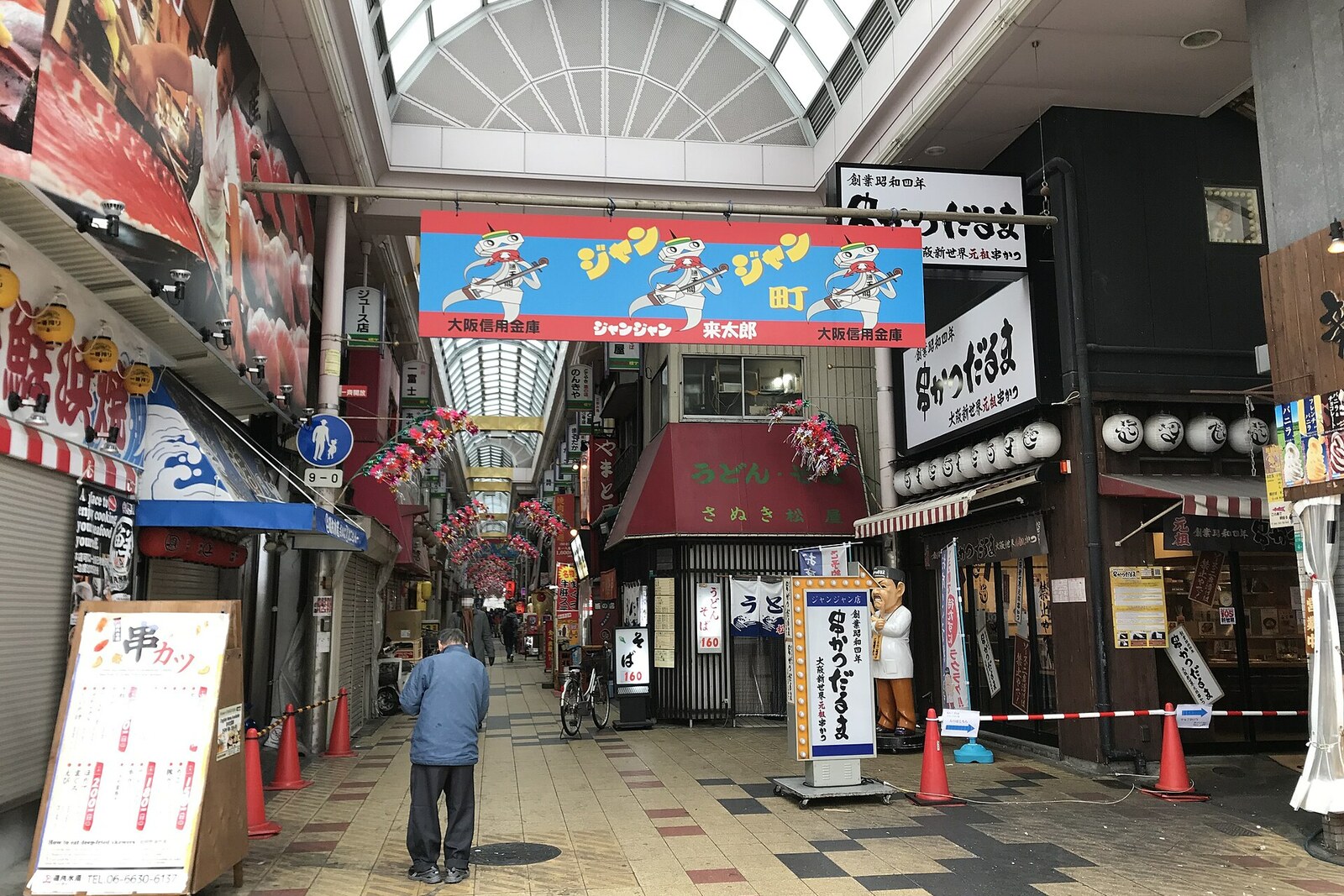
Look around first
What to notice
- Covered shopping arcade
- Row of narrow doors
- Janjan Kitaro emblem
- Shamisen in the character's hands
The story of the place
On the emblem, Tsutenkaku Tower is depicted holding a shamisen, while beneath the roof runs a tight row of doors behind which food is sold and games are offered. This passage served as a short route from Tobita, a licensed district of brothels, to Shinsekai's entertainment and catered to men making that journey. Air raids destroyed the commercial street, but in the nineteen sixties it was once again filled with inexpensive places to eat and gaming halls needed by the builders of World Expo facilities. During the area's renewal, the decision was made to preserve the arcade, and the tight row of entrances remained in place.
The owners of the establishments here had only a few seconds to earn money: a person passed one door and immediately found themselves at the next owner's. Each depended on the flow of people and tried to stop them before the neighbor did.
In nineteen eighteen, Tobita, a licensed district of brothels, opened south of Shinsekai. Three years later, the present narrow passage, then called Iwami-cho, became a short commercial route between Tobita and the entertainment around Tsutenkaku Tower. Snack bars, drinking establishments, and gaming venues crowded together here, catering to men continuing farther down the street.
The owners called out to passersby with musical instruments. The shamisen went “janjan,” the drum “dondon,” and the snare drum “tenten.” The establishments competed with one another, and the repeated “janjan” became the name of the whole street. Officially, it was Janjan Yokocho, but the owners’ nickname drove that name out of everyday speech: Janjan Yokocho and Janjan Yokocho became established.
During the war, air raids destroyed this commercial street along with most of Shinsekai. It was still struggling in the fifties, and in the following decade builders of facilities for the World Expo of nineteen seventy brought it back to life. They needed inexpensive food and affordable entertainment; merchants once again filled the short passage with snack bars and gaming halls.
Since nineteen ninety-seven, the decision during the area's renewal has been to preserve the narrow arcade. And in two thousand four, Janjan Kitaro—a caricature of Tsutenkaku Tower holding a shamisen—was made its emblem. The old touts themselves are no longer here; their instrument remains on the sign, and the name they brought remains above the same row of narrow doors.
Useful on site
A city route stop; if you plan to go inside, check the opening hours and visiting rules on the venue's official website.
Checked: date not specified. Check the official source before visiting.Do not block the passage, especially when stopping by shop windows. If you decide to have a snack, choose one place: the purpose of this stop is to feel how the street works, not to compile a complete gastronomic list.