 Guide On Map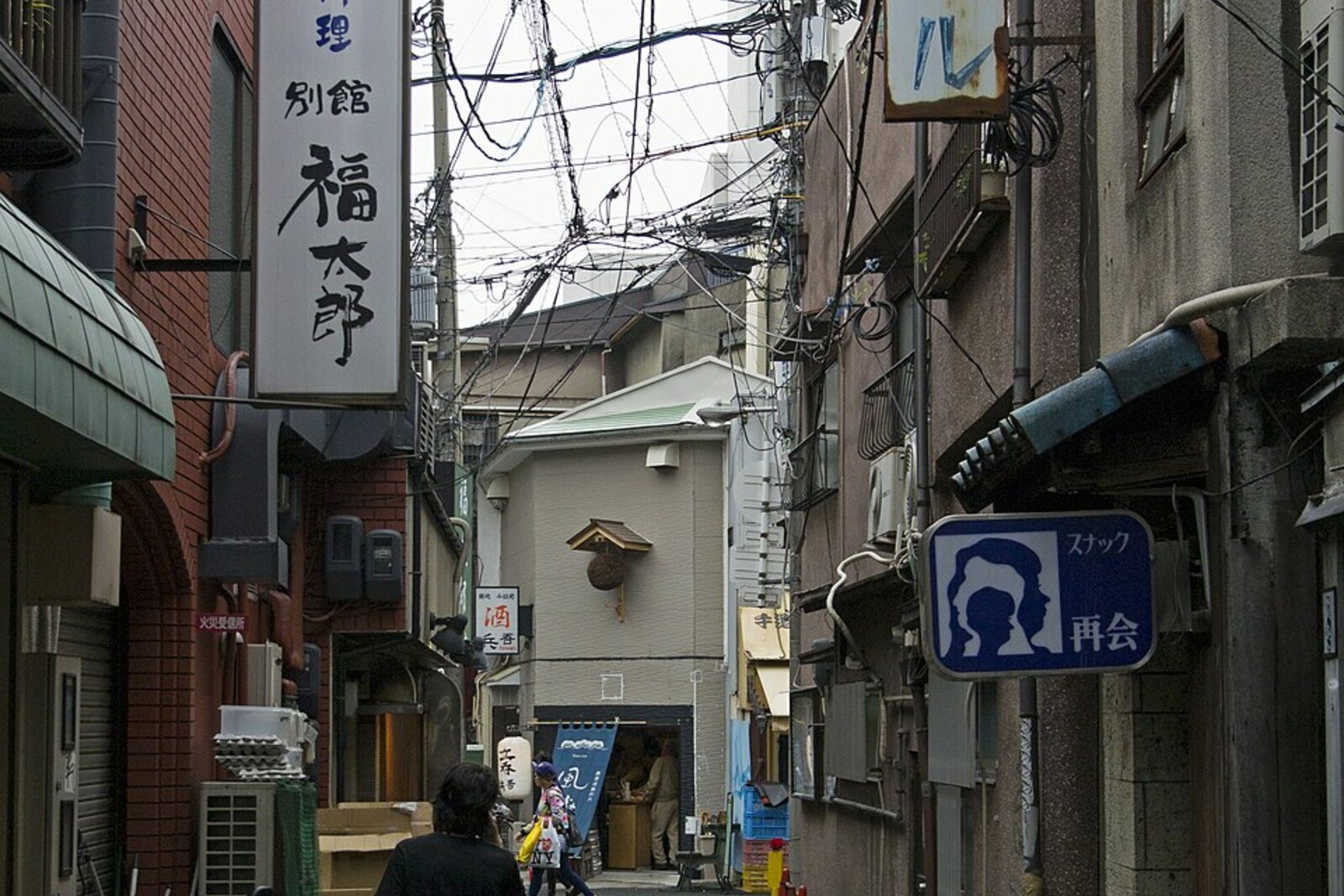
Look around first
What to notice
- Narrow passageways
- Low-rise buildings
- Establishment signs
- “Ura Namba” signs
The story of the place
“Ura Namba” was coined by the owners of two establishments here. Until the early two thousands, no such district existed on Osaka's map: there were the neighborhoods of Sennichimae and Namba-Sennichimae east of Namba Station, merchants' warehouses, old cabarets and clubs, and a few restaurants. Visitors went to Kuromon Market, Doguyasuji Shopping Street, or Namba Grand Kagetsu, but did not linger long in the alleys.
In two thousand seven, restaurateur Yuji Kawabata opened the Osaka Center of Yakiton here—a standing eatery serving pork offal grilled on skewers. His business rested on this product. Kawabata learned to butcher and cook pork offal from a former owner, then opened his own eatery in Nishinari. In Osaka, yakiton remained unfamiliar food: it was much easier to sell beef or chicken skewers here. Kawabata was risking money in an alley hardly visited by the customers he needed, and with a product that still had to be explained to those customers.
It was the local built environment that made it possible to take risks with comparatively small establishments. After the war, the neighborhoods east of the station were not redeveloped. A planned thirty-meter thoroughfare here was never built; the old plots, narrow passageways, and low-rise buildings remained. Shop owners began renting out warehouses, and independent restaurateurs could take spaces too cramped for a large restaurant but suitable for a counter, a kitchen, and a few tables.
Kawabata opened several more establishments nearby, each serving different food. His calculation was simple: a visitor to one bar should have a reason to move on to the next without leaving these streets. Around the same time, Koichiro Hoshimoto opened the iron-grill eatery Teppan Yaro here. Both owners wanted their alleys to stop being explained through a long chain of landmarks. Kawabata put the goal quite literally: a person should be able to get into a taxi and tell the driver the name of the district.
In two thousand eleven, Kawabata and Hoshimoto named it “Ura Namba.” “Ura” means the back side: their establishments lay behind Namba Grand Kagetsu when approaching from Namba's main streets. It was a name invented by merchants to attract guests, not an old place name and not a decision by the city administration.
One word was not enough. That same year, the owners of eleven establishments produced the first Ura Namba map and began handing it out to visitors. On the sheet, scattered bars became a single place for the first time, a place one could move around on foot. The local publisher Kayoko Maki took up subsequent editions of the map: the number of establishments marked kept growing, tips for foreign visitors appeared, and the print run reached ten thousand copies.
Kawabata gained a stream of customers for his eateries and opened new establishments in the area; Hoshimoto added the qualification “main in Ura Namba” to his restaurant. Other owners followed them into small warehouses and two-story houses. Over five years, the number of food-service and accommodation businesses east of the station grew by more than one-sixth, even as it was declining in Osaka's Chuo Ward.
Ura Namba still has no official boundary. The name usually refers to the alleys between the theater, Kuromon Market, Doguyasuji Shopping Street, and the station. The Osaka Center of Yakiton still occupies the building in Namba-Sennichimae where Kawabata began his risky venture. And the word he invented now appears on maps, hotel signs, and Hoshimoto's restaurant sign—exactly as an address one can give to a taxi driver.
Useful on site
The alleys are accessible as city streets; restaurants and bars keep their own hours, and many are geared toward the evening.
Checked: June 29, 2026. Check the official source before visiting.Small establishments fill up quickly, so choose one and be ready to wait or change your plan. Do not occupy a seat for long without ordering, and ask about photography rules inside.