 Guide On Map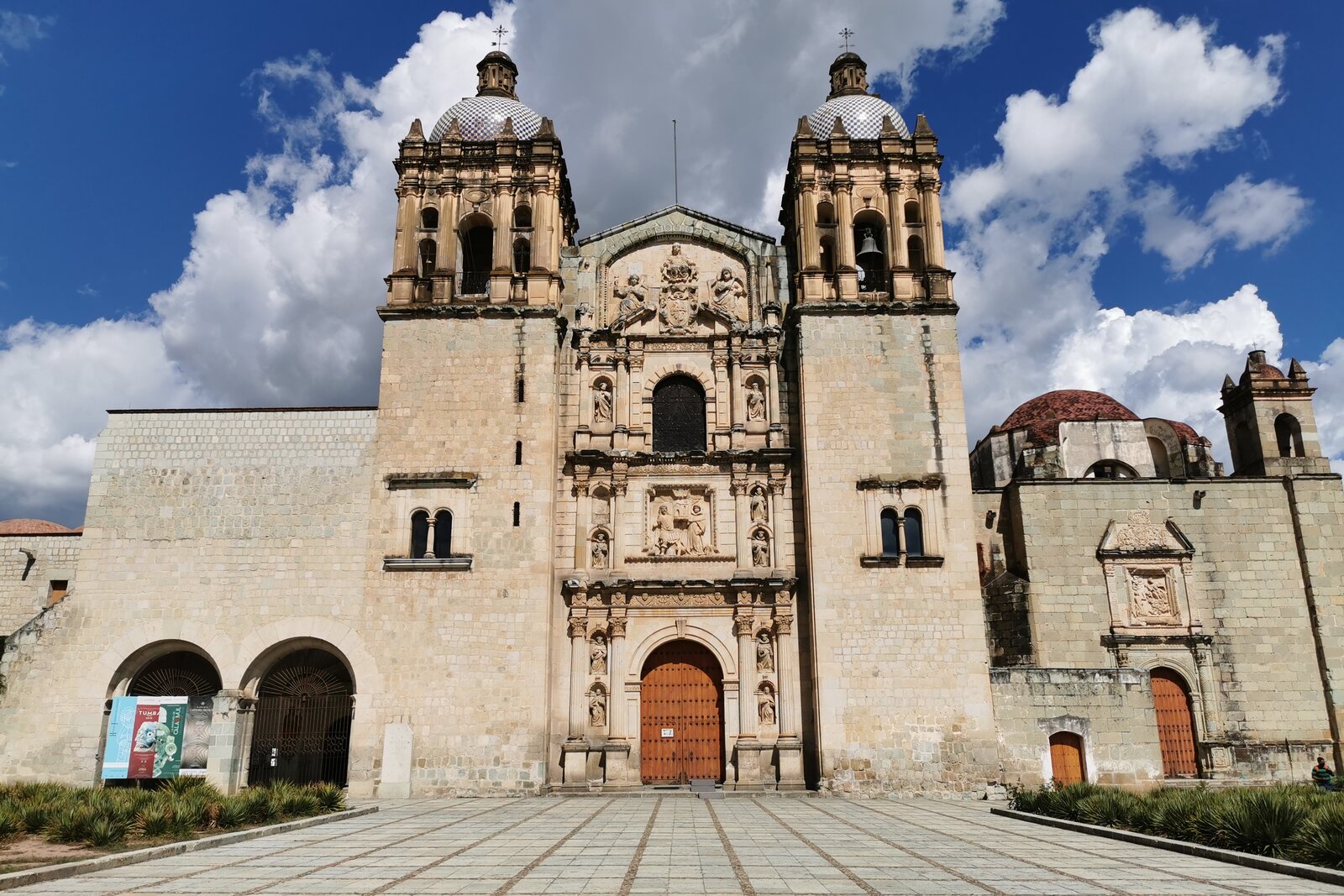
Look around first
What to notice
- Church façade
- Thick walls of the Former Convent of Santo Domingo de Guzmán
- Entrance to the Museum of the Cultures of Oaxaca
- Roofs of the complex
The story of the place
Beyond the façade begins a space much larger than a single church: old buildings and inner courtyards adjoin the church, connected by roofs. Their thick stone walls look fortress-like; a contemporary considered them almost comparable to a fortress in strength. After a long period of other uses, worship returned to the church, while the neighboring rooms were occupied by the Museum of the Cultures of Oaxaca. So today, an active church and a museum stand side by side beneath one roofline.
Santo Domingo de Guzmán is now divided by function: the church remains active, while the adjacent Former Convent of Santo Domingo de Guzmán is occupied by the Museum of the Cultures of Oaxaca. Its full name means “Church of Saint Dominic de Guzmán.” Dominic de Guzmán, a Castilian priest, founded the Order of Preachers—the Dominicans—in the early thirteenth century. In the sixteenth century, monks of this order built a church and a residence here for their mission in Oaxaca, so they gave the complex its founder’s name.
The monastery’s thick walls also proved useful to people with entirely different intentions. In the mid-nineteenth century, an active-duty battalion occupied some of the rooms, and prisoners were held here as well. Porfirio Díaz later recalled that the monastery was almost as strong as a fortress.
In eighteen fifty-four, President Antonio López de Santa Anna was persecuting liberals who were preparing an uprising against his government. After intercepted encrypted correspondence, Marcos Pérez—an Oaxacan lawyer and organizer of a conspiracy seeking to bring the city into the uprising—was imprisoned in Santo Domingo. La Torrecilla was chosen for him: a special monastic prison about three meters long and about two meters wide. A high barred window looked out onto the sacristy courtyard, and a guard of about fifty soldiers stood beyond a double door.
Pérez’s twenty-four-year-old student and courier, Porfirio Díaz, then still a law intern, decided to warn him. Díaz himself collected the conspirators’ letters from the post office; they arrived under a fictitious name. He avoided arrest only because another person was sent to collect the intercepted letter that day.
Díaz earned his living by running errands for his priest uncle: he delivered correspondence and collected rent from tenants, receiving a room and a little money in return. One of the debtors was Colonel Pascual León, the prosecutor handling Pérez’s case. The slow-paying debtor made the collector wait for long periods in his office while he ate breakfast. One day, Díaz saw the investigative file on the desk and managed to read the statements of Pérez’s accomplices. The prisoner now needed to be told exactly what the prosecution knew.
Around midnight, Porfirio and his younger brother Félix came to the monastery garden with a rope. One would stand on the other’s shoulders, reach the top, and pull his brother up after him. In this way, they climbed the four-meter wall, crossed the roofs of the monastery bakery and communal kitchen, and then lay down on the main roof and crawled between the sentries. The brothers determined the guards’ positions by their roll call, repeated every fifteen minutes.
Above La Torrecilla, Félix held the rope while Porfirio lowered himself to the window and gripped the bars with his hands. Directly beneath him stood a sentry, whom the depth of the wall prevented from seeing what was happening above. To wake Pérez, Díaz scraped off a little mortar with his fingernails and threw the crumbs inside. Pérez got up, put on his boots, began walking around the cell, and read psalms in Latin, gradually approaching the window. He asked for paper and a pencil. Two nights later, the brothers repeated the entire route.
After Pérez’s friends made efforts on his behalf, he was transferred to another cell in the same monastery, with windows facing the atrium. There, communication became easier: Díaz stood on the roof of the house opposite and composed messages, displaying each letter on a separate sheet. In this way, he informed Pérez of the amnesty that had been adopted. The amnesty freed the prisoner; Díaz, meanwhile, had to leave his job as a librarian when the battalion commander Marcial López de Lascano learned of the nighttime intrusions. More sentries were added to the monastery roof, and dogs were released.
Nearly half a century later, Archbishop Eulogio Gillow sought to restore the church’s former function. President Díaz supported his request, and in nineteen oh two the Church of Santo Domingo de Guzmán was reopened for worship. The museum now occupies the former monastic buildings. La Torrecilla’s window looked not onto the square in front of the façade, but onto the inner sacristy courtyard, deep within the same complex.
Useful on site
Check access to the church on site. The Museum of the Cultures of Oaxaca in the former convent, according to INAH: Tuesday–Saturday 10:00–16:00; tickets are listed separately on the INAH page for citizens of Mexico and foreign visitors. After the changes of 2025, do not consider the garden free admission: the official website asks visitors to contact the relevant office regarding tourist and school visits.
Checked: June 29, 2026. Check the official source before visiting.In the church, observe the rules of an active religious space. The museum is visited separately, and access to the Ethnobotanical Garden of Oaxaca depends on current rules and organized programs—check them before you come.