 Guide On Map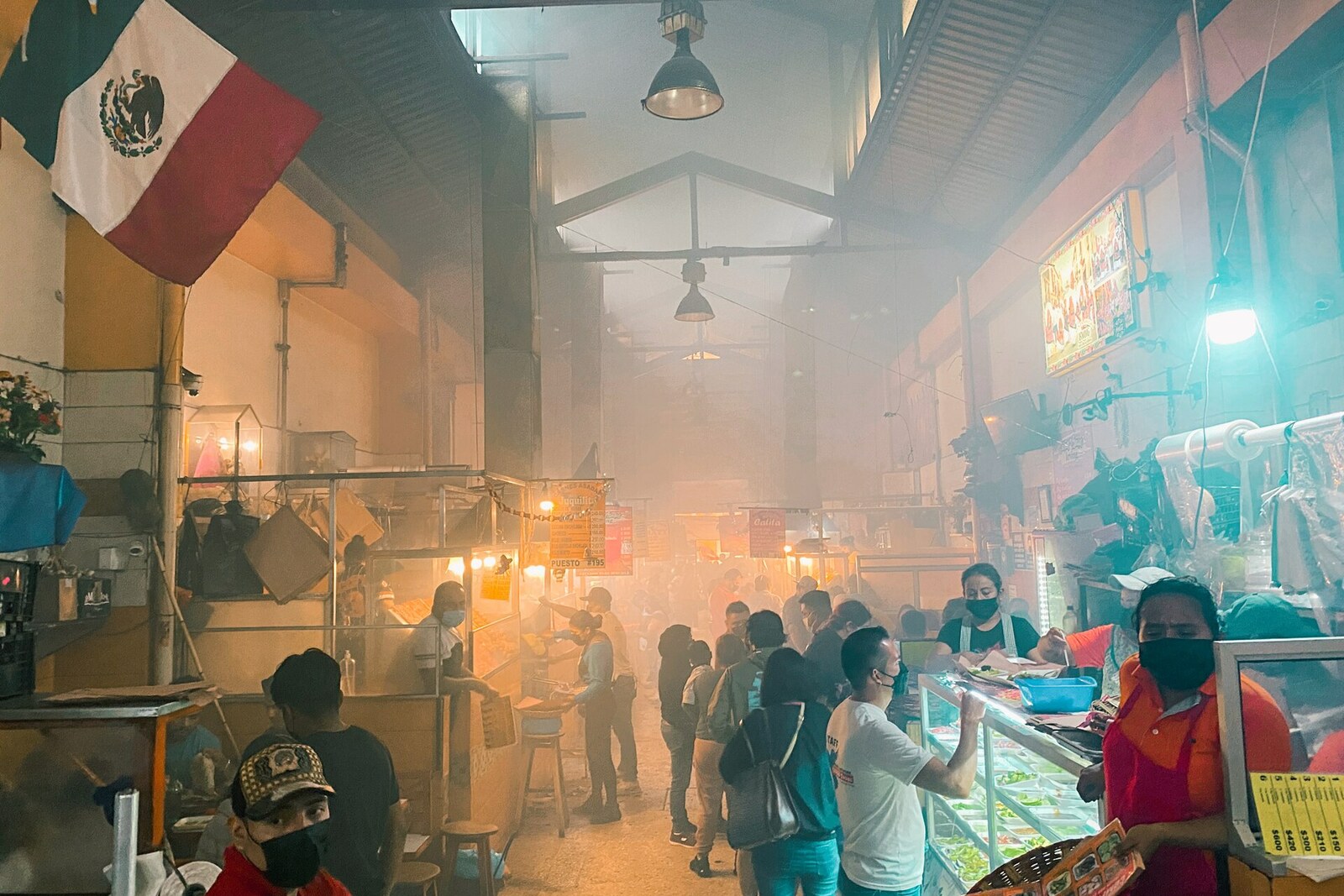
Look around first
What to notice
- Charcoal braziers
- Meat counters
- Shared tables
- Rows of vendors selling tortillas and vegetables
The story of the place
A city food market rose in the nineteenth century on the grounds of the former hospital of the Monastery of San Juan de Dios. It was rebuilt more than once, and the current building opened on the day that gave it its name. Under its roof, rows of vendors stretch out beneath charcoal smoke: the market has long brought shopping, cooking, and eating together in one building.
Here, an order is assembled from several vendors. In one row, you choose tasajo—thinly sliced salted beef—or chile-marinated pork, chorizo, or tripe by weight. The meat is placed on a charcoal brazier at the same counter. Other women vendors offer tortillas, onions, avocado, salsa, and drinks, while people eat at shared tables. This division has remained from the time when no “Smoke Corridor” yet existed inside the market.
More than sixty years ago, five or eight families sold meat outside, on Aldama Street. Their row was called “oreaderas,” after meat air-dried in the open. The vendors had no home refrigerators, so they dried tasajo and tripe: this way, the goods lasted through the journey and the trading day. They laid out the meat in flat reed baskets. Then wooden counters and braziers in metal containers appeared: a customer could take the meat raw or wait for it to be cooked over the coals.
Among the first vendor families was that of Julia García Castellanos. Her daughter, Dolores Olivera Martínez, and son-in-law, Ismael Rojas García, continued the business, and their daughter, Matilde Rojas Olivera, grew up among the counters on Aldama. For the family, selling meat was a livelihood passed down together with the place and the customers. When city officials moved the street rows into a vacant part of the covered market, the women vendors brought the old arrangement inside as well: meat separately, braziers separately, tortillas and vegetables separately. Over time, the several families became more than three dozen independent vending places. Another current vendor, Lidia Bolaños, already represents the fifth generation of her family.
The market itself is older than this meat row. Construction began in eighteen sixty-two on the grounds of the former hospital of the Monastery of San Juan de Dios, and twenty years later it opened as Mercado de la Industria. The building was later remodeled, and in nineteen fifty-six, the doctor and head of the city administration José Morales Paz secured state support for a new food market. Its opening was scheduled for November twentieth.
That date refers to Francisco Madero, an opposition candidate who sought free elections after President Porfirio Díaz had been reelected yet again. Madero was arrested, fled the country, and in the Plan of San Luis called on Mexicans to take up arms on the evening of November twentieth, nineteen ten. The uprisings that began then forced Díaz to resign a few months later; Madero won the next presidential election. The market, opened on the anniversary of that call, received its present name.
Julia García Castellanos had a basket of air-dried meat on Aldama Street. Her granddaughter has a counter inside the market. Between the counter and the shared table, there is still no single kitchen: the meat, charcoal brazier, tortillas, and vegetables belong to different vendors. The baskets remain in family stories, while the braziers gathered in one passage gave it its present name—Pasillo del Humo.
Useful on site
Most stalls are open daily 07:00–21:00; the smoky Pasillo del Humo usually comes alive from 10:00 to 17:00.
Checked: June 19, 2026. Check the official source before visiting.First, figure out whom to order the meat, grilling, side dishes, and drinks from: they may be different vendors. Do not bring food into someone else’s area without first checking the local rules. If your eyes or breathing become irritated, leave the smoky row immediately.