 Guide On Map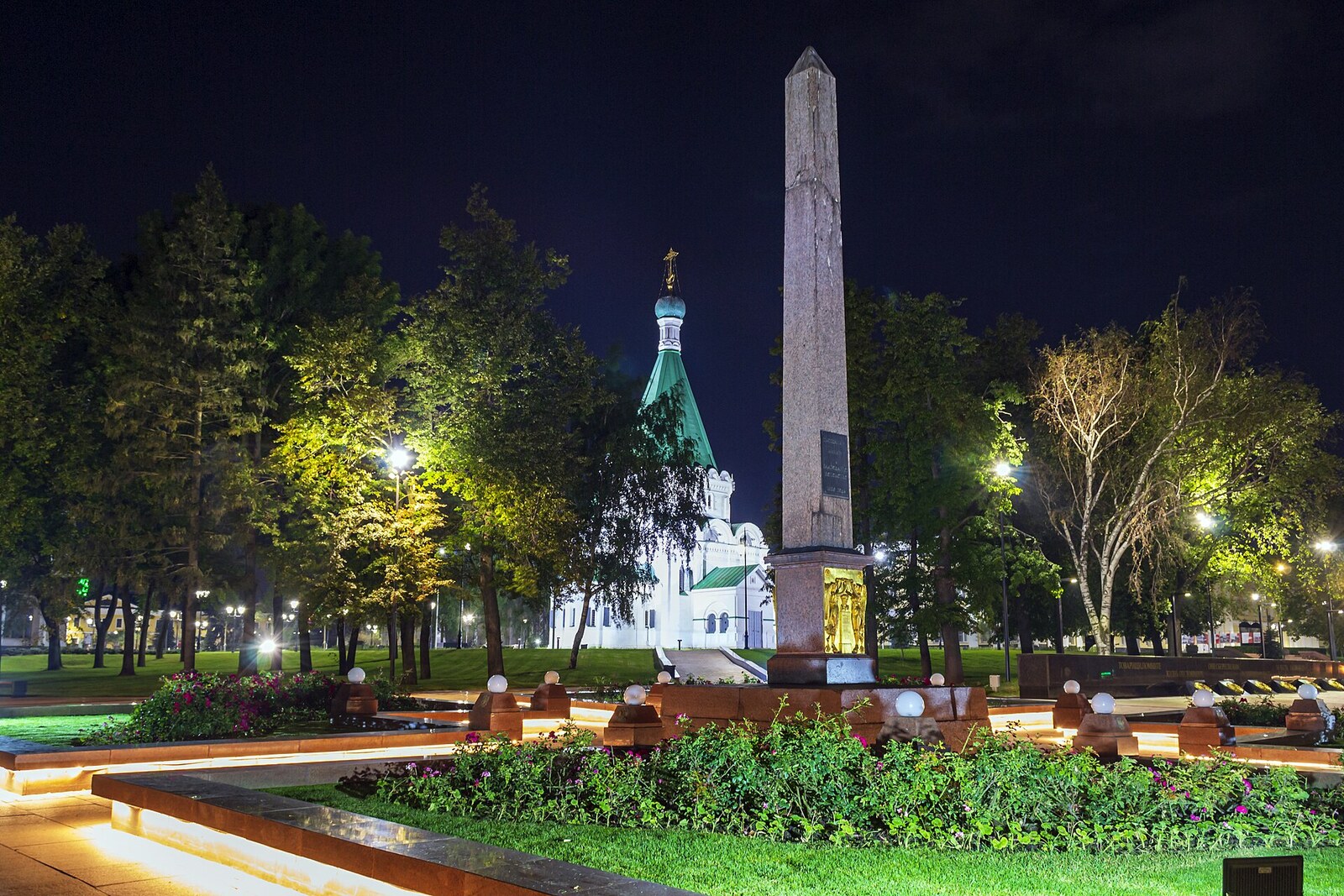
Look around first
What to notice
- Granite obelisk
- Bronze plaques with dedications
- Open area
- Freestanding bell tower
The story of the place
Different dedications appear on two sides of the granite obelisk: “to citizen Minin” and “to Prince Pozharsky.” Here, titles matter more than surnames. At the beginning of this story, one traded in meat and administered municipal levies, while the other commanded troops.
In the autumn of sixteen eleven, a Polish-Lithuanian garrison occupied the Moscow Kremlin, and the First Militia, which had tried to liberate the capital, fell apart. Kuzma Minin, the Nizhny Novgorod zemstvo elder—an elected administrator of the townspeople’s common affairs—pressed for the creation of a new army. He lived on the income from a butcher’s shop and now had to persuade his neighbors to give money to professional warriors. The emergency levy adopted by the city was burdensome: up to two-thirds of one’s property was demanded for the militia’s needs.
Minin collected funds, provisions, and equipment, but did not presume to command men. The people of Nizhny Novgorod sent for Prince Dmitry Pozharsky, a military commander recovering from a severe wound received during the unsuccessful struggle for Moscow. Pozharsky agreed to lead the new militia and proposed entrusting all logistical support to Minin. So, side by side stood a man responsible to the townspeople for the property collected and a prince responsible for the campaign.
The money collected was used to hire and equip warriors. New detachments joined them on the road to Moscow, and the treasury grew. In the autumn of sixteen twelve, the militiamen captured Kitay-gorod, after which the garrison in the Kremlin capitulated. Minin, a man of humble origin, received the high rank of duma nobleman; Pozharsky became a boyar and continued his military service.
Almost two centuries later, people across the country began collecting money for a Minin and Pozharsky Monument intended for Nizhny Novgorod. After the war of eighteen twelve, the Committee of Ministers decided to erect a large bronze group in Moscow. Nizhny Novgorod was left with another project: an obelisk.
Even it arrived here damaged. Its upper tip broke off during reloading. The sculptor Ivan Martos and the architect Avraam Melnikov arrived with stonecutters, shortened the stone shaft by two sazhen, secured the broken-off piece on a metal rod, and polished the seams. The obelisk was unveiled in eighteen twenty-eight. The bronze plaques retained the earlier date of eighteen twenty-six, when they were cast.
The obelisk did not serve as a tombstone, although Minin’s grave was nearby at the time. After his death, Filaret, the first Metropolitan of Nizhny Novgorod, transferred the remains believed to be Minin’s from the cemetery of Pohvalinskaya Church to Transfiguration Cathedral. When the cathedral was rebuilt in the nineteenth century, the remains were placed in its underground section.
In nineteen twenty-nine, museum staff opened the cathedral tombs and removed the remains they found before the church was destroyed. What they removed from Minin’s tomb was kept in a museum and, in nineteen sixty-two, transferred to Archangel Michael Cathedral. Transfiguration Cathedral is no longer here; a separate bell tower has been reconstructed from its former complex. An open area remains on the site of the former burial vault, while Minin’s name has remained on the obelisk beside the name of the man to whom he entrusted the army he had assembled.
Useful on site
The Kremlin’s open grounds follow its regular hours. The obelisk and exterior objects can be viewed without a ticket.
Checked: June 24, 2026. Check the official source before visiting.The main object at this stop is partly absent, so allow yourself time to compare in your mind the obelisk, the site of the church, and the modern development. Do not expect to see the preserved cathedral or the original tomb.