 Guide On Map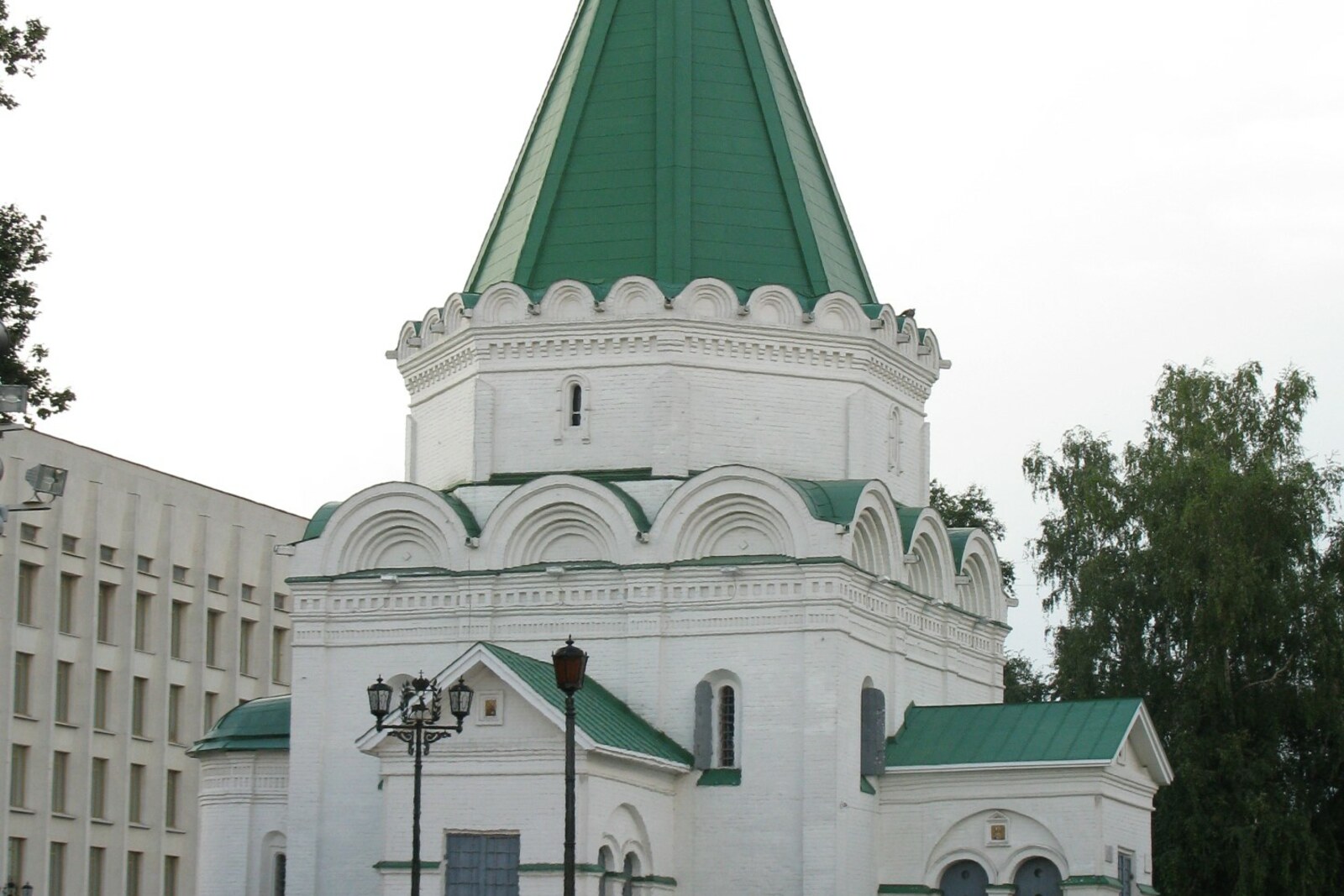
Look around first
What to notice
- The cathedral's tall tent roof
- The bell tower's small tent roof
- The arched opening between the bell tower and the hall
- The stone slab above Minin's remains
The story of the place
Archangel Michael Cathedral was commissioned by Mikhail Fyodorovich, the first tsar of the House of Romanov. He owed his throne to the people of Nizhny Novgorod as well: in sixteen twelve, the posad elder Kuzma Minin raised money and people, the voevoda Dmitry Pozharsky led the militia to Moscow, and after the Polish-Lithuanian garrison was expelled from Moscow, the election of a new tsar became possible.
By then, an ancient Church of the Archangel stood in the Nizhny Novgorod Kremlin. The cadastral book of sixteen twenty-one says of it plainly: “the church has fallen into ruin, and no services have been held in it for a long time.” In late sixteen twenty-seven, Mikhail Fyodorovich ordered a new cathedral to be built on this site at the treasury's expense—as a memorial to the Nizhny Novgorod militia.
The coincidence between the tsar's name and the church's name can be misleading. The cathedral is not dedicated to Mikhail Romanov. According to church tradition, the first wooden church here was erected as early as twelve twenty-one by the Vladimir prince Yuri Vsevolodovich, the founder of Nizhny Novgorod. Archangel Michael was considered the leader of the heavenly host and the patron of princes in military affairs. For a church inside a border fortress, this dedication was understandable four centuries before the House of Romanov appeared.
In the spring of sixteen twenty-eight, Lavrenty Vozoulin and his stepson Antip Konstantinov arrived from Moscow—assistant masters of stonework in the sovereign's service. At that time, an “assistant master” could mean an architect and construction supervisor: such a person drew up the estimate, calculated the building, and was responsible for the work of the masons. Royal commissions gave a master an income, but at the same time determined which city he was to be sent to and what he was to build there.
Lavrenty began the cathedral together with Antip, but died before the work was completed. He was buried in the cemetery of Pechersky Monastery. Antip had to bring the sovereign's commission to completion alone. By sixteen thirty-one, he had completed the church, after which he received his next decree—to go and build fortress towers in Vyazma. Later, he was brought in to build the Terem Palace in the Moscow Kremlin. The work he completed here after his stepfather's death marked the beginning of his own service as a state architect.
The cathedral's tall tent roof and the bell tower's smaller tent roof are the very structure built by Antip. The bell tower was connected to the prayer hall: through an arched opening, the bell ringer could follow the service and give the bell signal at the right time. After a long period as a museum, services resumed here in two thousand.
In nineteen sixty-two, remains identified as those of Kuzma Minin were transferred to the cathedral. The architect-restorer Svyatoslav Agafonov designed a stone slab above them. It appeared inside the church three hundred thirty-one years after Antip Konstantinov completed the cathedral-memorial to the Nizhny Novgorod militia.
Useful on site
Daily from 07:30 to 18:00. During services, tourist viewing may be restricted.
Checked: June 24, 2026. Check the official source before visiting.This is an active church: turn off external sound, do not disturb the service, and view the interior quietly. It is more convenient to finish the audio story before entering.