 Guide On Map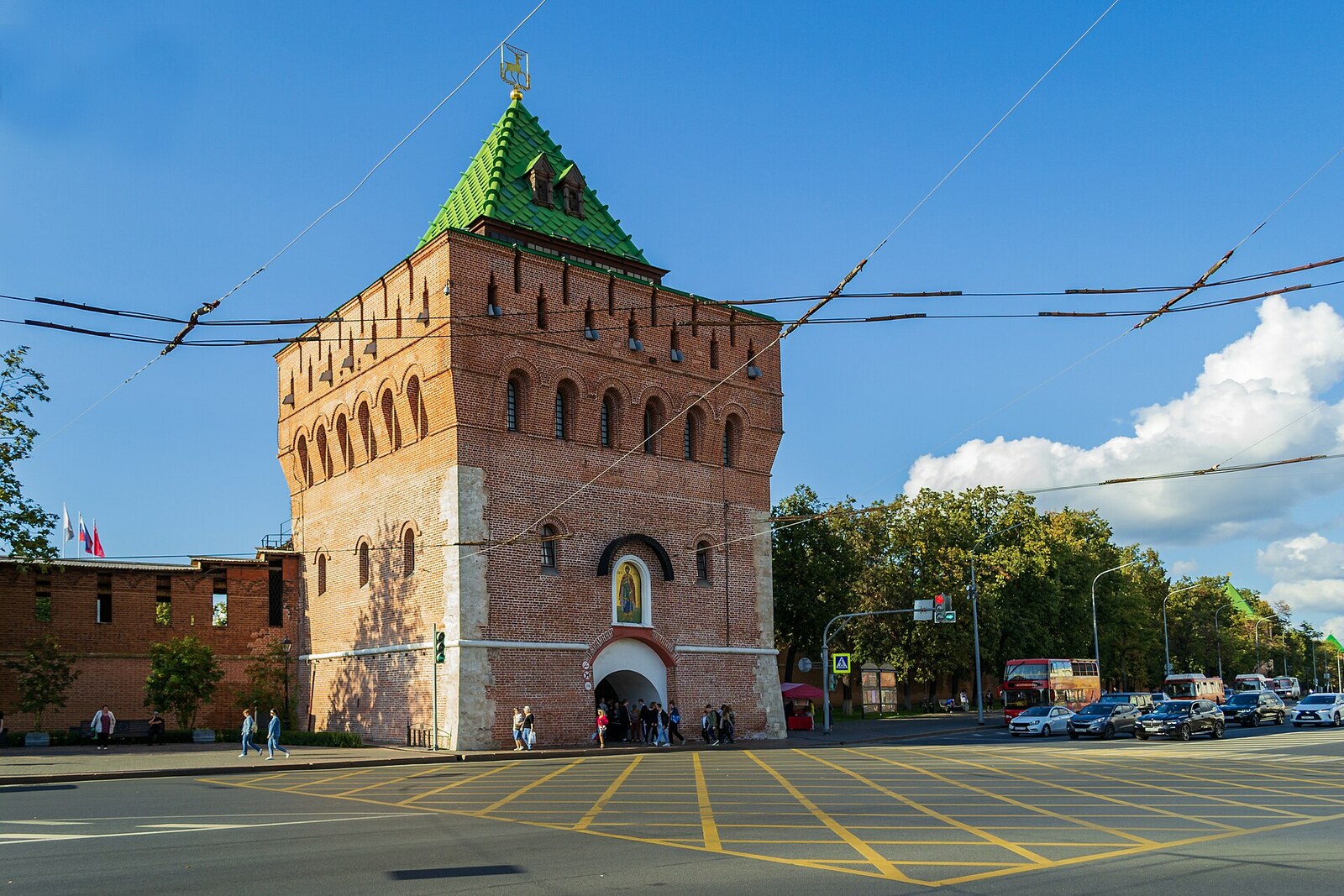
Look around first
What to notice
- Tall tented roof
- Flared band of embrasures
- Gate arch
- Skylight lantern
The story of the place
The gate arch in the tower's lower tier leads from the square into the Kremlin; it was once used to enter the city fortress. A moat lay before the gates, and the approach was protected by outer fortifications. When the passage's military role ended, the moat disappeared beneath an embankment, and the provincial archive was housed in the tower; museum exhibitions are now displayed here.
The main gates of the Nizhny Novgorod Kremlin look like a single sixteenth-century structure. Yet the tall tented roof and the flared band of embrasures appeared four centuries after the fortress was built. They were erected for a museum—despite discoveries made in the masonry itself.
The tower's name is older than the current building. In the fourteenth century, the Nizhny Novgorod prince Dmitry Konstantinovich fortified this entrance and built in front of it a church dedicated to his heavenly patron, the warrior Saint Demetrius of Thessaloniki. Researchers dispute exactly whom the name came from: the prince himself or the church that stood nearby. The current gate tower was built in the sixteenth century, but it remained Dmitrievskaya. The church has long been gone, but the names of the prince and the saint are still spoken at these gates.
By the end of the nineteenth century, there was no longer any need to defend the entrance. The moat before the tower was filled in, the former fortifications were dismantled, and the provincial archive was kept inside. The artist Andrei Karelin advocated opening an art museum in the city and donated fifty works to it. The city was preparing for the All-Russian Exhibition of eighteen ninety-six, so it was decided to combine the museum with the restoration of the Kremlin's main gates.
The project was entrusted to the restoration architect Nikolai Sultanov. He wanted to give the tower a ceremonial Old Russian appearance while also admitting enough light into the exhibition hall. Sultanov prepared two versions of the top without conducting measurements or excavations here. He first saw the tower itself on the day he brought the finished drawings to Nizhny Novgorod. The architect considered both versions equally plausible, but chose the one in which machicolations—projecting embrasures for firing downward—appeared beneath the roof, while a skylight lantern was installed above the hall.
During the work, the local architect Pyotr Malinovsky dismantled the upper masonry and discovered straight crenellations. The discovery showed that the flared band proposed by Sultanov had probably never existed here. Members of the Nizhny Novgorod Learned Archival Commission, responsible for studying antiquities, ordered a switch to the version with a straight top. The builders had already begun carrying it out.
Governor Nikolai Baranov, who headed the museum committee, demanded that the work stop. He was pressing to open the museum in time for the exhibition and considered the project approved by the capital's Imperial Archaeological Commission mandatory. Sultanov was urgently summoned to Nizhny Novgorod. The architect continued to defend his reconstruction, although the discovered masonry contradicted it. Under pressure from the governor, the commission yielded, and the tower was completed according to the approved version.
In eighteen ninety-six, the city art and history museum opened here. Karelin placed the donated paintings and historical objects in the new halls; soon afterward, Emperor Nikolai II and Alexandra Fyodorovna visited the exhibition. Several years later, the same archival commission called the alteration “highly arbitrary” and even “fantastical”: in pursuit of a presumed ancient appearance, people had destroyed authentic traces of the old top.
Later restorers did not remove this superstructure. They preserved it as the work of another era. The flared band beneath the roof and the tall tented roof are traces of the decision made by Baranov and Sultanov after the masonry had indicated the opposite. Beneath them remains the passage of the sixteenth-century fortress, and museum exhibitions are still held inside.
Useful on site
In summer, the general grounds are open from 06:00 to 02:00. In winter, the official website publishes differing general-grounds and gate hours; check the Dmitrievskaya Arch schedule on the day of your visit. The museum is open daily from 10:00 to 20:00, with the ticket office open until 19:00.
Checked: June 24, 2026. Check the official source before visiting.You can trace the history of the alterations from outside by comparing the lower and upper sections. The exhibition inside is a separate visit and is not necessary for continuing the walk.