 Guide On Map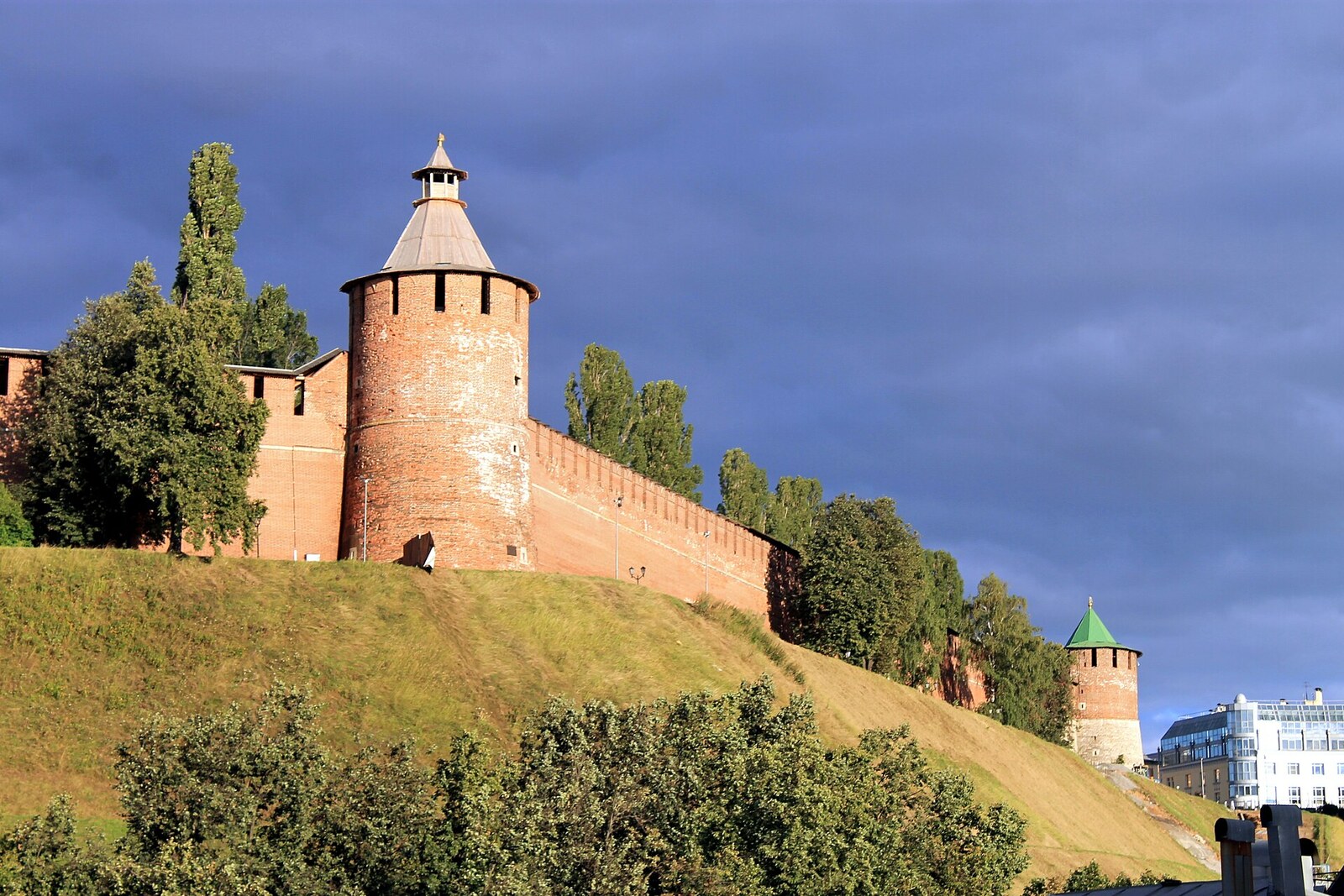
Look around first
What to notice
- Taynitskaya Tower
- Kremlin wall
- Path along the wall
- Pochaina Ravine
The story of the place
Kremlin Boulevard began with an order to remove housing from here. In October eighteen thirty-four, Nikolai I spent two days in Nizhny Novgorod. After the Makaryev Fair was moved here, the city grew rapidly, while the Kremlin was still residential: private houses stood right up against the fortress wall, with wooden outbuildings nearby.
The emperor wanted to clear the ancient fortress for provincial institutions and connect the upper part of the city with the piers. He ordered all private houses inside the Kremlin to be bought out, private construction here to be forbidden from then on, the wooden buildings by the wall to be demolished, and a boulevard to be laid in their place. For homeowners, this meant selling their homes to the state treasury and moving away. After the order was carried out, the Kremlin ceased to be a city quarter where a family could own a house.
The provincial architect Ivan Yefimov and the engineer Pyotr Gotman had to turn several orders into a single plan. They connected the boulevard with new descents, allowing carriages to bypass steep sections. For this scheme, builders filled in the old moats and laid Zelensky Descent beside Taynitskaya Tower, leading to the lower part of the city. In eighteen thirty-six, a special construction committee was created for the work, and three years later Nikolai I approved the prepared plan. Today’s path along the wall occupies part of the strip cleared then.
The earlier geography of the fortress remained beneath the embankment. The Pochaina River flowed along the bottom of the ravine and is now enclosed in a collector. There was a bridge across it, with a road leading to the bridge. The builders of the tower aimed its front embrasures slightly to the left: presumably, the gunners were meant to keep this very crossing under fire.
The name “Taynitskaya” appeared only in the eighteenth century. In seventeenth-century documents, the tower was called Mironositskaya, after the Church of the Myrrhbearers on the opposite slope, and “na Zelene,” after the zelyony dvor, or gunpowder works, in the ravine. Later, the name was linked to an underground passage to the Pochaina River, by which the fortress defenders supposedly could reach water during a siege.
The passage itself has not yet been proven. At the beginning of the twentieth century, researchers collected accounts of the Kremlin’s underground chambers. Witnesses recalled a corridor about fifteen sazhen long in the direction of Severnaya Tower, but they were retelling someone else’s words or childhood impressions. The architect-restorer Svyatoslav Agafonov, who studied Taynitskaya Tower in detail, did not describe such a passage.
At the end of two thousand twenty-three, museum staff dismantled a closed entrance on the wall side and, for the first time in many decades, gained access to the middle tiers. They found staircases, firing chambers, and a blocked-up corridor leading to a side embrasure. Earlier witnesses could have mistaken such a corridor for the beginning of an underground passage. The investigation has not yet found any further tunnel to the river.
On the surface remain a name without a discovered hidden passage and a boulevard laid after the imperial order. The Pochaina River can no longer be seen from here: it flows in a collector beneath the ravine, beside the tower that was once called by its name.
Useful on site
Kremlin Boulevard is accessible during the grounds’ opening hours. The upper viewing platform of Taynitskaya Tower is open only as part of the paid museum route along the wall.
Checked: June 24, 2026. Check the official source before visiting.Do not look for an open entrance to the legendary hiding place: the underground passage and the bed of the Pochaina River are not visible from the surface. Here it is more important to compare the tower, the ravine, and the direction of the wall.