 Guide On Map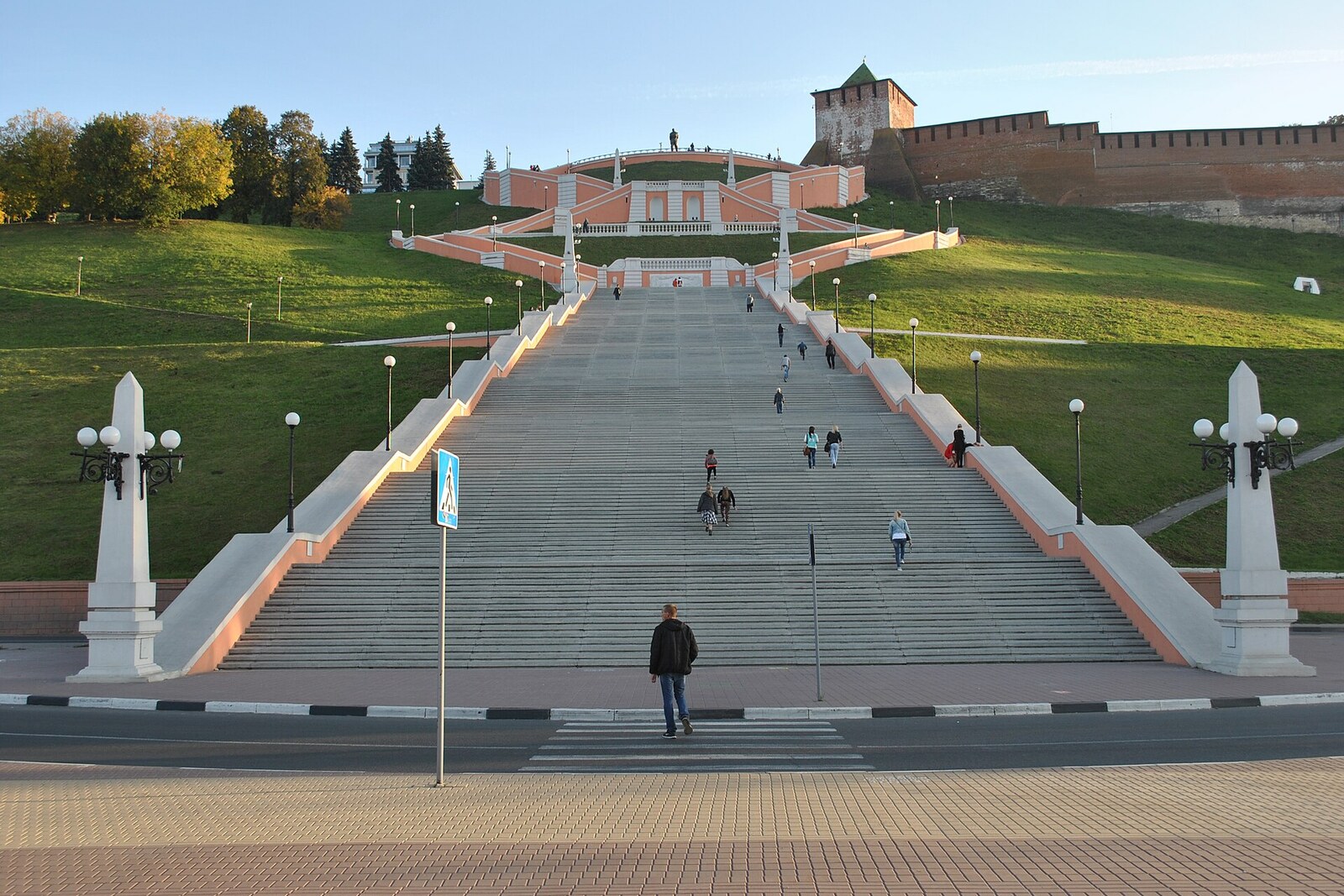
Look around first
What to notice
- Two symmetrical semicircles
- Decorative shields and banners
- Stone flights of the right semicircle
The story of the place
Two symmetrical semicircles form the Chkalov Staircase into a descent from the high Volga bank to the Nizhne-Volzhskaya Embankment, giving the upper part of the city a direct link to the river. The upper platform leads up to the monument to the pilot, while the lower one leads to the water; the shields, banners, and intertwined ribbons in the decoration preserve the memory of the victory at Stalingrad. In the right semicircle, among the stone flights, two old sections remain, with steps laid during the first construction. At first, the staircase was called the Volga Staircase, but the city gradually gave it Chkalov's name.
The decision to build a grand staircase across this slope cost Alexander Shulpin his post as head of Gorky, his Party card, and two years in prison.
Construction was his profession. Shulpin began as a foreman, leading a small group of builders, then worked as a technician and site supervisor, graduated from an engineering and construction school, and headed the city architectural and planning department. In nineteen thirty-nine, after becoming deputy chairman of the city executive committee, he proposed linking the center on the high Volga bank with the embankment by the water. The war halted preparations.
In the spring of nineteen forty-three, Shulpin returned to his idea in a new role: he was now chairman of the city executive committee, meaning that he ran the city's municipal services. After the victory in the Battle of Stalingrad, he took the project to Moscow and secured official permission for the memorial descent. The choice of location solved two problems at once. The steep Volga Slope separated the upper part of the city from the Nizhne-Volzhskaya Embankment, while the Chkalov Monument already stood above. The staircase was built between the monument and the river.
The decision was especially risky because of the timing. That same summer, Gorky endured severe bombing raids, and its factories and city utilities needed restoration. Despite this, Shulpin continued construction. He involved several city organizations, ordered workers to be recruited in districts across the oblast, and German prisoners of war were sent here at the final stage.
The original funds were not enough. The architects had to abandon the river station at the foot, the fountain, the columns, and part of the sculptural decoration. Even so, by the opening in nineteen forty-nine, costs had reached seven million seven hundred sixty thousand rubles. A few months later, Shulpin was accused of embezzling city funds and removed from office.
Shulpin spent about two years imprisoned in Murmansk Oblast. After Stalin's death, he was released and rehabilitated. He returned to Gorky and again earned his living in his former profession, working for construction organizations.
At its opening, the staircase was officially named the Volga Staircase: it was dedicated to the victory at Stalingrad, as the shields, banners, and intertwined ribbons in its decorative details recall. But local residents called it the Chkalov Staircase because the upper platform adjoins the monument to the pilot. In the nineteen eighties, the popular name finally displaced the former one.
After the reconstruction, little remained of the original staircase of the nineteen forties. On the right side of the upper semicircle, two historic flights were preserved—seventy-eight steps laid under Shulpin.
Useful on site
Open space; the official operator indicates a seasonal schedule for public areas. In ice, heavy rain, and during temporary closures, stay on the upper platform.
Checked: June 24, 2026. Check the official source before visiting.The upper platform is enough to understand the idea: going all the way down means many steps and then climbing back up. Do not go down onto the flights when the surface is wet or slippery.