 Guide On Map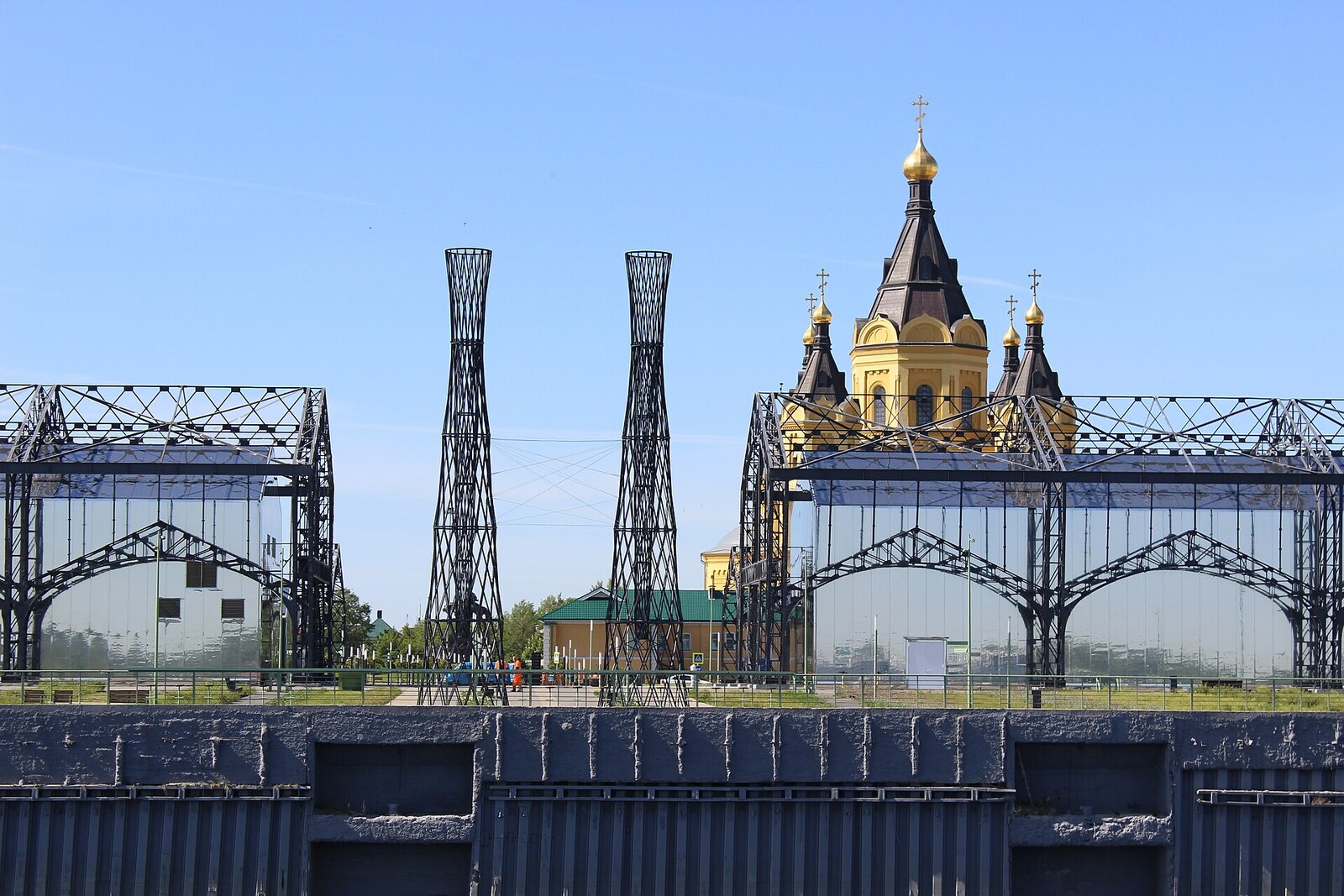
Look around first
What to notice
- Riveted trusses
- High empty framework
- Polished steel volumes
The story of the place
Concert and exhibition halls now operate inside the warehouses, but the historic metal does not bear these new rooms. Separate volumes with polished steel facades were placed beneath the old framework so as not to load it. In the nineteen sixties, the two surviving structures were moved within the port, turned a quarter turn, and placed on concrete foundations, while walls and roofs concealed the trusses from view for a long time. Now the high empty span with riveted joints preserves the scale of the former warehouse space.
Alexander Zeveke, a Nizhny Novgorod merchant of the first guild, had a very practical task here: where to store the cargoes from which he made his living on the Volga River. The steamship company, of which Zeveke was one of the owners, went bankrupt. Its vessels and plots at Siberian Pier passed to the transport company Nadezhda, and the merchant himself became its authorized representative for Volga River steamship navigation. The new owner needed large fireproof warehouses—packhouses.
Four kilometers from here, the main pavilion of the All-Russian Exhibition of eighteen ninety-six stood empty at the time. The exhibition was held on the site of today’s May Day Park. The pavilion’s iron framework was even older: it had been made for the Moscow exhibition of eighteen eighty-two, dismantled, transported to Nizhny Novgorod, and assembled again.
Nadezhda paid one hundred fifteen thousand rubles for the pavilion. In an explanatory note, the company stated its calculation directly: the ready-made metal parts reduced costs and made it possible to equip the pier in about a year and a half. Zeveke submitted the drawings to the Fair office. The exhibition hall was to be dismantled for the third time and turned here into cargo warehouses.
The project was stopped by Pavel Unterberger, the governor of Nizhny Novgorod, who was responsible for rebuilding the pier and sought fire protection. The new warehouses were supposed to be separated by wide gaps and limited in size. The company, however, wanted to keep the enormous exhibition spans; otherwise, the purchased framework would have had to be cut up and remade.
Nadezhda’s engineer, Alexander Ventskovsky, reworked the drawings, but the five warehouses still came out almost fifty meters wide. The company argued that beneath the high ridge, smoke in a fire would rise more slowly, automatic fire-extinguishing pipes could be installed above the goods, and a passage for carts and railcars would remain down the middle. While officials corresponded with the ministries, builders began erecting these structures without final permission. About eight thousand rubles had already been invested in the unfinished warehouses.
Nadezhda’s board undertook not to build a second story, not to stack goods higher than two sazhen—about four and a quarter meters—to remove the wooden partition walls, and to install an automatic water supply. After that, the ministry permitted the large spans to be retained. By the Fair of nineteen oh two, the warehouses were complete. Unterberger did not succeed in having them remade to ordinary dimensions, but the fire-safety conditions were included in the final permission. Nadezhda itself did not last long: in nineteen oh eight, the company was liquidated, and the warehouses passed to new owners.
In the nineteen sixties, the two surviving frameworks were moved within the port, turned ninety degrees, and placed on concrete foundations. Walls and roofs concealed the metal, so the warehouses’ origins were forgotten over time.
In two thousand fifteen, the Nizhny Novgorod architect Denis Plekhanov saw a photograph of their interior. The riveted trusses were too intricate for an ordinary port hangar. Plekhanov compared them with photographs of the exhibition pavilion and aerial imagery from nineteen forty-three; subsequent archival research confirmed his hunch. The structures received protected status, and in two thousand twenty-two, concert and exhibition halls opened inside them.
The architect Sergei Tchoban left the old trusses on the outside and placed separate volumes with polished steel facades beneath them. The modern halls do not load the historic metal. Above their roofs, the high empty framework still rises—the very span that Nadezhda was allowed to retain only after its written promise not to build a second story here.
Useful on site
The exterior structures are visible from public space. The exhibition and concert Strelka Warehouses operate according to the schedules of specific events; the information line is listed as available daily from 10:00 to 19:00.
Checked: June 24, 2026. Check the official source before visiting.The historic structures are clearly visible from outside. Check and arrange separately any visit to an exhibition, concert, or other event inside.