 Guide On Map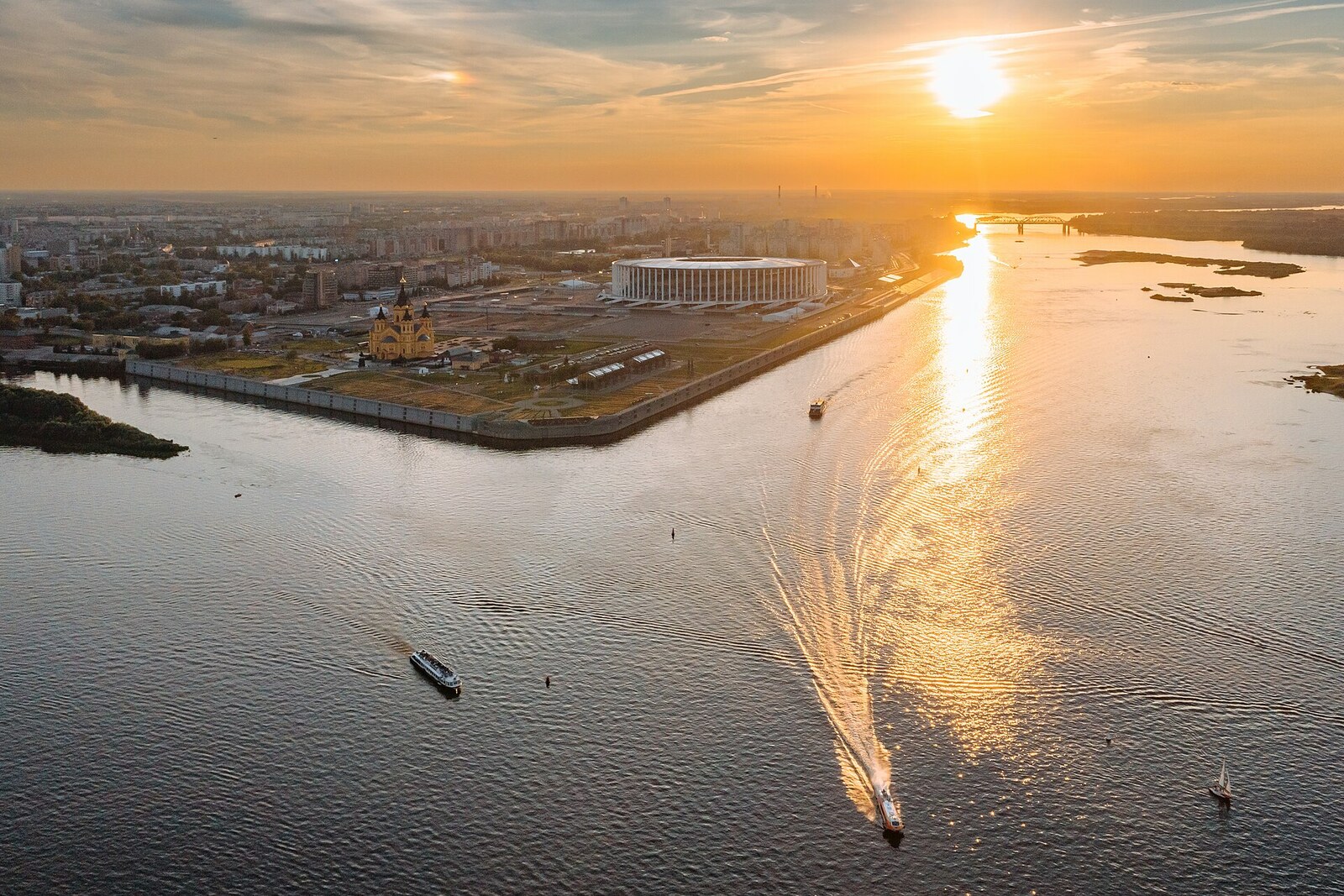
Look around first
What to notice
- Oka River
- Volga River
- Red letters reading “Strelka”
- Wooden decking of the amphitheater
The story of the place
At the confluence of the Oka River and the Volga River, the low cape of Strelka first appeared in old documents as Strelitsa, then became part of Strelitsky Stan in Nizhny Novgorod Uyezd. Before the trading buildings were constructed, the site was raised by three and a half meters; the excavated soil went into the canals, and wharves for unloading vessels were built along the water. A cargo port was added later, and its work remained Strelka’s main activity for nearly two centuries. The red letters on the slope repeat the brick inscription made by port workers, while its first version lies beneath the wooden decking of the amphitheater.
On July twentieth, eighteen seventeen, merchants opened a trial fair on this low cape. There were no stone trading rows yet: trade took place in temporary booths. For merchants whose business depended on the turnover of a single short season, the choice of location meant whether they would have time to sell the goods they had brought and return home before the freeze-up.
The previous summer, a fire destroyed the fair near Makaryev Monastery. The governor of Nizhny Novgorod, Stepan Bykhovets, pressed to move the trade to his city. He argued that many vessels and wagon trains passed through Nizhny anyway, and that merchants could shorten their journey here by nearly one hundred versts. A rumor circulated in the city that Bykhovets himself had arranged the fire in order to move the fair. There was no evidence for this, but he also needed the new fair to succeed as an answer to the dangerous accusation.
The place frightened the merchants. Strelka was flooded by spring high water, and the Oka River separated it from the city. Bykhovets ordered a floating bridge built across the river—a deck laid across connected vessels. When townspeople doubted that it could bear a crowd and loaded wagons, the governor drove a team of six horses at full speed across the bridge, galloping to the opposite bank. The bridge held. According to Bykhovets’s report, more goods were brought to the new fair than had been brought to Makaryev the year before. The merchants agreed to remain at Strelka.
After this trial, the Spanish engineer in Russian service Augustin Betancourt was put in sole charge of building the permanent fair. One of the proposed options stood near Nizhny Novgorod Kremlin, on the high bank. Betancourt secured the placement of the trading town here: vessels could approach the low bank from both the Oka River and the Volga River, and goods could be transferred near the shops. The engineer was responsible for the entire project, lived every summer with his family at an estate he had bought nearby, and personally directed the work.
The convenience of the wharves required a struggle with the lowland itself. At Betancourt’s direction, the site for the trading buildings was raised by three and a half meters, and the excavated soil was used to lay out the canals. In eighteen twenty-two, two thousand five hundred thirty shops opened in the new buildings. During the season, no fewer than one hundred fifty thousand people came here—while Nizhny Novgorod had eighteen thousand permanent residents. Specialized wharves appeared by the water, followed by a cargo port: the engineers chose Strelka for unloading vessels, and this work remained its main occupation for nearly two centuries.
The name itself appears in old documents as “Strelitsa”; later, Strelitsky Stan, a territorial district of Nizhny Novgorod Uyezd, was located here. In nineteen sixty-seven, port workers laid out the word “Strelka” in brick on the slope so that it could be read from passing vessels. The modern red letters repeat their outline, while the first port inscription has been preserved beneath the wooden decking of the amphitheater.
Useful on site
Open public area; individual sections may be closed for mass events, maintenance, or weather conditions.
Checked: June 24, 2026. Check the official source before visiting.The cape can be windy, and there may be slippery sections by the water. Stay on the open paths and do not approach the edge for a better angle.