 Guide On Map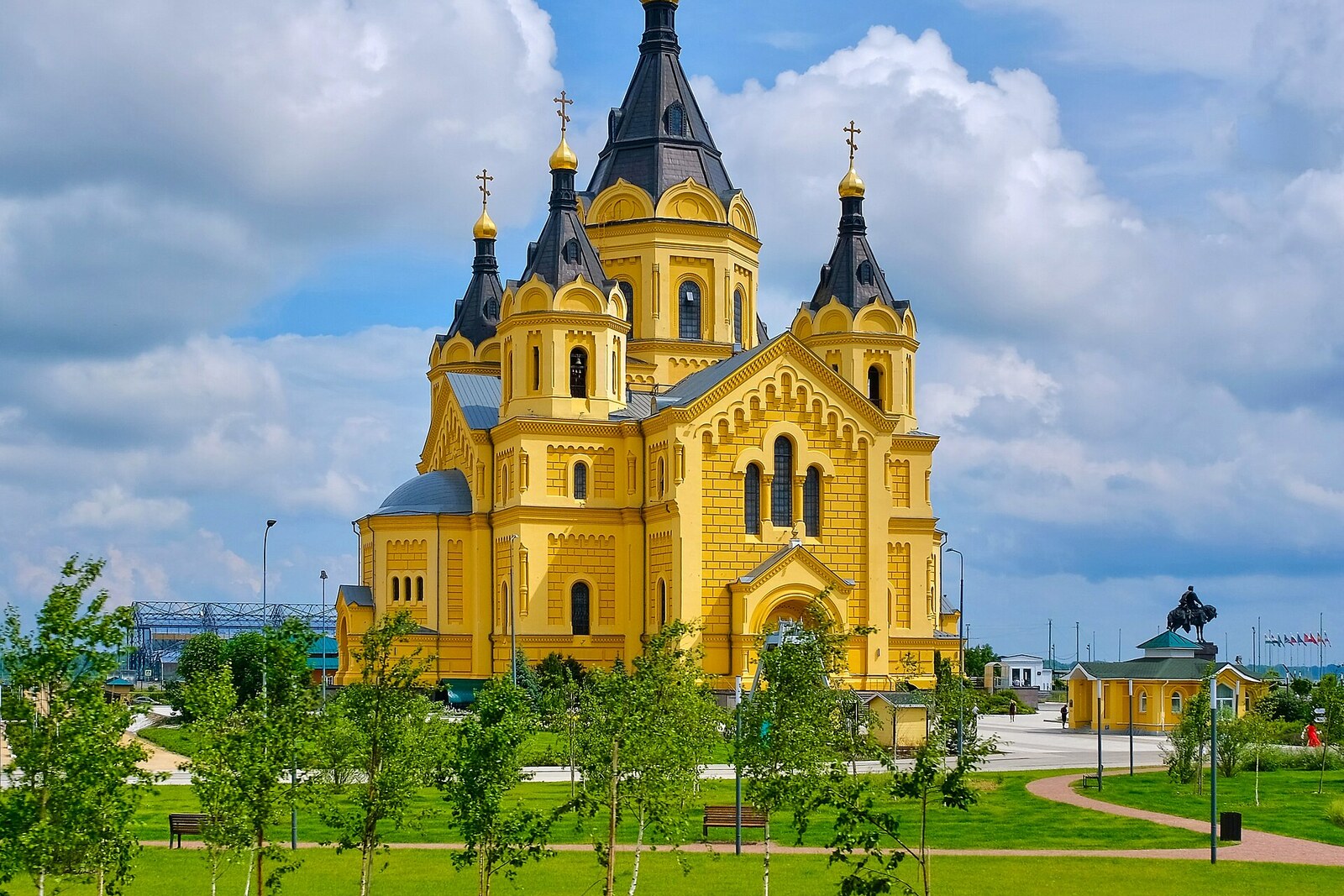
Look around first
What to notice
- Five tented roofs
- Brick walls
- Western narthex
The story of the place
Five tented roofs above brick walls rise over a church designed primarily for the Fair season, rather than ordinary parish life. The spacious main hall was kept cold and opened when merchants came to the Fair; in winter, services were held in a small warm church inside the western narthex. The cathedral now operates year-round and gathers people every day.
By the middle of the nineteenth century, the Orthodox merchants had already outgrown Spassky Cathedral. Many kept shops on the distant, Siberian side of the Fair, and had to walk across the entire trading town to reach the old church. Merchant representatives asked Bishop Antony Pavlovsky to establish a second church nearby.
In August eighteen fifty-eight, Emperor Alexander II visited the Fair with his family. After his visit, the merchants changed their plan: instead of a small church, they decided to build a huge cathedral in memory of the visit. The emperor chose a site on Strelka.
The main altar was dedicated to Alexander Nevsky—the patron saint of the emperor who shared his name and of his son, the future Alexander III. Alexander Nevsky himself was the Novgorod prince Alexander Yaroslavich. In twelve forty, he defeated a Swedish detachment on the Neva River, received the epithet Nevsky, and was later venerated as an Orthodox saint. The Nizhny Novgorod cathedral received his name through the imperial family: the merchants were commemorating Alexander II's visit.
The site chosen by the emperor almost stopped the project. It flooded in spring, and most members of the building committee considered the ground too unreliable for a heavy structure. Nevertheless, they did not abandon the designated site. The architect and engineer Robert Kilevain rejected ordinary piles: as groundwater levels changed, the wood could begin to rot. He laid a wooden raft beneath the cathedral and a solid stone slab on top of it. The raft ended up in a water-filled clay basin, where the wood remained constantly wet and bore the weight of the brick walls evenly.
Voluntary donations were not enough for the planned vast structure. Then, in eighteen sixty-nine, the organizers introduced a ten-percent levy on shops and trading plots. Muslim merchants were exempted from paying for an Orthodox church. The missing money came from the very trading activity for whose participants the second church had been requested.
Alexander II did not live to see the consecration: he was murdered in the spring of eighteen eighty-one. In summer, the cathedral was opened by his son Alexander III—the very second imperial namesake of the saint whom the merchants had mentioned when choosing the dedication.
At first, the new church had no permanent parish. The enormous main hall was left unheated and opened only during the Fair; in winter, services were held in a small warm church inside the western narthex. It is now a cathedral, and services are held daily throughout the year. The five tented roofs have been restored, and the entire brick structure still stands on its hidden wooden raft—exactly where Alexander II chose the site.
Useful on site
Active cathedral. The official website lists tours daily from 11:00 to 16:00; check services and holiday changes for the specific date.
Checked: June 24, 2026. Check the official source before visiting.The cathedral is active: viewing it from outside is enough for this story, and inside, turn off the sound and do not disturb the services.