 Guide On Map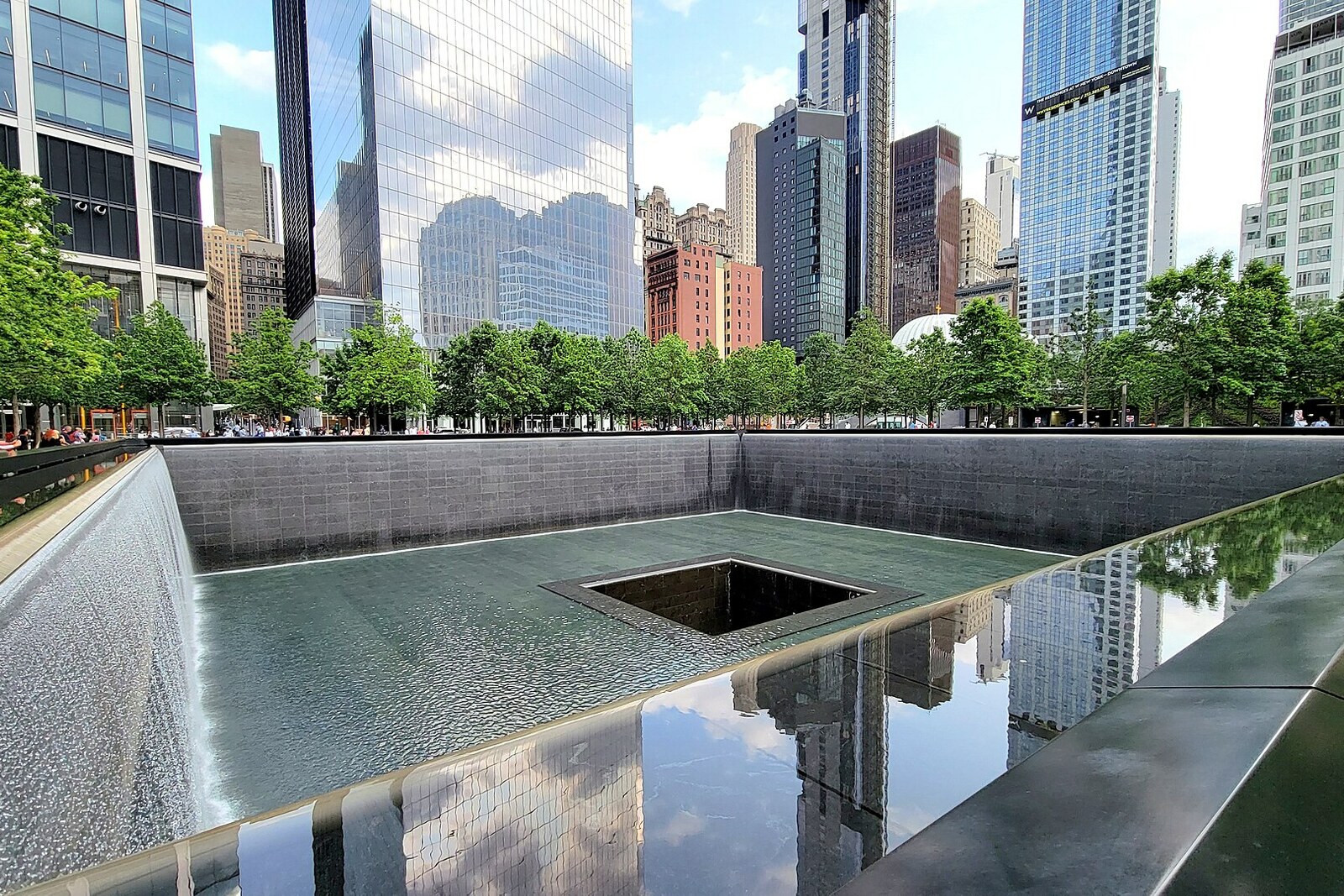
Look around first
What to notice
- Two square pools
- Falling water
- Bronze parapets
- Engraved names
The story of the place
This site was home to a business complex managed by the Port Authority of New York and New Jersey. Its towers functioned as separate vertical cities: large companies leased entire floors, while elevators and long stairwells distributed the flow of people. Today, the boundaries of the former foundations are marked by two water-filled squares; along their edges, metal holds names grouped together not alphabetically, but by workplace and personal closeness.
Two square pools occupy the places where the Twin Towers of the World Trade Center stood. Water falls into their former foundations. Engraved on the bronze parapets are two thousand nine hundred eighty-three names: victims of the September 11 attacks in two thousand one and six people killed in the explosion at this same complex in nineteen ninety-three.
That first explosion occurred in the underground garage. Tens of thousands of people had to be led out of the towers by the stairs. Richard Cyril Rescorla, responsible for the security of Dean Witter's offices in the South Tower, directed the evacuation of the financial company's employees. After the explosion, he demanded that the company move to a low-rise building. The executives decided to stay. Rescorla then drew up his own plan: employees were to descend regularly from the upper floors, walk in pairs, and leave part of the stairway clear for rescuers. Employees complained about the drills that took them away from work. For Rescorla, those descents were the work.
On the morning of September eleventh, two thousand one, terrorists hijacked four passenger planes. The first plane struck the North Tower. The Port Authority of New York and New Jersey, which managed the complex, announced over the internal public-address system that people in the South Tower should remain where they were. Rescorla was there, on the forty-fourth floor. He canceled that instruction for his employees and began the evacuation before the second plane struck the South Tower.
By then, Dean Witter had become part of Morgan Stanley, which occupied more than twenty floors. Nearly three thousand people began doing what they had rehearsed repeatedly: descending in pairs, listening to the floor wardens, and not blocking the stairway. Rescorla walked between the flights with a megaphone and sang so that people would keep moving. Two thousand six hundred eighty-seven employees made it out of the tower.
Rescorla himself did not leave with them. He began going back up, checking whether anyone remained in the offices. He was last seen on the stairway of the tenth floor, going upward. Soon afterward, the South Tower collapsed. Thirteen Morgan Stanley employees and consultants died, including Rescorla. His remains were not found.
The names on the memorial are not arranged alphabetically. They were grouped by place of death, work, and personal connections; relatives could ask for people who had been close in life to be placed beside one another. Richard Cyril Rescorla's name is engraved on the parapet of the South Pool. Within this same square was the stairway on which he was last seen going up.
Useful on site
According to the official Visit page: the memorial is open daily from 8:00 to 20:00 and is free; the museum operates Wednesday–Monday from 9:00 to 19:00, with last entry at 17:30, plus select Tuesdays and holiday hours. Security, screening, and changes to operations are possible throughout the site on commemorative dates.
Checked: June 15, 2026. Check the official source before visiting.This is an active place of remembrance, not an ordinary photo spot: yield space at the names and keep a quiet tone. A museum visit is planned separately and is not required for the route.