 Guide On Map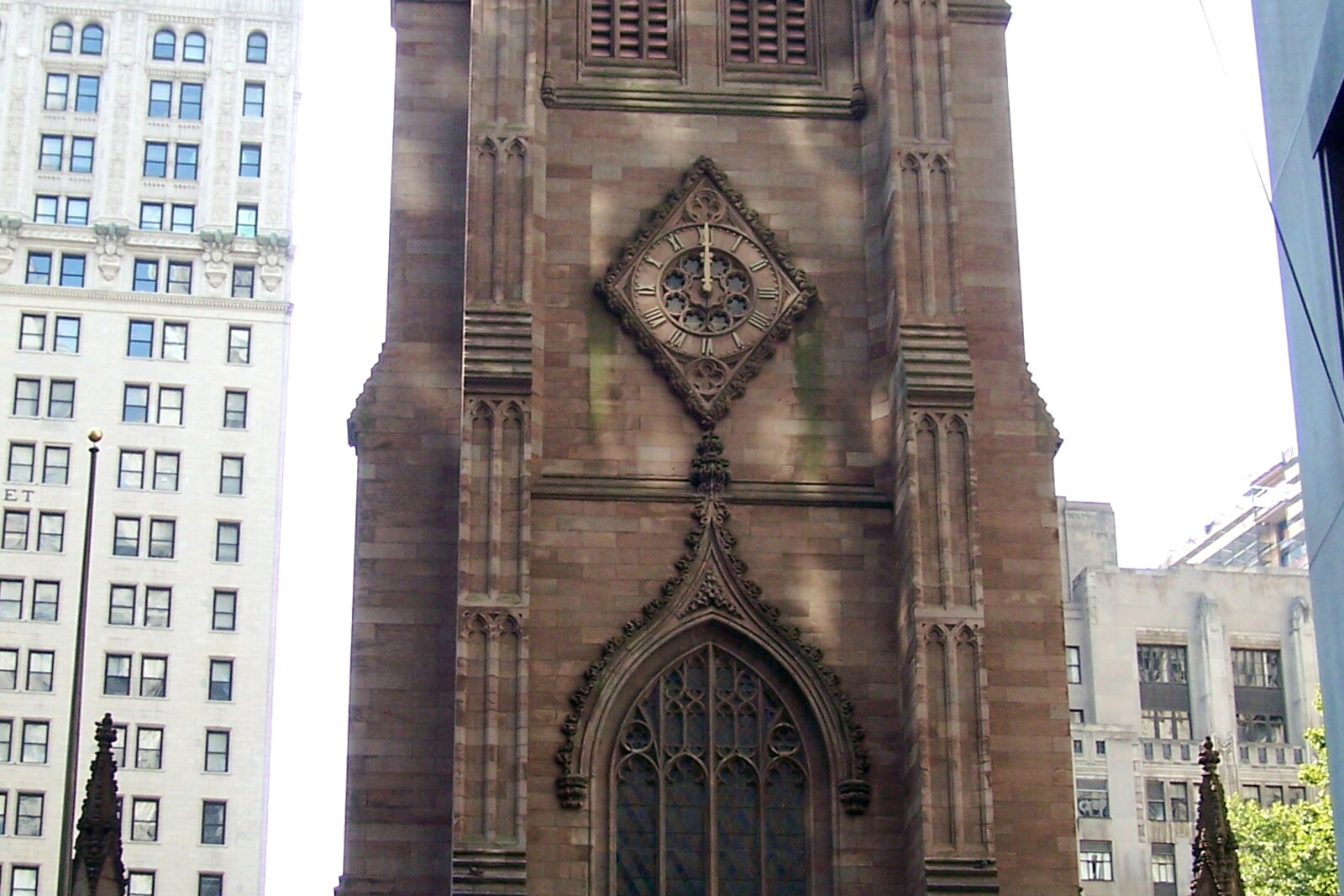
Look around first
What to notice
- Stone church walls
- Entrance portal
- Tall church tower
The story of the place
The tall stone tower above the entrance portal belongs to the third Trinity Church, consecrated in eighteen forty-six. Within these walls gathers the congregation of Manhattan’s first official Anglican parish. The parish council divided land on the western side of the island into plots, leased them out, and filled its treasury with rent along with donations. The parish archive holds a royal charter with a red wax seal that secured the rights and property of this congregation.
On March twentieth, seventeen seventy-seven, the priest Charles Inglis laid his palm on a scorched wall. The wall was all that remained of the first Trinity Church, built on this site in sixteen ninety-eight. The church itself no longer existed: six months earlier, it had burned down in the Great Fire of New York.
Members of the parish council stood nearby. The warden, Elias Desbrosses, spoke an old legal formula and installed Inglis as the fourth rector—handing him “actual and corporeal possession” of the church, its rights, income, and property. There was almost nothing to hand over physically, so Inglis held on to the surviving masonry.
The position involved a very earthly estate. Trinity Church was Manhattan’s first official Anglican parish and existed under a charter from King William the Third of England. Queen Anne later granted the parish two hundred fifteen acres on the western side of the island; the parish council divided the land into plots and collected rent. While still an assistant priest, Inglis received two hundred pounds a year here, along with voluntary donations. The rector was assigned a salary of three hundred pounds, leadership of the congregation, and a role in managing this property.
Inglis worked to keep the parish part of the Church of England and to continue worship under its rules. In the spring of seventeen seventy-six, George Washington came here for a service. Before it began, one of the Continental Army generals asked that prayers for King George the Third and the royal family not be read. For an Anglican priest, such a prayer followed from the oath given at ordination. Inglis ignored the request, although he later admitted that Washington himself had probably not ordered it.
After independence was proclaimed, officers demanded the keys to Trinity Church. Inglis refused again, and the parish soon closed its churches. British troops then occupied New York City; fire destroyed the church and its rector’s house, but Inglis remained to minister and was promoted amid the ruins.
His choice had a time limit—until the end of the war. The New York State legislature declared Inglis and his wife guilty of supporting the enemy, confiscated their property, and permanently banished them from the state. Returning was punishable by death. In November seventeen eighty-three, before the British left New York City, Inglis resigned his post and departed for Canada. Four years later, he was consecrated the first bishop of Nova Scotia.
The returning parishioners who had supported independence now risked losing all of Trinity Church: the parish, its land, and its rules of governance all stemmed from a royal charter. They challenged the selection of Inglis’s successor, secured the appointment of temporary trustees, and invited Samuel Provoost—a former priest here who had taken the side of independence—to become rector. On April seventeenth, seventeen eighty-four, the legislature rewrote the charter: it removed subordination to the English Crown and vested parish property in the church corporation itself. After that, Trinity Church became an Episcopal parish of the new country and was able to build a second church on the former site.
The wall Inglis touched is gone. The present church was consecrated in eighteen forty-six; it is the third Trinity Church building on this site. The parish archive still holds the royal charter of sixteen ninety-seven with its red wax seal, and services continue in the church whose right to remain here the parishioners formally secured again after Inglis’s departure.
Useful on site
According to Trinity Church, the church is open to visitors daily from 8:30 to 18:00, and the churchyard from 8:30 to 16:00. Access may be restricted because of weather, construction, and services; security screening is in place.
Checked: June 15, 2026. Check the official source before visiting.Move calmly through the cemetery and do not disturb services or private visits. If access to the graves is closed, the monuments can be viewed from behind the fence.