 Guide On Map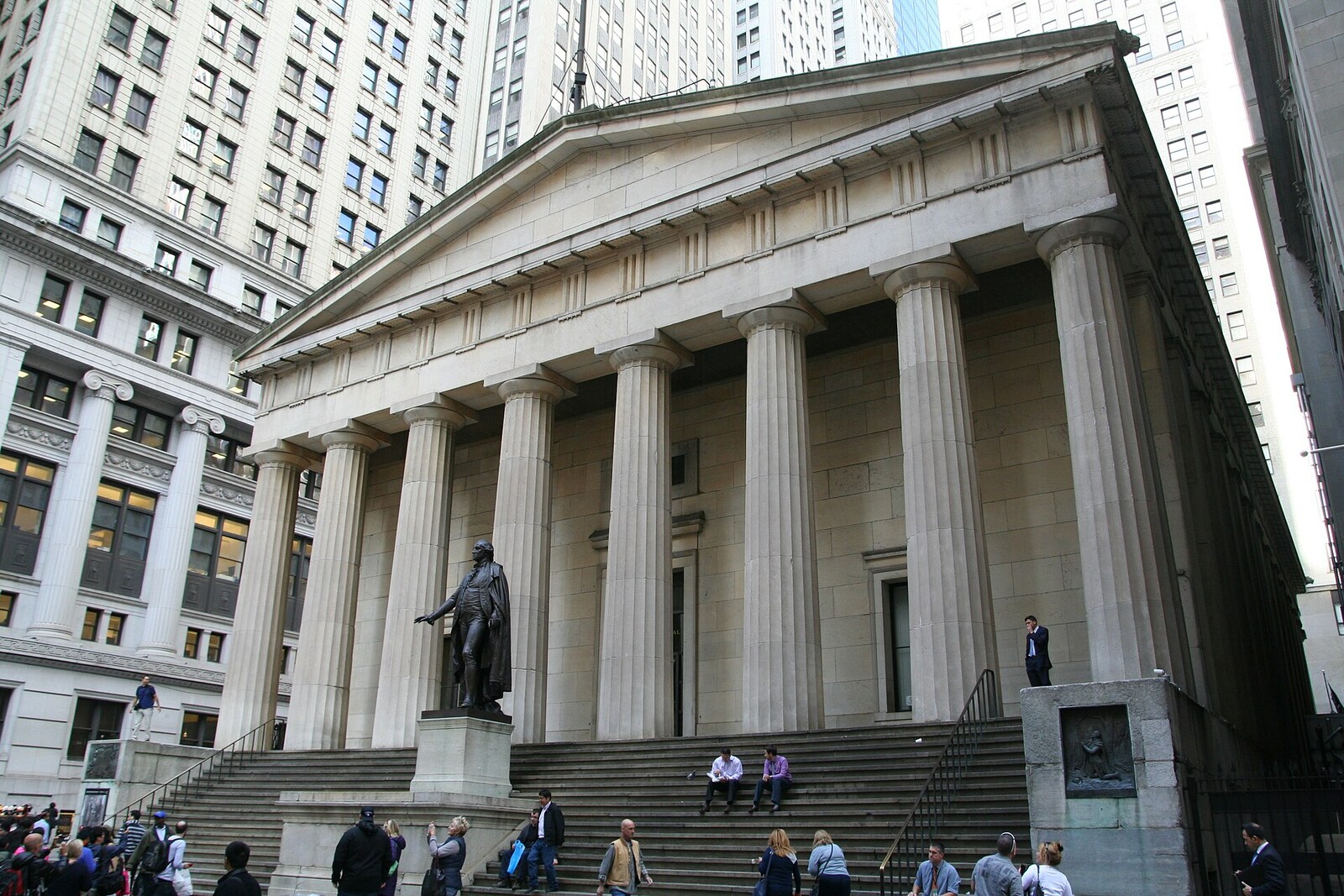
Look around first
What to notice
- Marble portico
- Bronze statue of Washington
- Rotunda
- Cracked floor slab
The story of the place
Beneath the marble portico stands a building that first served as the federal customhouse for goods arriving in New York City harbor. Later, gold and silver of the Subtreasury were kept in its underground vaults. Its present name preserves the memory of the former Federal Hall—the remodeled New York City Hall that stood at this corner of Wall Street and Nassau Street. The bronze figure at the steps recalls that the old building is gone, while the site has retained its governmental significance.
Here stands the white-marble Federal Hall with columns. On March fourth, seventeen eighty-nine, George Washington, the former commander in chief, who was almost certain to be declared the first president of the United States, asked an Alexandria merchant, Richard Conway, for a loan.
Washington owned land, but he lacked cash. He received income from crops and rents; the Mount Vernon estate depended on the labor of enslaved people. After several poor harvests, tenants delayed their payments, while land could be sold only for far less than its value. Washington asked for five hundred pounds at interest, to settle debts in Alexandria and to be able to leave Virginia if he were not allowed to remain a private citizen.
After the war, he had already returned command of the army to the United States Congress. Now he was to take an office that had never existed before. Washington feared leaving his peaceful life and failing to meet the expectations of people who greeted him as a victor. But he considered it impossible to refuse after the electors' unanimous decision.
The new government was meant to begin work on March fourth itself, in the building on this site. Yet the members of Congress could not assemble a quorum for more than a month. Only on April sixth did they count the votes, and on April fourteenth a messenger delivered Washington the official notification.
New York City then served as the nation's capital. To keep the capital here, the city authorities commissioned Pierre L'Enfant to remodel the old New York City Hall at the corner of Wall Street and Nassau Street. After the renovation, it was called Federal Hall—a federal hall intended for the United States Congress, the president, and the first government institutions of the new federation.
The name Wall Street is much older. In sixteen fifty-three, Peter Stuyvesant, director of the Dutch colony, ordered a wooden palisade built along the northern boundary of New Amsterdam. It was built in part by enslaved Africans. The fortification crossed Manhattan from the East River to the Hudson River. The English dismantled the palisade in the late seventeenth century, but the street laid out along its line was called Wall Street—the street of the Wall. A city hall soon rose there, and ninety years later it became Federal Hall.
By April thirtieth, even the order of the inauguration remained unclear. Vice President John Adams pressed for a ceremonial form of address for the head of state. The senators liked the option “His Highness, the President of the United States of America and Protector of Their Liberties.” The United States House of Representatives refused, and those involved settled on the short title “President of the United States,” which has remained.
On the day of the ceremony, they forgot to send an escorting delegation for Washington in time, so both houses waited for about an hour. At last, he passed through the United States Senate and stepped onto the second-floor balcony above Wall Street. Robert R. Livingston, the Chancellor of New York and the state's highest judicial officer, administered to him the oath set down in the U.S. Constitution. Washington then returned to the hall and delivered the first presidential address—slowly and visibly nervous.
He held the office for eight years. In seventeen ninety-seven, Washington handed it over to John Adams and returned to Mount Vernon.
The building where the ceremony took place was demolished in eighteen twelve. The white-marble building with columns did not open until eighteen forty-two, as a federal customhouse; later, gold and silver of the Subtreasury were kept in its basement vaults. Its present name was given to it as a memorial to the former Federal Hall.
The bronze Washington was installed roughly where the vanished balcony had stood. Inside the rotunda lies a brown slab from its floor. When it was moved, it cracked, and beneath a later cement covering the original stone was revealed—the very stone on which the man who had borrowed money for the journey took the first presidential oath.
Useful on site
Federal Hall National Memorial is open year-round according to the NPS; admission is free, and visits are currently organized on weekdays; the program schedule and internal arrangements may change. The accessible entrance and ramp are on the 15 Pine Street side; security screening may be required at the entrance.
Checked: June 15, 2026. Check the official source before visiting.First, look at both sides of the intersection from the street. Check separately whether it is possible to enter Federal Hall; security screening or a closed entrance does not prevent you from hearing the main account.