 Guide On Map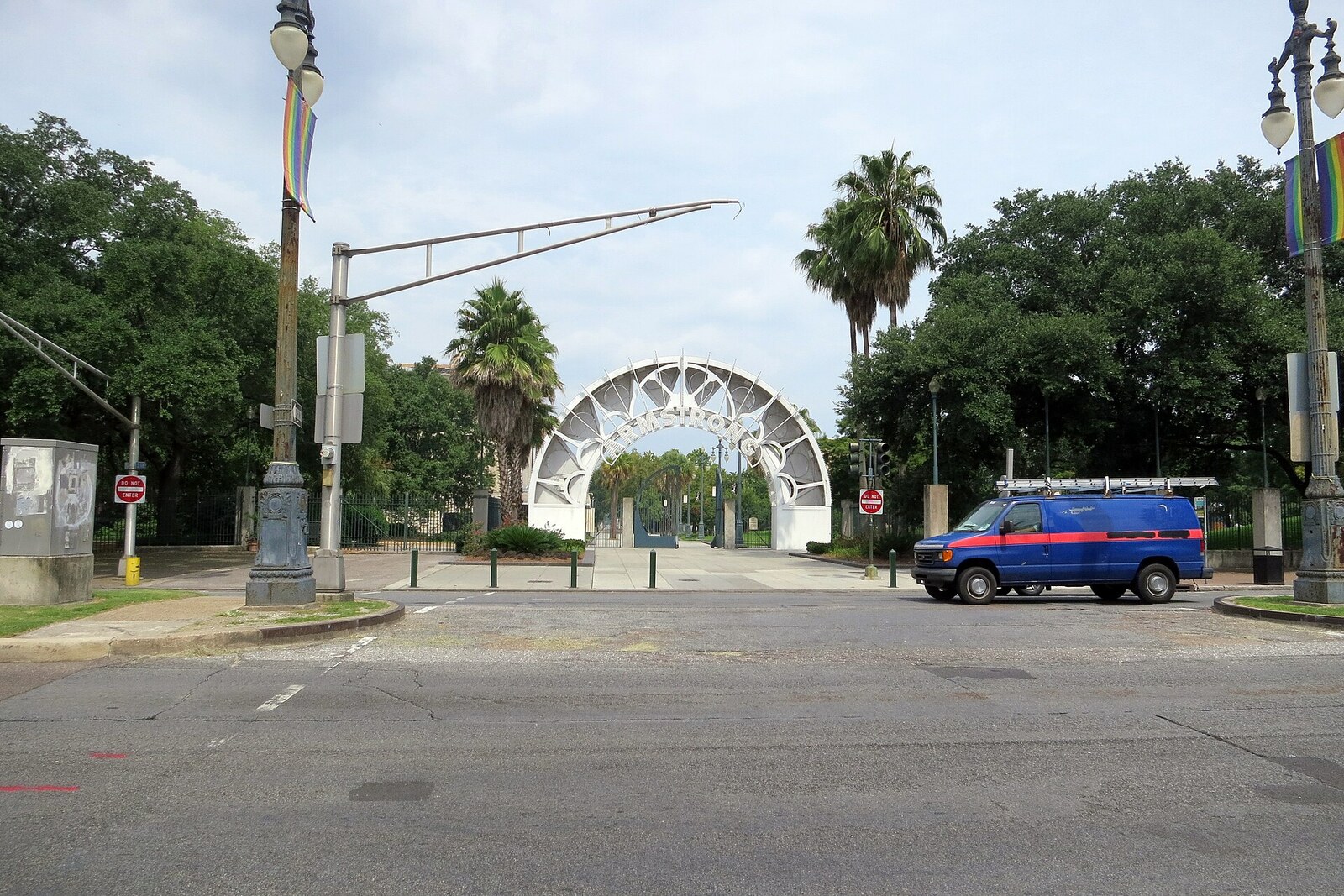
Look around first
What to notice
- Round brick square
- Brick circles
- Gates bearing the name Louis Armstrong
The story of the place
The round brick square beyond the gates is Congo Square. Two hundred years ago, there was no arch, no fountains, and no park paths here. Beyond the line of the old city rampart lay open public land. In eighteen seventeen, municipal officials designated it as a place where enslaved residents of New Orleans could gather on Sundays.
The Code Noir, a body of laws governing slavery, had exempted Sunday from ordinary work since seventeen twenty-four. It did not grant freedom or the right to gather. People met anyway by the levees, in courtyards, and on plantations. A city ordinance permitted dancing and entertainments only on Sundays, before sunset, and where the mayor directed. A gathering elsewhere could end in arrest and whipping. The open tract beyond the rampart allowed police officers to keep the entire crowd in view.
Field laborers, domestic servants, craftsmen hired out by their owners, and free Black city residents came here. Mostly women traded around the square. They brought what they had grown, caught, or prepared themselves: calas rice fritters, pies, pralines, roasted peanuts, coffee, and ginger beer. For an enslaved woman selling goods, Sunday earnings were a rare sum she could control. Such earnings were also saved toward buying freedom from slavery, either for oneself or for someone close.
Between the market rows, people formed circles. In the middle, people danced and musicians played; those standing outside clapped, answered the song leader, and relieved tired dancers. People from Senegambia, Benin, Kongo-Angola, and the Caribbean Islands brought different languages, religious rites, rhythms, and instruments.
On a Sunday in eighteen nineteen, the British architect Benjamin Henry Latrobe, who had come to oversee construction of the city waterworks, counted five hundred or six hundred people here. He sketched two drums and a stringed instrument with a body made from a dried gourd. An elderly man played it, probably remembering a musical tradition from before his arrival in Louisiana. Latrobe regarded the performance with contempt, but he recorded something else as well: there was no disorder, and none of the city residents he questioned could recall any harm from these weekly gatherings.
Later, violins, triangles, and tambourines joined the drums and African stringed instruments. Participants combined African and Caribbean techniques familiar to them with European melodies. Public dancing here ended before the American Civil War, but the related rhythms, call and response between song leader and chorus, and the way of building music around a dancing circle continued to be heard in Black neighborhoods, among Mardi Gras Indians, in brass bands, and in street processions. Historians do not trace all of jazz back to a single square, but they regard this as one of the places where African musical practice remained public for the longest time and entered the music of New Orleans.
The word “Congo” became attached to these performances as early as the colonial era: old accounts call the dance “Congo,” and by the eighteen eighties Congo Square appears on maps. The name does not mean that everyone who gathered came from one land. It preserved the memory of people from Kongo-Angola and of the dances city residents associated with them.
Louis Armstrong could not have seen these Sunday gatherings: the New Orleans trumpeter was born only in nineteen oh one. In his recordings, he brought the improvising soloist out of the ensemble and into the foreground, becoming one of the musicians through whom jazz was heard around the world. In nineteen eighty, the city dedicated a park and a statue to him. That is why Armstrong’s name is written on the gates: it refers to the whole park and to the later history of New Orleans jazz, not to the old dances in the square.
Nothing remains from those gatherings: no stalls, no instruments, and no original surface—this was open ground then. The brick circles were laid when the park was created, repeating the arrangement of the dancing circles in Latrobe’s drawings. Sunday drum circles now gather on this paving.
Useful on site
The park is open daily: 8:00—18:00 in winter, 8:00—19:00 during daylight saving time. Checked 2026-06-30.
Checked: June 30, 2026. Check the official source before visiting.If the entrance is closed, listen to the story at the gates and do not try to go around the barrier. On the square itself, keep a passage clear for visitors and events.