 Guide On Map
Tremé: music, memory, and the fight for a place
From Congo Square through Tremé to Dooky Chase’s Restaurant
Guide On Map on your phone
Open the walk like a regular app
It takes about 10 seconds to install. No app store needed.
The whole path
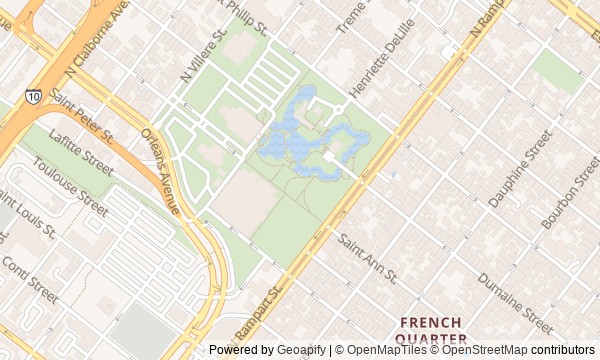
Route map
About the walk
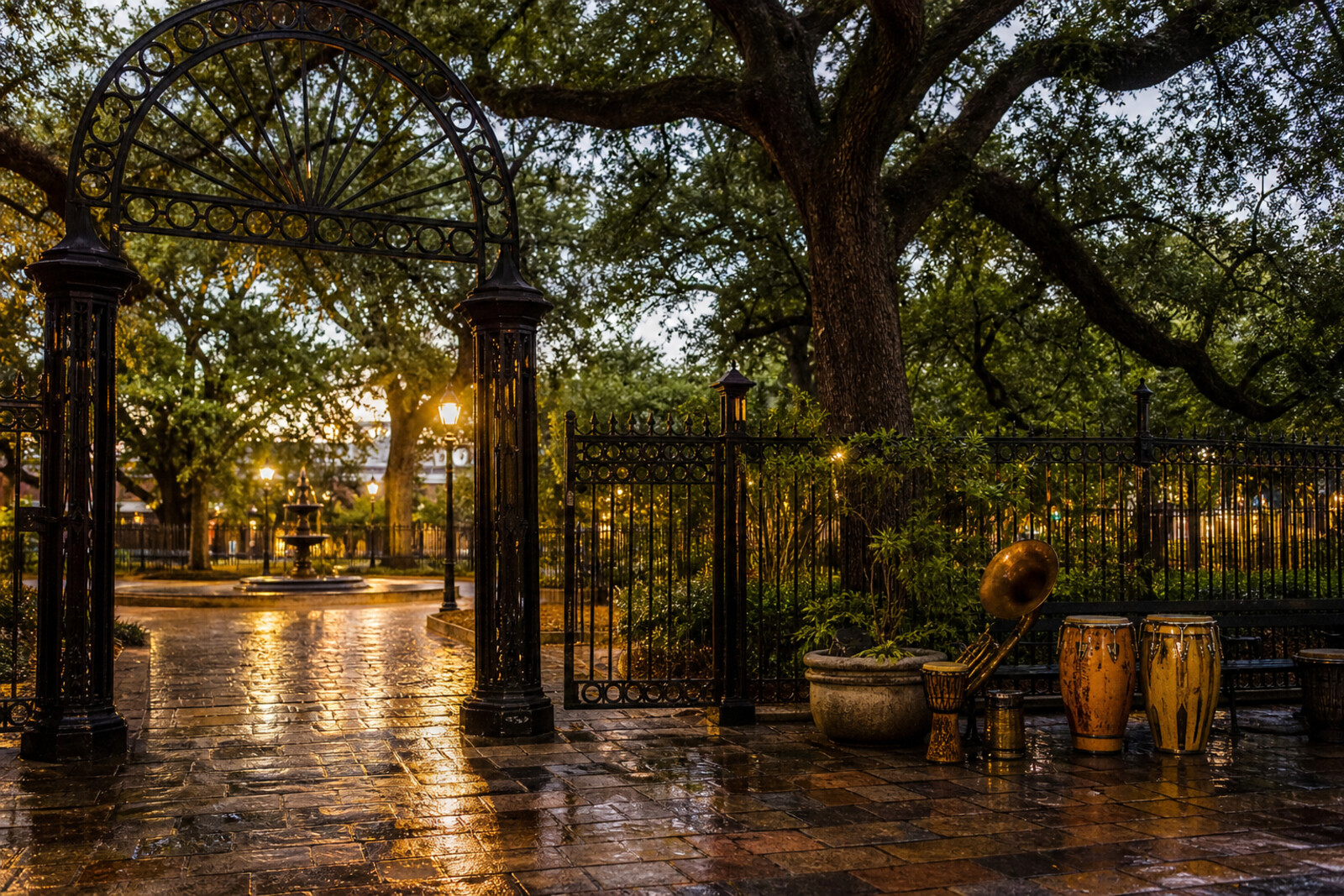
You will begin on the open brick square in Louis Armstrong Park, then walk to a surviving Masonic hall and out onto the streets of Tremé. Ahead are a church, a small museum, the concrete underbelly of an overpass, and a restaurant with an upstairs room.
This is not a walk through clubs or grand jazz landmarks. Music appears here as the right to gather, earn a living, walk down your own street, and be heard. Why did the city allow dancing in only one place? Why did a family buy a church pew for someone who could not afford one? What was carried out of a museum after its roof gave way? The answers stay inside the stories.
The approach is calm and precise: documents, visible details, and human actions, without the legend of “jazz being born in one place.” By the end, you will read Tremé through a brick circle, side pews, a ceremonial costume, and oak trees painted on concrete—and explain why this neighborhood’s music is preserved in more than notes.
Why this order
Congo Square sets the opening scene: music is allowed into public space, but kept under watch. Right after it, Perseverance Hall No. 4 reveals the next step in the same story—musicians are already being hired for long-distance trips. From the block cleared for the park, the route reaches a church where the fight for a place becomes a literal fight over pews. Nearby, the museum continues the story of community: after the memory of people whose names were not preserved come objects saved by neighbors and carried into a new building. Then St. Philip Street leads to North Claiborne Avenue: costumes and second lines leave the museum rooms for a street cut off by an overpass. The final walk to Dooky Chase’s Restaurant completes the thread at a business that survived when neighboring establishments did not, and provided a room for the struggle against segregation.
Those who want to understand New Orleans music beyond clubs and stages Those who care about the stories of Black Tremé and its community institutions Fans of routes where buildings and street details bear out the story
Those expecting only biographies of famous musicians Those looking for an easy walk without the subjects of slavery and segregation Those interested above all in the architecture of the French Quarter
Before you go
Choose daylight hours and comfortable shoes: much of the story unfolds on the street rather than indoors. Before setting out, check access to the park, museum, and church separately—events, services, and site conditions can change their usual hours. Plan Dooky Chase’s Restaurant as a separate restaurant visit and arrange a table in advance; the route stop itself does not give you the right to enter without a reservation. Keep quiet at the memorial, do not record sound during services, and do not photograph worshippers without consent. Tremé remains a residential neighborhood: do not block sidewalks or treat processions, costumes, or local residents as scenery.
When to go
Allow about two hours for the walk without visiting the museum or eating. With a museum visit and lunch, the route takes about three hours.
Backup plan
If the park is inaccessible, begin at the gates: the story of the square can still be read through the boundary between the city and the permitted gathering place, and you can return to the square later. If the museum is closed, look at the house from outside and shift your attention to the next stop, where processions and community memory continue to live in street space. If you cannot enter the church, do not try to get inside during a service—the memorial and the parish’s history remain a complete part of the stop. Without a table at Dooky Chase’s Restaurant, end the walk at the facade; it is better to postpone the restaurant visit than turn a working dining room into a walk-through museum.
Route conditions
Surface. Paved — 1.8 km (data covers 82% of the route)
Facilities. Drinking water — 2
Elevation. Ascent — 1 m; descent — 2 m
OpenStreetMap extract of June 25, 2026: database data, not a check on the ground. Data © OpenStreetMap contributors, ODbL licence
Walk plan
Open in maps ↗- 1
Congo Square
This is where the conversation begins about why police oversight did not stop the transmission of musical techniques. - 2
Perseverance Lodge No. 4
The surviving hall will link the city’s dances to musicians’ work on river steamboats. - 3
St. Augustine Church and the Tomb of the Unknown Slave
The purchase of church seats explains how free people of color secured places for their enslaved neighbors as well. - 4
Backstreet Cultural Museum
The rescued collection will show how residents preserve tradition not only in objects, but also in parades. - 5
North Claiborne Avenue beneath Interstate 10
Here, the scale of the change that road construction brought to Tremé’s commercial and community street becomes visible. - 6
Dooky Chase’s Restaurant
The finale moves the struggle from the street to the room where nonviolent actions against segregation were prepared.
Route features
Everything you need stays in the browser
Progress, saves and your trip plan are stored on this device.
Add Guide On Map to your home screen so the walk opens outside the browser.
How we handle sources, maps and corrections: our editorial standards