 Guide On Map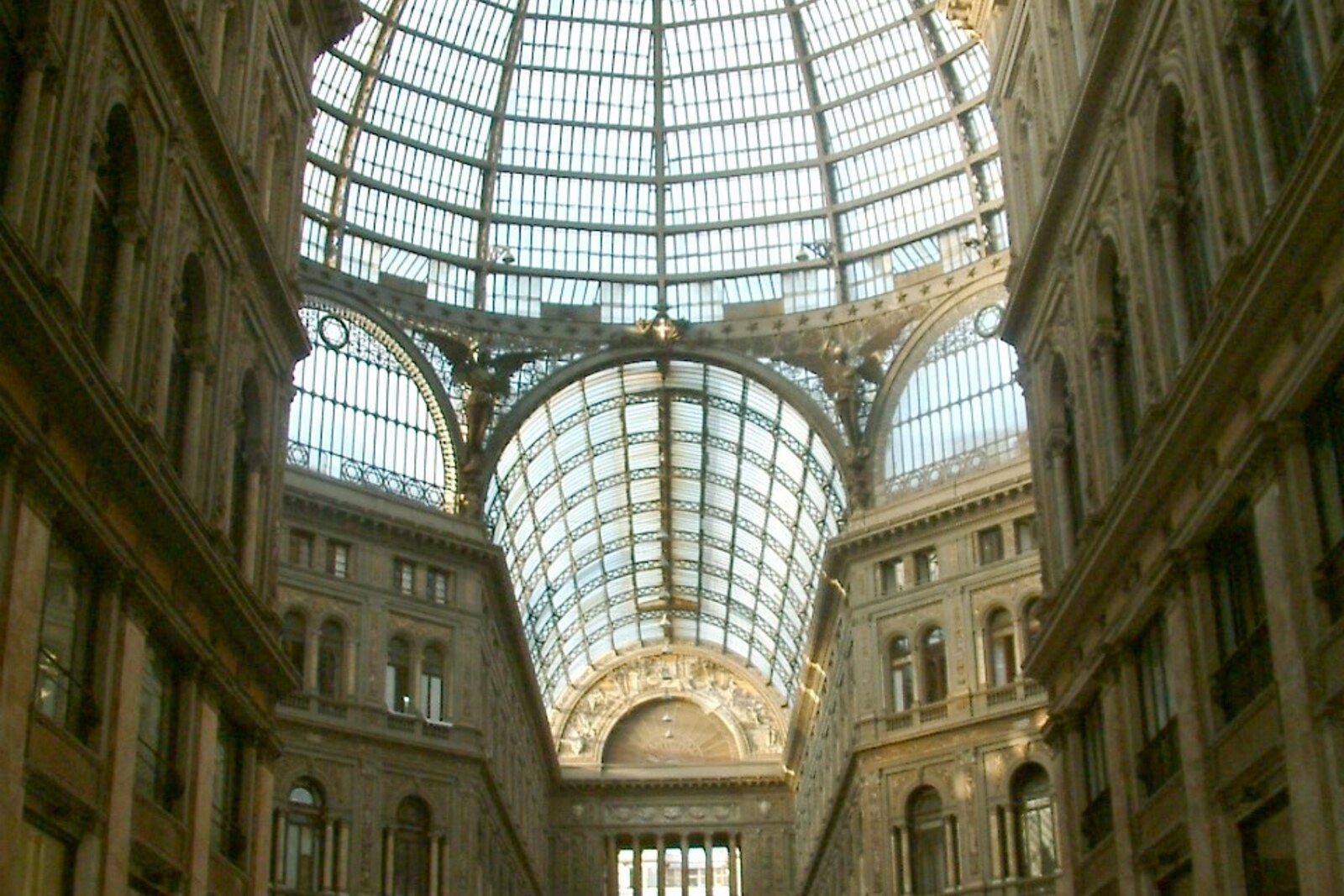
Look around first
What to notice
- Glass roof
- Central octagon
- Four multistory buildings
- Memorial plaque at number twenty-seven
The story of the place
In one of the Galleria's buildings, Matilde Serao founded a daily newspaper with her husband, and twelve years later—after breaking with him—founded a second one, so that she could once again have an editorial office of her own.
In eighteen ninety-two, Serao and the journalist Edoardo Scarfoglio published the first issue of Il Mattino—“The Morning.” They lived by newspaper work and hoped to turn the new publication into the leading daily newspaper of southern Italy. The editorial offices were housed in a Galleria building, and a rotary printing press was installed in the basement: paper fed into it in a continuous roll, so the print run could be produced faster than in the earlier sheet-fed newspapers.
This proximity of offices, a printing shop, and stores was built into the very design of the Galleria. The glass roof spans two intersecting streets, and four multistory buildings stand around the central octagon. From the beginning, space here was rented to merchants, editorial offices, hotels, and residents. The grand hall also served as a passage through the city.
Serao knew what had been here before. In eighteen eighty-four, during the cholera epidemic, she published articles about Naples's poor districts. At the time, the Santa Brigida district crowded this site: tall houses without courtyards stood along several narrow alleys, and entire families lived in the lower rooms. While officials promised to improve the city's health through demolitions, Serao carefully recorded how residents earned their living, what they could buy with a day's income, and why relocation alone would not free them from poverty. The articles became the book The Belly of Naples.
After the epidemic, the houses of Santa Brigida were demolished. Covered passageways were laid out on the cleared site, and the Galleria opened in eighteen ninety. It was named after Umberto I, the second king of united Italy. At the height of the cholera epidemic, he came to Naples and visited the sick, though he risked infection; the name became an expression of gratitude for this visit and for his help to the city. The king did not build the building—his name preserved the reason that set the redevelopment of the district in motion.
Serao became editor of a newspaper inside the main building of the very redevelopment program whose consequences she continued to dispute. But then her marriage broke down, and with it the publishing partnership. Scarfoglio kept Il Mattino, while Serao left the editorial office they had created together.
She moved only a few dozen meters. In nineteen oh four, her new newspaper, Il Giorno, “The Day,” began publication at number twenty-seven in the same Galleria. Serao became the first woman in Italy to found and lead a daily newspaper, and she ran it until her death in nineteen twenty-seven. In the new edition of The Belly of Naples, she returned to the city's redevelopment: wide streets and expensive façades had already appeared, while the old overcrowded houses remained immediately behind them.
There are no longer printing presses in the basements. A plaque at number twenty-seven commemorates the editorial office of Il Giorno, and the former passageway of Vico Rotto San Carlo behind the Galleria is now called Piazza Matilde Serao. Above the grand entrance remains the name of the king who came during the cholera epidemic; by the rear building is the name of the journalist who investigated what came of the demolitions.
Useful on site
The official city portal gives the Galleria's opening hours as 08:30–20:30 on weekdays and 08:30–22:00 on Saturday and Sunday; admission is free. Shops and individual spaces have their own hours.
Checked: June 29, 2026. Check the official source before visiting.First take in the dome from the center, then step back toward one of the arms for an overall view. After rain, the smooth floor may be slippery.