 Guide On Map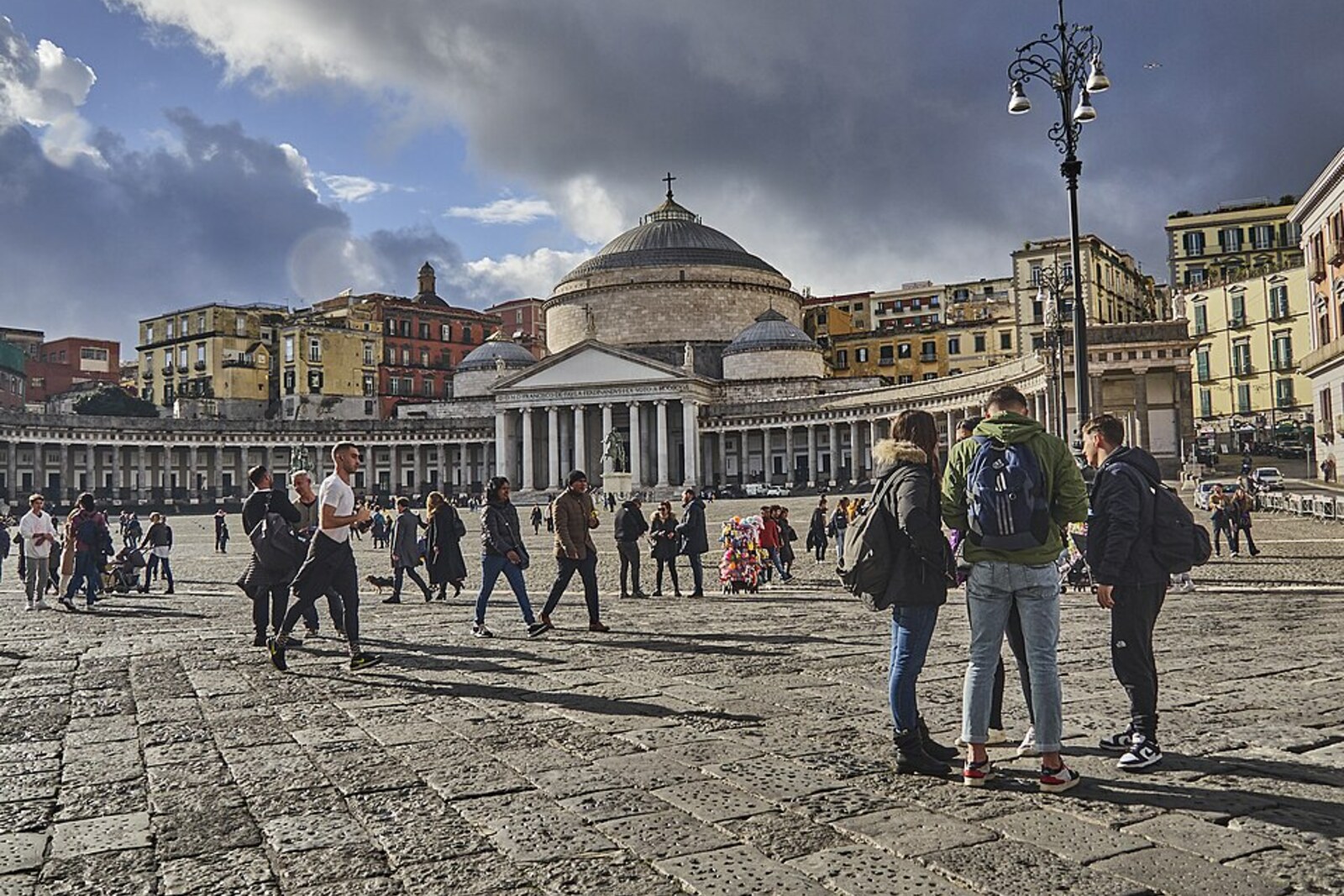
Look around first
What to notice
- The basilica with its semicircular colonnade
- Royal Palace of Naples
- The square’s open space
The story of the place
This open square before the Royal Palace of Naples was once called the square by the palace. The semicircular colonnade arose as part of the plan for a large public forum, where city residents could gather before the seat of power. Later, a basilica was built at the center of the arc as a sign of gratitude for the return of the ruling dynasty. The church steps, columns, and palace façade still leave a broad space between them for ceremonies, concerts, and celebrations.
On October twenty-first, eighteen sixty, three urns were placed beneath the colonnade of the Basilica of San Francesco di Paola. The side urns held ballots marked “yes” and “no”; the middle one was left empty. A man over twenty-one who possessed civil rights took the slip he chose and dropped it into the middle urn. This procedure made no provision for secret voting: officials, neighbors, and companions could see which answer a hand reached for.
Until recently, this space was called Largo di Palazzo—the square by the Royal Palace of Naples. The last Bourbon king, Francis II, had left Naples and was trying to keep his crown by defending himself in Gaeta Fortress. Giuseppe Garibaldi, commander of a volunteer army, had taken the capital and was governing the conquered provinces as dictator. Now it had to be decided whether they would join a united state headed by Victor Emmanuel II, King of Sardinia.
Voters were asked one question: did the people desire a united and indivisible Italy, with Victor Emmanuel as constitutional king and with his lawful descendants? Property qualifications were required for parliamentary elections at the time, but all adult men with civil rights were admitted to the plebiscite. Artisans, clerks, and manual laborers came in groups—by profession, workplace, or neighborhood. Their earnings depended on the same employers, clients, and neighbors in whose sight they chose a ballot. The plebiscite was conceived as a public confirmation of a change that had already taken place, so an open choice was then considered part of the ceremony, although it also made it possible to monitor voters.
Two weeks later, people gathered in the square again for the announcement of the overall result in the mainland provinces of the former Kingdom of the Two Sicilies. On November third, Vincenzo Niutta, president of the Supreme Court, climbed onto a specially built wooden platform. He had been charged with giving the count official force. Niutta announced: one million three hundred two thousand sixty-four votes for unification, ten thousand three hundred twelve against.
After the announcement, Victor Emmanuel entered Naples, Garibaldi handed over authority to him and left for the island of Caprera. Francis II held out in Gaeta until the following February, then went into exile. In March eighteen sixty-one, parliament proclaimed the Kingdom of Italy. The square was given the name Plebiscite—the direct vote whose result Niutta announced here.
The site for the platform was not chosen arbitrarily. The semicircular colonnade was commissioned by Gioachino Murat, the Napoleonic marshal who became king of Naples and wanted to create a large public forum before the palace. Murat was overthrown and, after an unsuccessful attempt to regain the crown, was shot. The restored Bourbon king Ferdinand I retained the arc of columns, but ordered a basilica built at its center in gratitude to Saint Francis of Paola for the restoration of the dynasty. A few decades later, ballots were laid out beneath the portico of this church, and from the square in front of it the end of the Kingdom of the Two Sicilies was announced.
Niutta’s wooden platform has long been gone. What remain are the basilica steps, the colonnade, and the façade of the Royal Palace of Naples opposite. City ceremonies, concerts, and large celebrations are still held between them, and the name recalls the day when the vote totals were read aloud before the palace.
Useful on site
Open around the clock, an open square. The interiors of the Basilica of San Francesco di Paola and the Royal Palace of Naples have separate hours and are not part of the required walk.
Checked: June 29, 2026. Check the official source before visiting.To take in the whole ensemble, move to the edge of the square; in hot weather, do not count on shade in the center. Try the closed-eyes game only with someone accompanying you and away from traffic.