 Guide On Map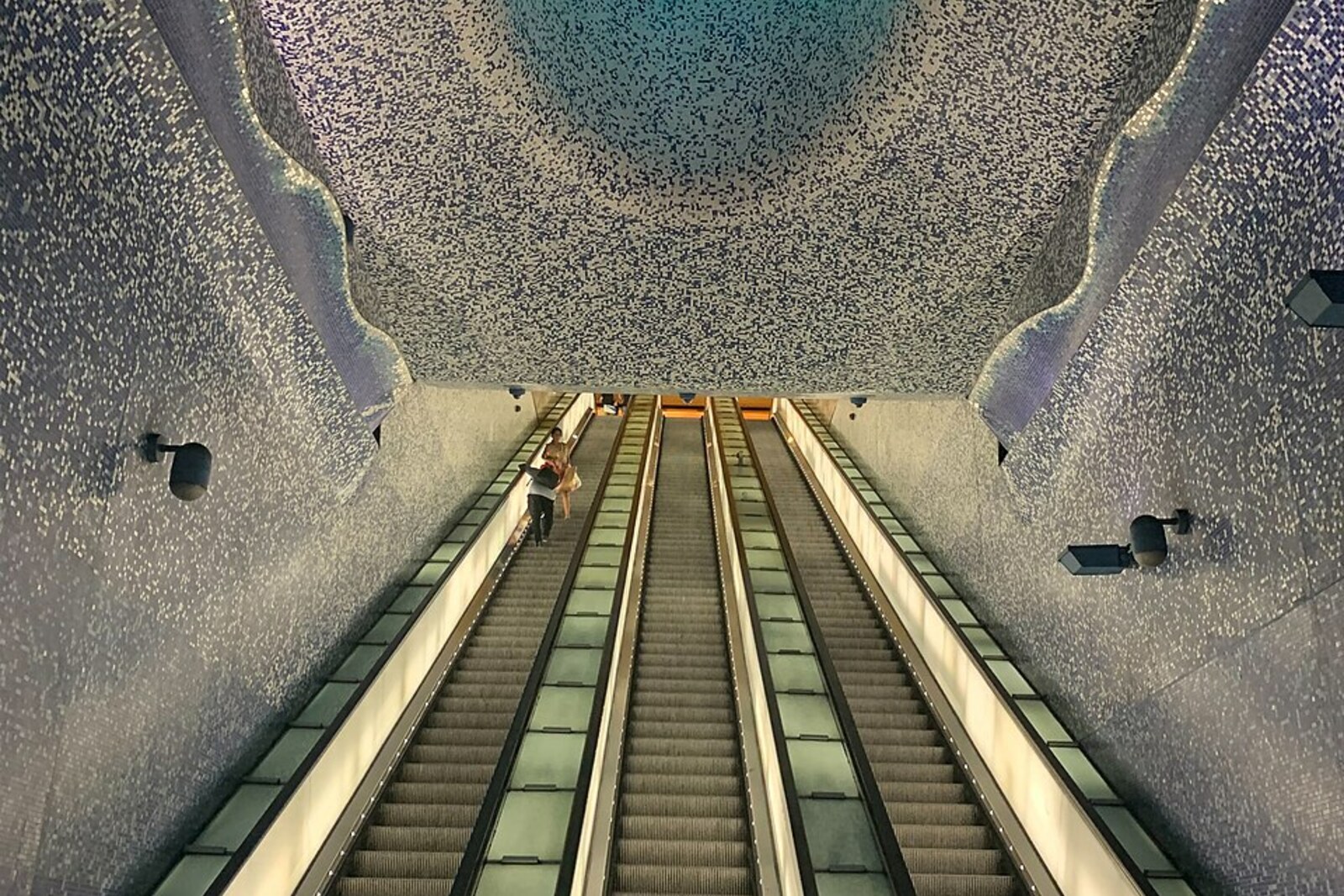
Look around first
What to notice
- The oval opening of the “Crater de Luz”
- Blue glass mosaic
- A fragment of the Aragonese wall
- Images of the sea surface
The story of the place
The station is named after Via Toledo, laid out by the Spanish viceroy Pedro Álvarez de Toledo between Naples's two main squares. The platforms lie about fifty-three meters below the street, and some halls are already below sea level. The descent is composed of urban layers: black asphalt at the entrance, ocher tuff deeper down, and blue glass mosaic covering the walls below. Above the escalators, the oval opening of the Crater de Luz runs upward, and daylight reaches down through it.
In the two thousands, when the Catalan architect Oscar Tusquets Blanca arrived at the construction site, which had already begun, a technical shaft about forty meters deep gaped above the future station. A crane pulled through it the tuff excavated during the tunneling. Once the work was finished, they intended to fill in the void.
Tusquets was invited as the station's designer, and he proposed changing the structure: to close the shaft only partially, leaving passengers a view of the surface. The decision had to be made while construction was underway, not at the finishing stage. The architect wanted the depth to stop being an abstract number: from the lower hall, a strip of daylight was to remain visible above.
This is how the “Crater de Luz” appeared—a name meaning “crater of light.” Its oval opening passes through several levels above the escalators. The Toledo platforms lie about fifty-three meters below the street, and a substantial part of the station is below sea level. Tusquets turned the descent into a conventional cross-section of Neapolitan ground: at the entrance he retained the black of the city's asphalt, lower down he introduced the ocher of tuff, and below sea level he covered the walls with blue glass mosaic. A fragment of the Aragonese city wall found during the excavations was incorporated into the upper vestibule.
For the lower section, Tusquets insisted on inviting the theater artist Robert Wilson. Wilson installed two long images of the sea surface in the passageway and wrote a program that changes the color and brightness of the LEDs inside the crater over time. This is why the blue shaft looks different depending on the daylight and the lighting.
The station's name repeats that of the street above. In fifteen thirty-six, the Spanish viceroy Pedro Álvarez de Toledo ordered this street laid out to link Naples's two main squares.
The oval blue opening above the escalators is the very part of the working shaft that, under the original plan, was to have been filled in.
Useful on site
Operates according to the schedule of Metro Line No. 1. As of 2026-06-29, the operator had announced summer restrictions on the northern section of the line; Toledo Metro Station was not listed as closed, but check current notices before going down.
Checked: June 29, 2026. Check the official source before visiting.The main works are inside the station and partly beyond the turnstiles, so a Metro ticket is needed for a full visit. Do not stop on the escalators to take a photo.