 Guide On Map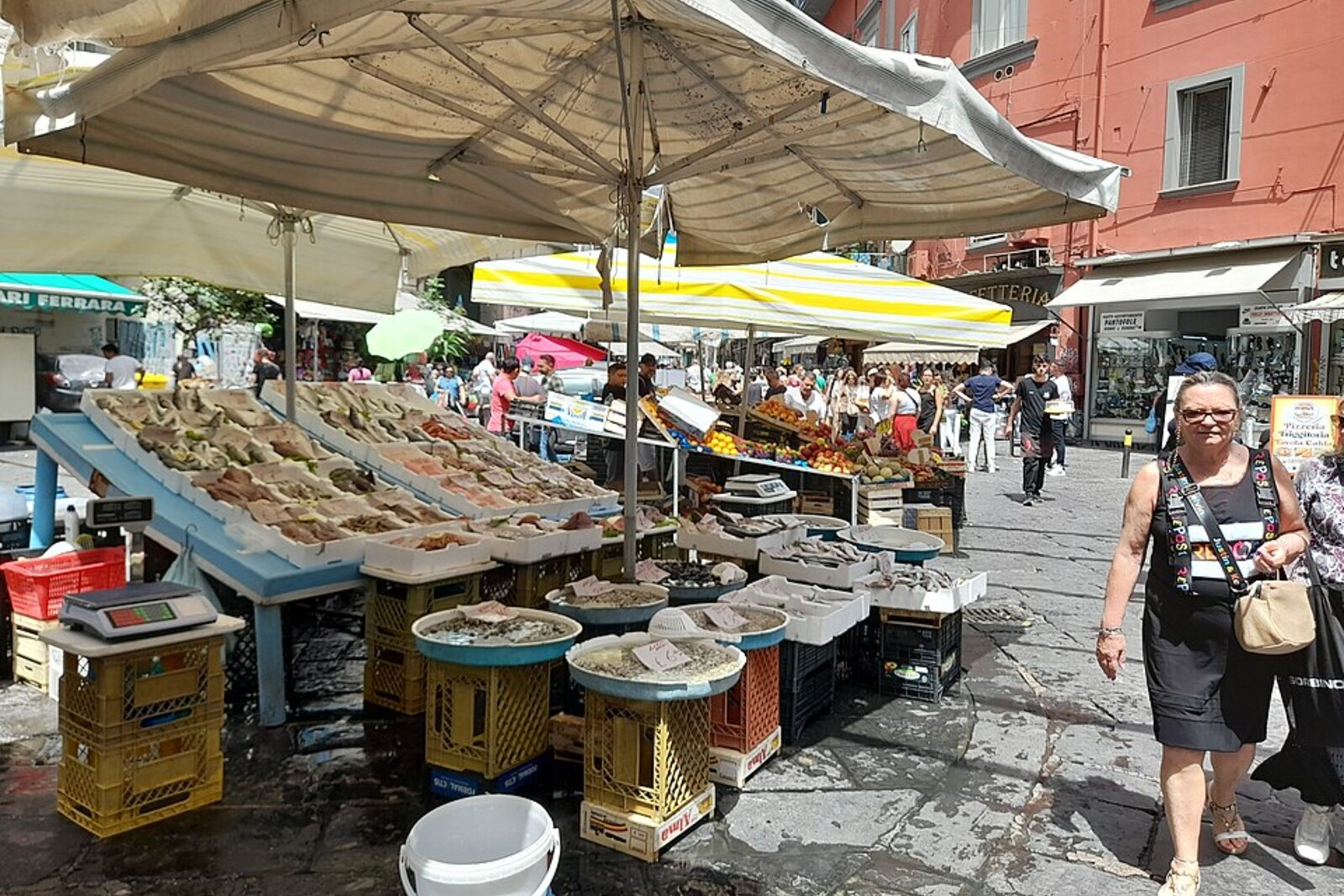
Look around first
What to notice
- Fish counters
- Vegetable crates
- Marble inscription about Porta Medina
The story of the place
Fish counters, vegetable crates, shops selling cold cuts and cheese, roasting pans, and household goods stretch along Pignasecca and Via Portamedina. This market is arranged as a long passage between Piazza Carità and Montesanto. Trade depends on the flow of people that passed through here long before the railways appeared.
The name itself refers to a vanished landscape. In the sixteenth century, the gardens of the Pignatelli family lay here. When Via Toledo was laid out in fifteen thirty-six, the green plots began to be cleared. According to one version, a single pine survived, only to dry out later. In Neapolitan, a pine was called “pigna,” so Pignasecca means “dry pine.” There is no reliable record of this tree: the origin of the name remains a local tradition.
The city wall better explains why the market appeared. As early as the fifteenth century, people and goods from Vomero came down toward Piazza Carità. Near present-day Montesanto, fortifications blocked the route. To get inside, they had to go to Porta dello Spirito Santo, another entrance to the city. For those carrying goods to sell, such a detour meant extra time on the road.
In fifteen ninety-seven, residents of the slopes illegally broke an opening in the wall about the height of a person. Documents have not preserved their names. They risked punishment for damaging the fortifications, but gained a direct route to the city streets. In Neapolitan, the hole was called “pertuso,” and the passage came into use as Porta Pertuso—the hole-gate.
Forty-three years later, Ramiro Núñez de Guzmán, Duke of Medina de las Torres and the Spanish viceroy responsible for order at the city entrances, legalized the passage. Stone gates were built in place of the breach and named Porta Medina, after the title of the duke who commissioned them. Residents continued to use the old name, Porta Pertuso. An unauthorized gap became an official entrance, and goods from the hills gained a short road to Piazza Carità, where a busy food market was already operating in the seventeenth century.
In eighteen seventy-three, the Naples municipality reached an agreement with a French company that intended to establish markets here and ordered Porta Medina demolished. By then, trade had long filled this route; now the last narrowing along its path disappeared as well.
Eleven years later, the journalist and writer Matilde Serao recorded the result. She described an unbroken market from Piazza Carità through Pignasecca and Montesanto to Ventaglieri. Shops were housed in buildings, but traders brought macaroni, vegetables, fruit, cold cuts, cheese, and fish out onto the street. In the morning, a tuna seller set the full price, then lowered it by evening: the day ended together with the stock of goods. The street gave the seller customers precisely when delay turned into a loss.
Later, passengers from the stations and the Montesanto Funicular joined the old flow from the slopes. A marble inscription survives on the building opposite the station: Porta Medina stood here, built in sixteen forty and destroyed for the public good in eighteen seventy-three. The gates themselves are gone; their official title remains in the name Via Portamedina, while the market occupies the road that residents once cut through the wall.
Useful on site
The municipal market list gives Largo and Via Pignasecca daily hours of 07:00–15:00, mixed trade, 32 stalls. The actual density of stalls and shops varies; it is more reliable to come in the morning.
Checked: June 29, 2026. Check the official source before visiting.Do not block counters or entrances, keep an eye on your belongings, and ask permission if you want to photograph a seller or goods from very close up.