 Guide On Map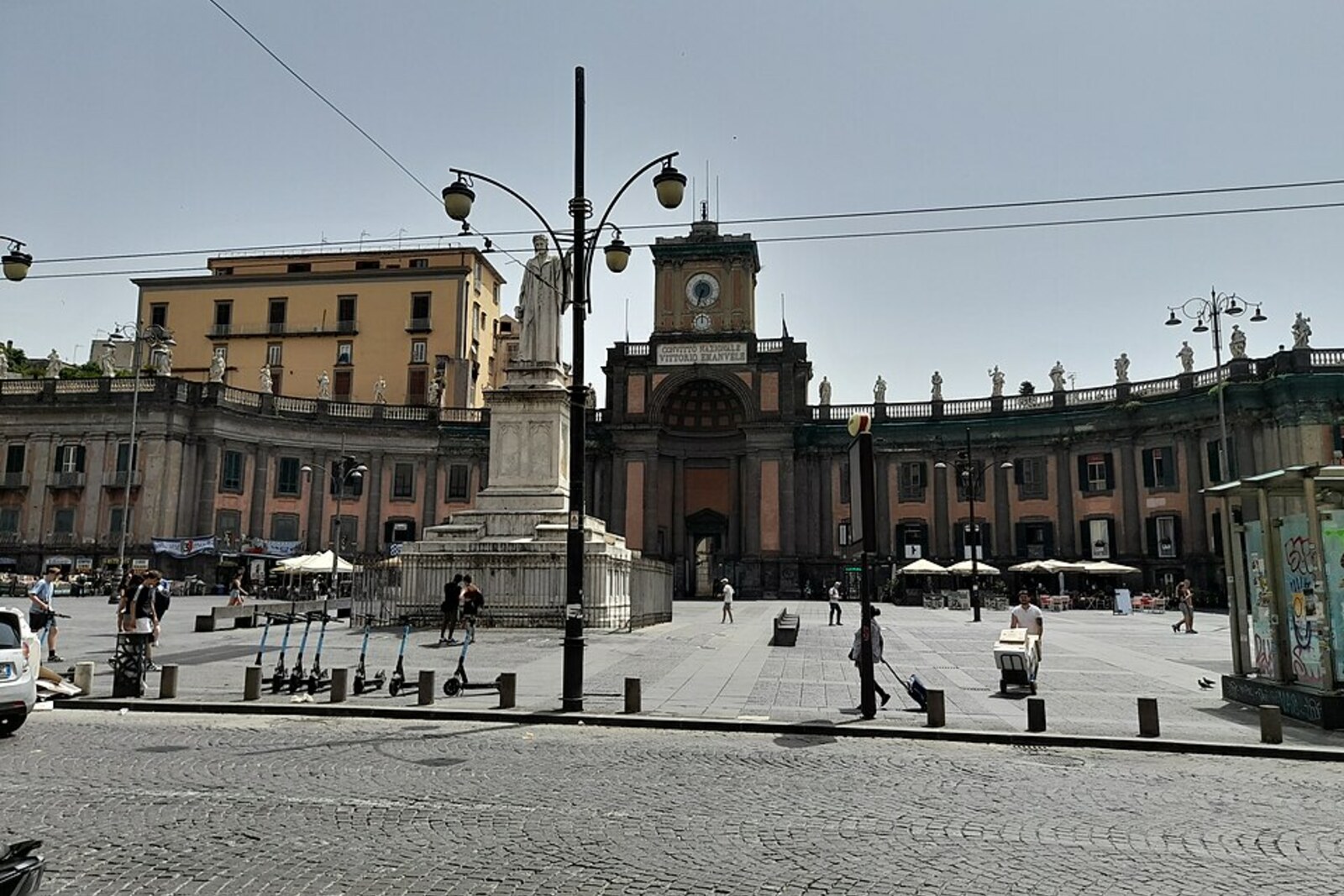
Look around first
What to notice
- The semicircular Foro Carolino
- Twenty-six marble allegories
- The Statue of Dante with a book
The story of the place
The semicircle of Foro Carolino encloses the square; twenty-six marble statues stand along its cornice, each depicting an allegory of a ruler’s virtue. In the middle of the eighteenth century, the court architect built this facade for Charles of Bourbon and provided a central niche for his equestrian monument. After construction, the semicircle stood without a rider in the middle.
Today, the square gathers several city flows: metro passengers emerge here, people head from here to Via Toledo, and through Port'Alba they enter the old center. Such a place arose long before the metro. Since fifteen eighty-eight, merchants have traded here on Wednesdays, beside what was then the city wall, at Largo del Mercatello—the small market square.
In the middle of the eighteenth century, Charles of Bourbon, the king of Naples, decided to turn this commercial space into a monument to his own rule. The court architect Luigi Vanvitelli built the semicircular Foro Carolino. At the top stand twenty-six marble figures—allegories of Charles’s virtues. An equestrian statue of the king himself was planned for the center. Vanvitelli arranged the entire composition around it: the rider was to stand in line with the central niche. A permanent monument to Charles never appeared here. The semicircle was completed, but the place prepared for the king remained empty.
It was taken by Dante Alighieri, the Florentine poet and author of The Divine Comedy. The square is named after him not because of an event in his Neapolitan biography. Dante was chosen both as an author whose Tuscan language became the basis of a shared Italian literary language and as a figure capable of representing the country across its former state borders.
One of the monument’s main initiators was Luigi Settembrini, a literature teacher who sought the unification of Italy. Under the Bourbons, he earned money through private lessons and took part in the secret society Italian Unity. For this, he was sentenced to death. The execution was commuted to life imprisonment, and Settembrini spent eight years in the island prison of Santo Stefano. There he continued translating ancient authors and studying the history of Italian literature.
After the fall of the Kingdom of the Two Sicilies, Settembrini returned to Naples and received a chair of Italian literature at the university. In eighteen sixty-two, he headed a society that raised money for the Statue of Dante. The literary critic Vittorio Imbriani ran the subscription, while the sculptors Tito Angelini and Tommaso Solari offered to do their work free of charge. The money was still insufficient, costs rose, and the project stretched out for almost a decade.
In July eighteen seventy-one, the marble Dante was unveiled without a ceremonial celebration. At the same time, the former Largo del Mercatello received its present name. Dante stands with a book in the place prepared for the equestrian Charles; behind him, the twenty-six virtues of the king during whose reign Settembrini would later be sentenced to death still stand in formation.
Useful on site
Around the clock, open square.
Checked: June 29, 2026. Check the official source before visiting.Step back far enough to see the entire facade, but do not linger in the path of traffic and pedestrians.