 Guide On Map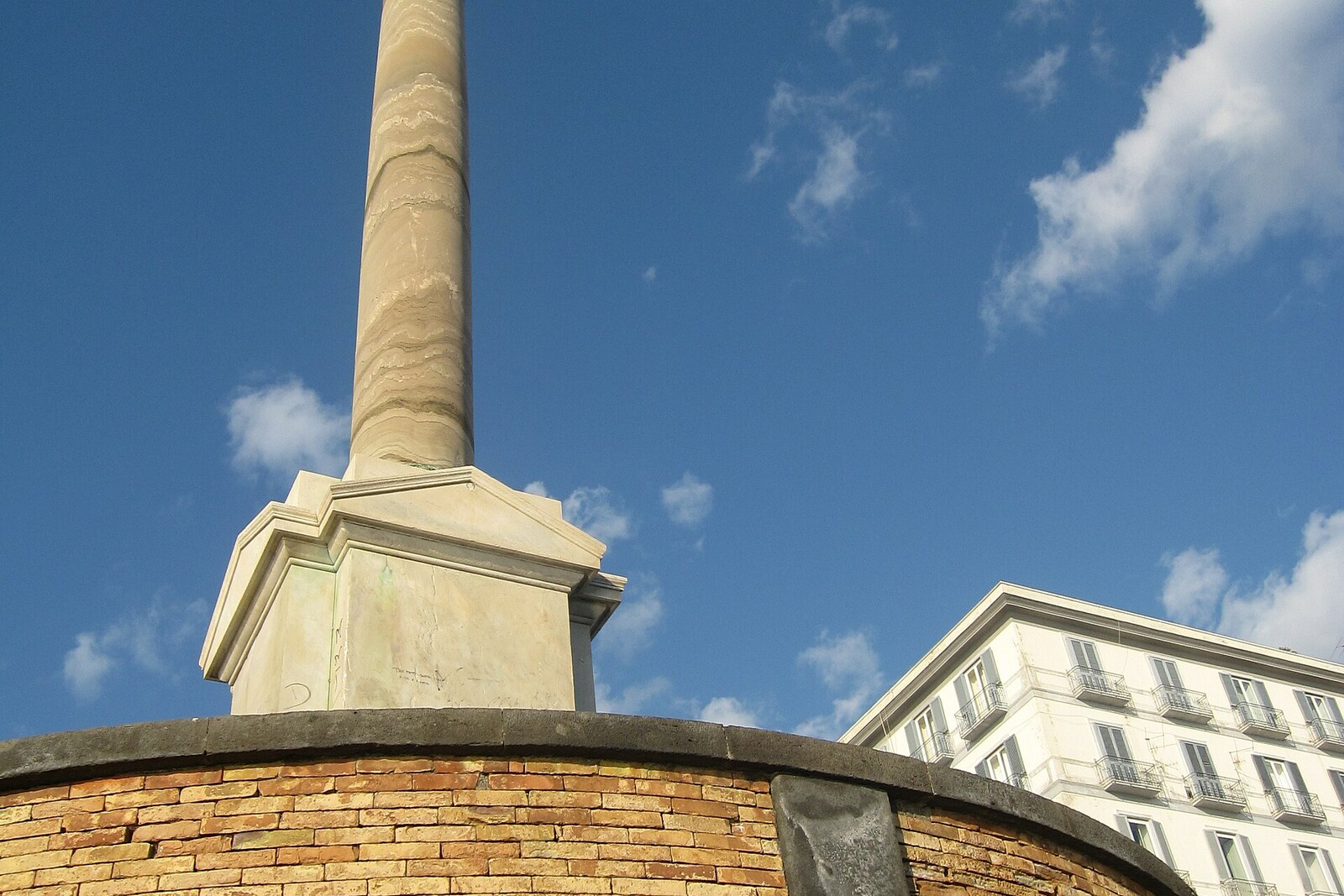
Look around first
What to notice
- Marble shaft without a capital
- Stone pedestal
- Inscription about those who died in naval battles
The story of the place
Without a top or a figure, this twenty-ton marble shaft looks like a fragment placed here temporarily. It was found during work near Naples Cathedral, then given to monks for a statue of their founder, but a neighboring homeowner obtained a ban: in an earthquake, the heavy sculpture could collapse onto his house. The column was buried again beside the church and only much later sent to the National Archaeological Museum of Naples. From there, sixteen horses brought it to the sea, while the place for a figure remained empty.
Near Piazza Vittoria stands an ancient marble shaft without a capital. The inscription on its pedestal dedicates it to those who died fighting at sea, “at all times and everywhere.” This is the present purpose of Colonna Spezzata. The base appeared here earlier, and the city had already assigned it to two unrealized monuments.
One project commemorated sailors who died off Lissa in eighteen sixty-six. Carlo Persano, commander of the Italian fleet, tried to stop the Austrian squadron and, while the fleet was changing formation, transferred to another ironclad without informing the other ships. Confusion followed, and the Austrians broke through the gap in the formation. The ironclads Re d'Italia and Palestro sank, and six hundred forty people died. Persano returned to Italy, was put on trial, and lost his admiral's rank, his decorations, and his place in the fleet. The monument to the dead sailors required an expensive bronze sculpture; no money was found for it.
The other person planned for this pedestal was the Neapolitan admiral Francesco Caracciolo. In seventeen ninety-nine, he served the king, transported the court from Naples to Palermo, and then requested permission to return home for the sake of his estates. Caracciolo was a duke, a landowner, and a courtier with an income: his position depended on the preservation of his inheritance.
A republic had already been proclaimed in Naples. A few weeks later, Caracciolo took command of its small flotilla and fought against the ships of his former sovereign. After the republic fell, he was captured. At his trial, the admiral maintained that he had joined the republicans to save his property, but his previous service made his action especially grave in the king's eyes. British admiral Horatio Nelson, who was helping restore the monarch, ordered the prisoner to be tried aboard his own ship. On June twenty-ninth, Caracciolo was sentenced and, on that same day, hanged from the mast of HMS Minerva. His body was thrown into the sea; several days later, it washed ashore at the Santa Lucia District, where the admiral was buried in the church of Santa Maria della Catena.
In eighteen sixty-seven, the archaeologist Giuseppe Fiorelli secured the installation here of a pedestal for a statue of Caracciolo. The funds were enough only for the base. In the centennial year of the Neapolitan Republic, the historian Benedetto Croce tried to complete the monument to the admiral, but the fundraising effort failed again. For another fifteen years, the pedestal remained without a figure.
In nineteen fourteen, city officials decided to fill it with an antiquity from the storerooms of the National Archaeological Museum of Naples. The chosen column had been found as early as the seventeenth century during work near Naples Cathedral. The archbishop promised it for a statue of the city's patron, San Gennaro. His successor revoked the promise, and the viceroy transferred the column to monks who intended to place their founder, San Gaetano, on it.
Then Agostino Pisani, the owner of the neighboring house, intervened. He feared that the heavy statue would collapse in an earthquake, destroy the house, and kill him and his brothers. Pisani went to court and won the case. The monks stopped the work and buried the column again beside their church. It was not found until eighteen fifty-nine and was sent to the museum.
On April twenty-first, nineteen fourteen, sixteen horses brought the twenty-ton marble shaft to the sea. The statue of Caracciolo was cancelled for good, and the dedication was extended to all those who died in naval battles. The admiral's name remained on the street plaques of the street that begins at the square. His name is not on the pedestal: above the inscription for the dead stands a column previously intended for two saints.
Useful on site
Open urban space.
Checked: date not specified. Check the official source before visiting.The square is exposed to sun and wind; listen from the safe pedestrian area, without going around the monument through traffic.