 Guide On Map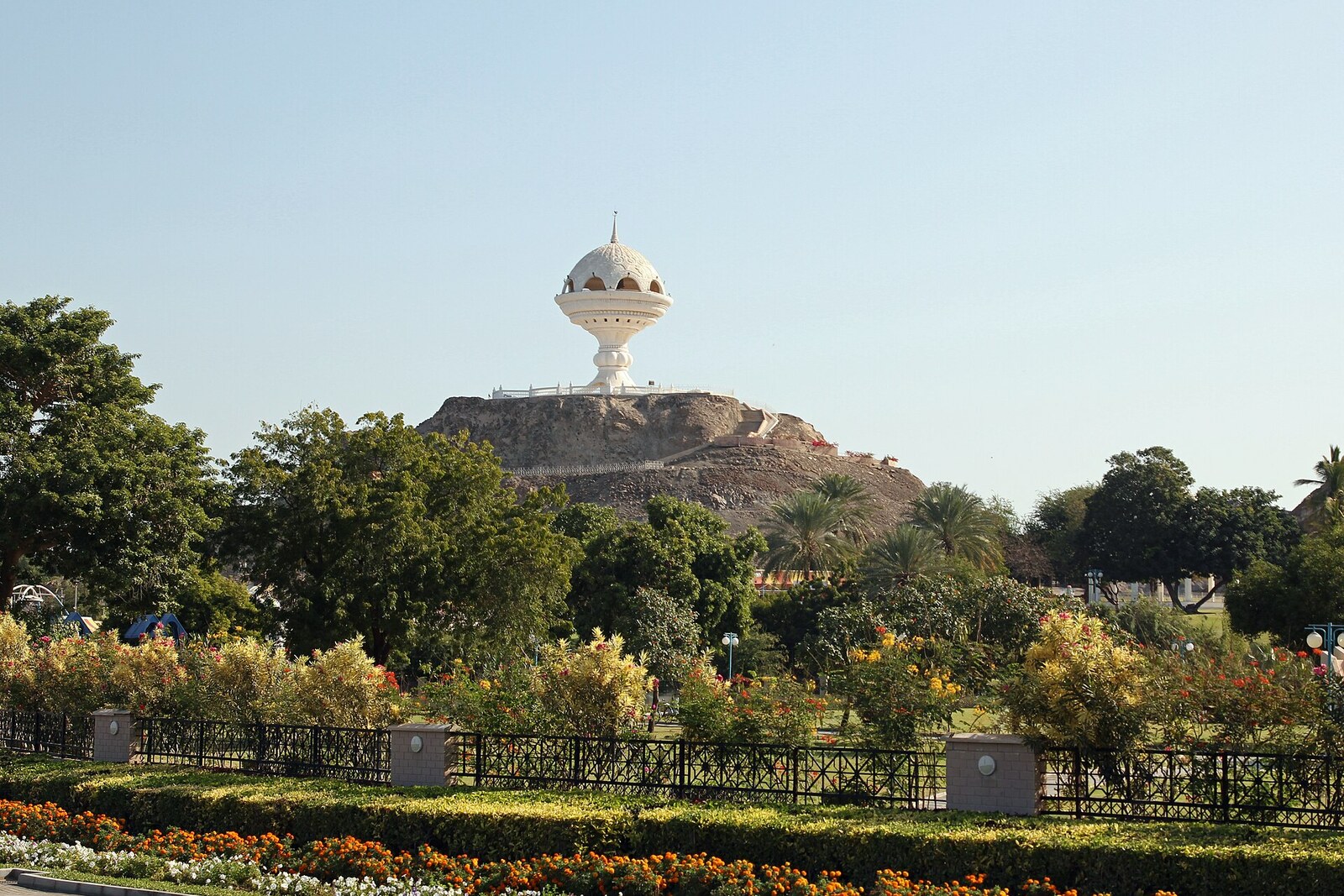
Look around first
What to notice
- White incense-burner tower
- Modern highway
- Mountain ridges
- Sections of the old road
The story of the place
The white tower above the park repeats the shape of a mijmar—an Omani incense burner in which charcoal and frankincense are placed. It was built in nineteen ninety for the twentieth National Day, which coincided with the twentieth anniversary of Sultan Qaboos bin Said's reign. No real fire was lit inside: the builders enlarged a household vessel to the size of a tower, visible from the harbor and the road between Mutrah and Old Muscat.
The opening of the first motor road between these cities took place at Riyam Pass, above which the white incense burner now gleams. Until the end of the nineteen twenties, residents traveled from commercial Mutrah to Muscat, where the sultan's court and government offices were located, either in small boats or along rocky mountain trails. Goods could be carried overland only on the backs of people and pack animals.
Under Sultan Taimur bin Faisal, it was decided to build a road for cars through the pass. The work was entrusted to Captain Allan Robertson Walker, commander of the Muscat Infantry. His soldiers, who served for pay and were trained to guard cities, cut the route through the rocks. The result was a simple cement road without lighting or road signs, but two oncoming cars could pass each other on it.
On December twelfth, nineteen twenty-nine, the builders sent a Morris test truck along the new route. It became the first automobile to enter Muscat overland. The ceremonial opening was scheduled for December eighteenth. Taimur bin Faisal planned to arrive in Mutrah by sea, transfer to a car, and travel through Riyam, but a strong northerly storm the day before prevented his vessel from putting to sea. The ceremony was postponed.
On December twenty-sixth, the sultan did travel from Mutrah to Muscat. At the summit of Riyam Pass, he stopped the car and thanked Walker, the officers, and the soldiers who had laid the road. Regular taxis soon appeared between the cities, the number of automobiles quickly rose to more than two dozen, and the boatmen who had previously carried passengers along the coast began to lose this income.
The present-day highway runs at the foot of the white incense burner, and sections of the old route can still be traced on the mountain ridges opposite Riyam Roundabout. The Morris truck reached Muscat by them first.
Useful on site
The park and viewing approaches have an inconsistently confirmed schedule; go in daylight and do not count on an ascent at night.
Checked: June 24, 2026. Check the official source before visiting.Do not look for an unofficial entrance to the monument. On the steep trail, continue only in safe weather, good light, and suitable footwear.