 Guide On Map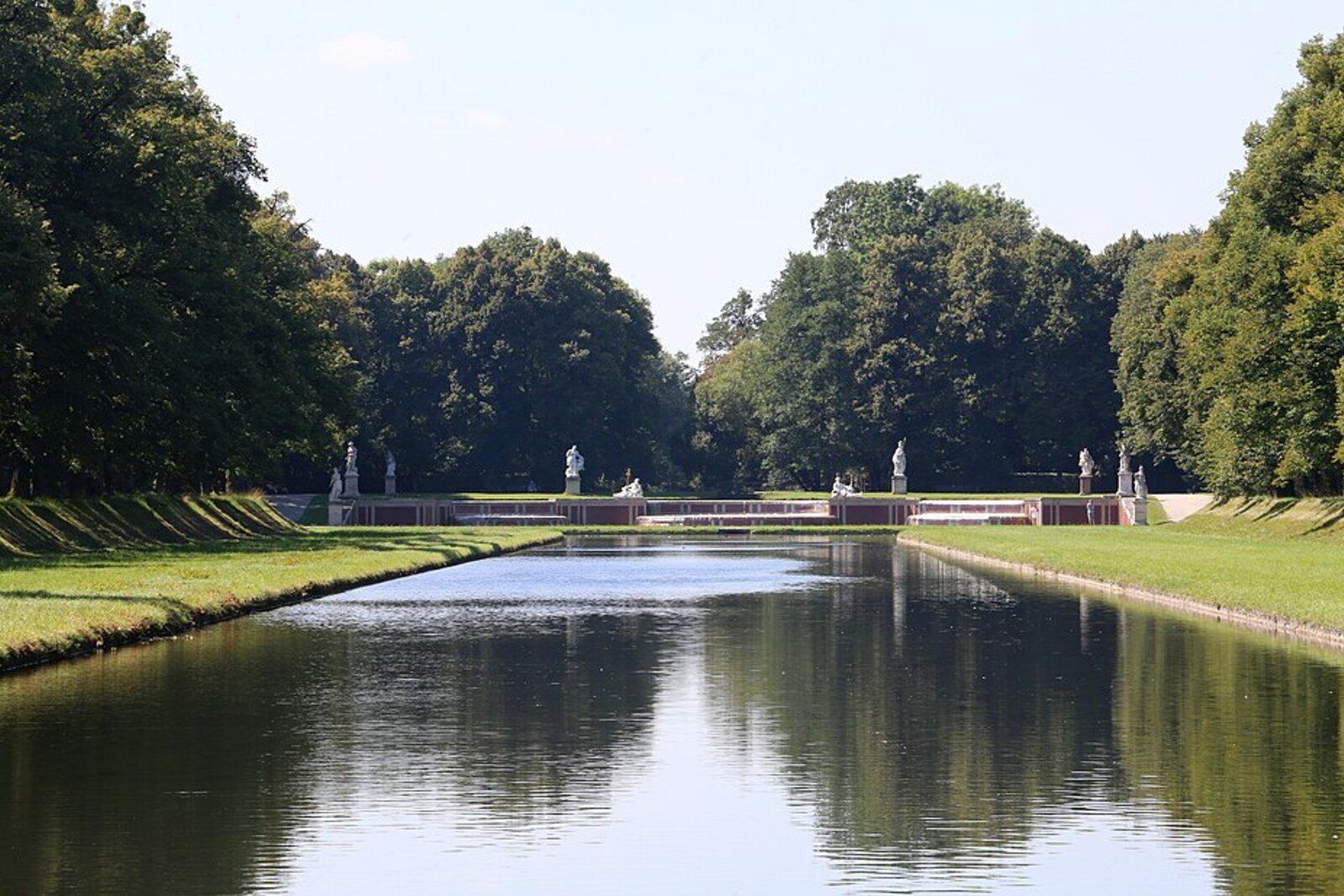
Look around first
What to notice
- Figures of the Danube and the Isar
- Marble cladding
- Water stairway
- Middle Canal
The story of the place
A tall waterfall was impossible here: the park lies on almost level ground. That is why the Great Cascade is arranged as a broad water stairway with basins between its steps, where the flow gradually loses height. The reddish-white marble cladding is not original: the surfaces were initially wooden, and after an aerial bomb struck, most of it had to be replaced. The present cascade retains the old layout of the drops, but not the former material.
The two reclining figures by the central drop represent the Danube and the Isar. The water between them comes from a third river—the Würm. At Pasing, it is diverted into a canal, carried to the park's western boundary, and here released from the upper level to the lower one. From the lower basin, the water flows along the Middle Canal toward the palace. The cascade was placed where water enters the park; at the same time, it closed the distant view from the palace staircase.
On almost level ground, court architect Joseph Effner could not create a high waterfall. In seventeen seventeen, he spread the drop across the width: he built a wooden water stairway with intermediate basins. The water lost height in several broad streams, and it was called the Great Cascade because of the scale of the entire structure.
It fell to another architect, François de Cuvilliés, to replace the wooden structure. As a teenager, he entered court service in a position officially called “court dwarf.” His salary depended on the elector's favor, while Cuvilliés sought a different career: he learned to draw fortifications, passed the officer's examination, and requested to join the Hungarian campaign. In seventeen seventeen, he was refused because of his very short stature.
Max Emanuel, who commissioned the expansion of Nymphenburg, decided to use Cuvilliés's abilities differently. He paid for Cuvilliés to study architecture in Paris. On returning to Munich, Cuvilliés received a post as court architect with a salary of six hundred guilders a year and found himself alongside Effner, who was then directing palace construction.
After Max Emanuel's death, the new elector, Charles Albert, began giving commissions to Cuvilliés. By seventeen thirty, Effner retained his high title but had in fact lost his leadership; later, he was left with the gardens, repairs, and supervision of the water installations. Cuvilliés was assigned the rebuilding of the cascade constructed by Effner. He went from being a rejected military engineer to chief court architect, and after his death, his son had to complete the cascade's renovation.
In seventeen sixty-nine to seventeen seventy-one, the wooden surfaces were covered with reddish-white marble. The architectural frame Effner had intended at the sides was never built. In November nineteen forty-four, an aerial bomb damaged the cascade; by nineteen sixty-five, it had been restored, with much of the cladding replaced.
Effner's wooden stairway is no longer here, and a significant part of the visible marble was laid after the war. What remains is the arrangement of the drops themselves: the Würm's water enters the park between the figures of the Danube and the Isar, loses height here, and continues along the straight canal toward the palace.
Useful on site
The cascade is in the park and accessible during the gate opening hours: January–March, November and December 6:00–18:00; April and October 6:00–20:00; May–September 6:00–21:30. The water installations usually operate from Easter until mid-October, but the exact operation of the fountains and pumps must be checked against current notices.
Checked: June 29, 2026. Check the official source before visiting.First look at the falling water, then turn toward the palace: this makes it easier to connect the cascade with the entire axis you have walked. Stay on the permitted paths and do not approach the wet stone at the edge of the structure.