 Guide On Map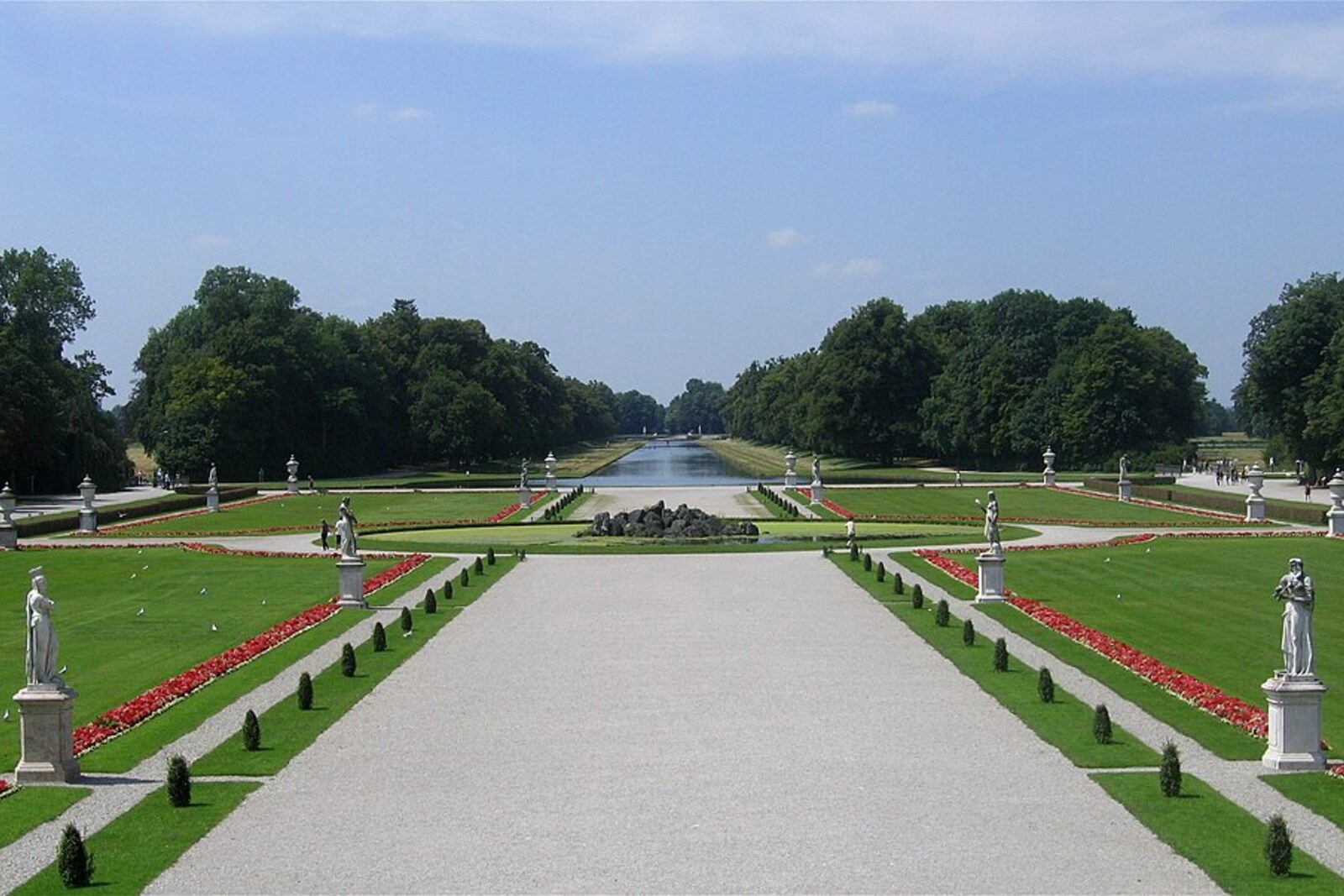
Look around first
What to notice
- Four lawns
- Round basin
- Fountain jet
- Marble statues
The story of the place
The Great Parterre is a flat rectangular garden immediately behind the palace's western façade. Four lawns are bordered with flowers; at the center is a round basin with a fountain, while marble gods stand along the edges. A parterre was a low formal composition right beside a building, designed above all to be viewed from the palace staircase and upper windows. This is why the trees here do not block the straight line from the central block to the canal and the Great Cascade.
At the beginning of the nineteenth century, the Bavarian Elector Maximilian IV Joseph decided to redesign the park in the English style. The court gardener Friedrich Ludwig von Sckell wanted to replace the straight avenues and clipped sections with clearings, winding paths, and bodies of water with irregular banks. But in eighteen oh one, the Elector ordered the formal center of the garden to be retained. Sckell simplified the intricate patterned flower beds into broad lawns with flower borders, while preserving the parterre's dimensions. That is why strict geometry remained near the palace, even though the landscape clearings created by the same gardener begin farther on.
Maximilian Joseph also decided to rebuild the central fountain. The wooden pumps of seventeen sixty-seven required water towers and creaked so loudly that even the court in the eighteenth century complained about the noise. The Elector needed a stronger jet, and in eighteen oh two he assigned the work to Joseph von Baader, director of mining and mechanical engineering in Bavaria, who had published his own theory of pumps.
The following year, Baader installed two cast-iron machines in the Green Pump House. Water from a side canal turns the wheels, which move the beams and ten pistons. Baader placed reservoirs of compressed air between the pumps and the pipe: they even out the pressure, so the jet does not pulse with every stroke of a piston. The machines require no electricity; they are driven by the difference in water level in the canals. One unit still bears an inscription naming Baader as the inventor and stating that he built the machine on the Elector's orders.
In eighteen oh five, Napoleon saw this jet. The French emperor was planning to return Versailles, deserted after the Revolution, to the ranks of his residences and was looking for a way to supply its fountains with water again. The Nymphenburg installation impressed him so much that the following year he summoned Baader to Paris and commissioned a similar system for Versailles. The engineer prepared a design, but it was never built.
The Versailles commission remained on paper. At Nymphenburg, the two pump units of eighteen oh three still supply water to the round basin. The machines stand deep in the park, while the jet they raise is visible above the Great Parterre.
Useful on site
Park: the main gates are open in January–March, November, and December 6:00–18:00; in April and October 6:00–20:00; in May–September 6:00–21:30. The other gates close half an hour earlier. In 2026, the Great Parterre fountain is not operating because of repairs to the water wheel in the Green Pump House.
Checked: June 29, 2026. Check the official source before visiting.First look from the palace along the center, then move slightly to one side to notice the transition from the symmetry of the parterre to the freer groves and banks. The fountain does not need to be operating to read the composition.