 Guide On Map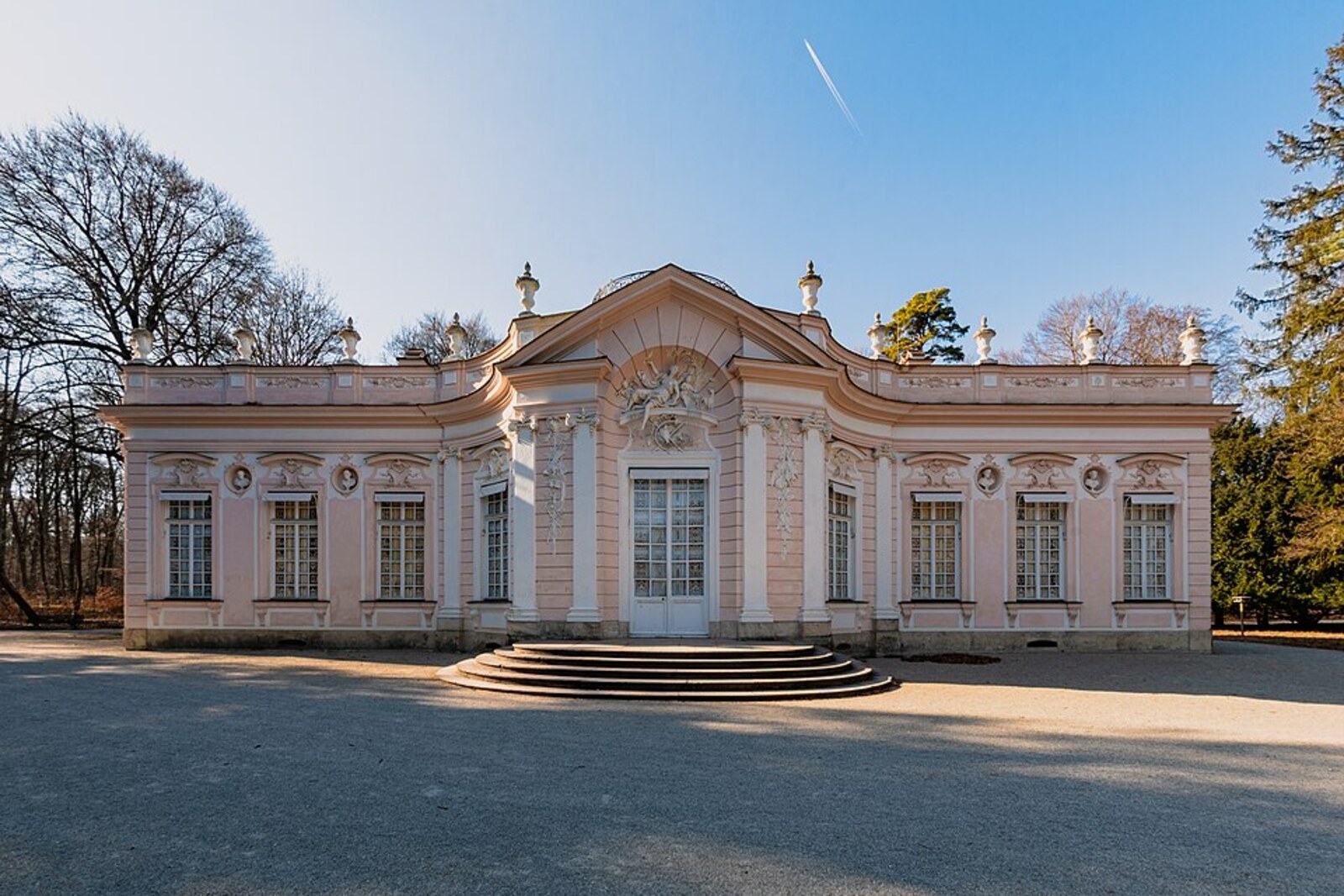
Look around first
What to notice
- Pink-and-white façade
- Railing on the roof
- Monograms on the railing
- Dog niches
The story of the place
On the round platform above the dome of Amalienburg, Maria Amalia waited for pheasants to rise above the trees. From here, she and her husband shot at the birds with guns. From the pink-and-white façade, it is hard to guess that the openwork railing on the roof surrounds a firing position.
Maria Amalia, the wife of Elector Charles Albert, was a passionate hunter and travelled far beyond Munich for the hunt. Charles Albert wanted to provide her with a hunting lodge near the summer residence. In seventeen thirty-four, he commissioned the court architect François de Cuvilliés to build a pavilion suited to her pursuit. Five years later, Maria Amalia received her own small palace, named after her: Amalienburg.
A clearing in the pheasant garden was chosen for it. The birds were raised in advance for court hunts. On the appointed day, beaters and dogs drove them toward the pavilion, while stretched cloth panels forced the pheasants to fly up in front of the roof. On the platform, Maria Amalia was handed loaded guns, each allowing one shot. According to accounts by court guests, she shot here with her husband and often without him. The quarry was not sought in the forest: it was brought precisely to the place where the Electress waited.
Cuvilliés placed everything for the rest of the hunt under one roof. The dog room had low niches for hounds, with built-in cupboards for guns and equipment above them. A dressing room and a rest room lay nearby. After the shooting, the court moved into the round Hall of Mirrors, where they rested, listened to music, and held celebrations. Food was prepared right there in its own kitchen, so the party did not need to return to the main palace.
The staircase leading up to the firing platform has disappeared. The platform itself remains, along with its railing bearing the monograms of Charles Albert and Maria Amalia, the gun cupboards, and the dog niches beneath them.
Useful on site
Amalienburg is open daily from 1 April to 15 October, 9:00–18:00, and closed in winter. Last admission and ticket sales are 30 minutes before closing. Admission is available with a ticket for the park pavilions or a general Nymphenburg ticket.
Checked: June 29, 2026. Check the official source before visiting.The façade and hunting emblems can be seen without entering. The Hall of Mirrors, the ceremonial kitchen, and the Dog Room are inside, so if the pavilion is closed, focus on its compact scale and exterior decoration.