 Guide On Map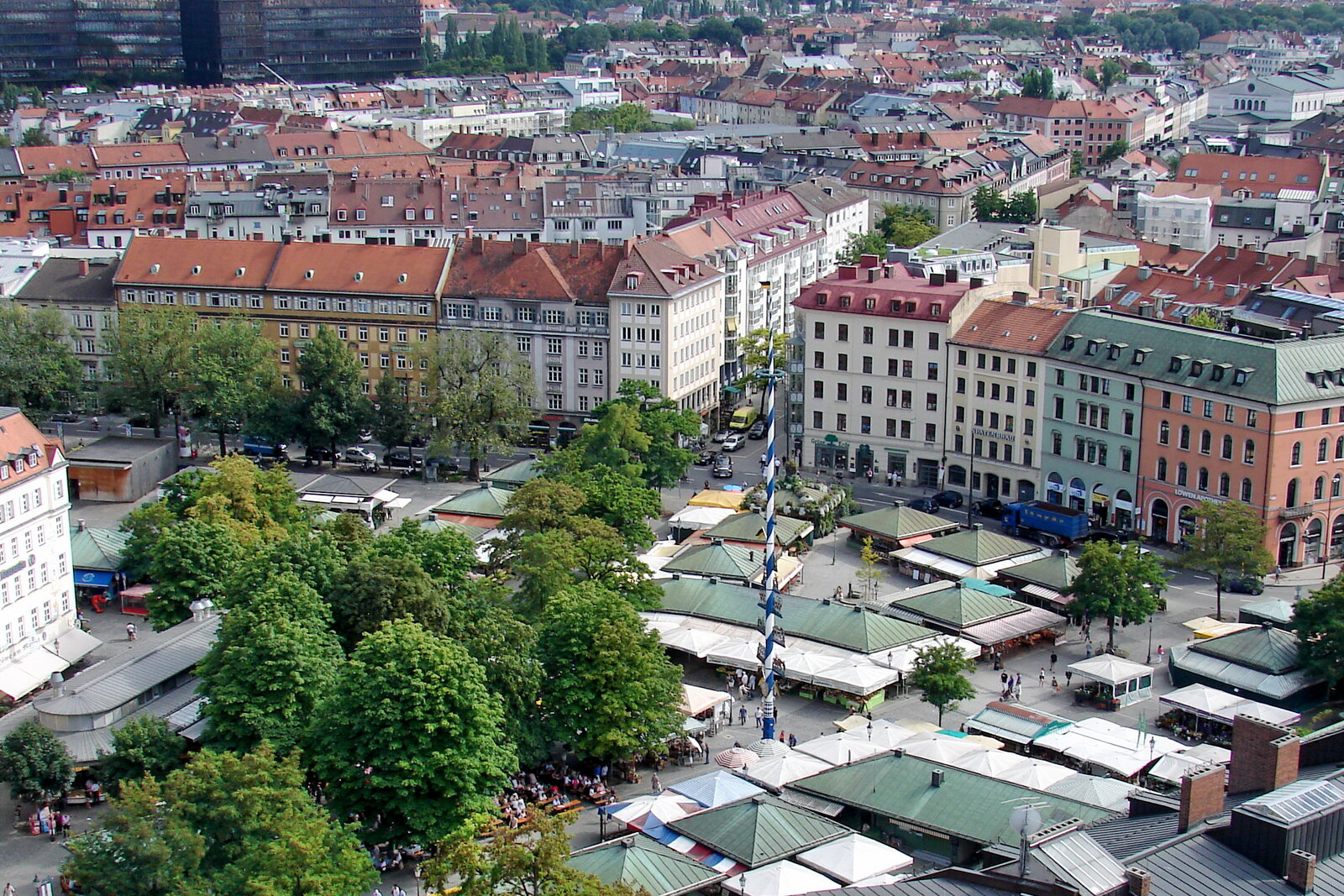
Look around first
What to notice
- Church of the Holy Spirit
- Permanent market rows
- Open market square
The story of the place
The market rows of Viktualienmarkt run from the Church of the Holy Spirit to the open square; permanent stalls once assigned individual plots to sellers. The buildings of a home for poor elderly Munich residents once stood along Frauenstraße, and the church was part of this larger complex. A courtyard lay along its wall, now occupied by stalls. The city replaced the daily struggle for a favorable place with the rental of permanent stalls, and regular customers could return to a familiar merchant.
In the spring of eighteen oh seven, King Maximilian I Joseph ordered part of the food trade to be moved from Marienplatz (formerly Schrannenplatz) to the courtyard of the Hospital of the Holy Spirit. On the former square, carts, sacks of grain, sellers, and buyers were already obstructing traffic. The king wanted to clear the center of his new capital and instructed the city council to demolish four houses belonging to the hospital there.
This land could be put to use thanks to a reform by the royal minister Maximilian von Montgelas. A year earlier, he had transferred the administration of the city’s charitable funds to the state administration. By then, the Hospital of the Holy Spirit served as a home for the elderly, mainly poor Munich residents. They received housing and support there. Now merchants set up carts and temporary stalls in the courtyard around their buildings.
The residents remained beside the market for another sixteen years. After returning the hospital to the city, officials found that trade in the courtyard and the dilapidated buildings had made the former arrangement unsuitable. On October first, eighteen twenty-three, all two hundred thirty-two people were relocated from here: one hundred eighty-two women and fifty men received rooms in a former convent on Mathildenstraße. The vacated buildings were then gradually dismantled, and the market was expanded.
At first, sellers took up their places afresh every morning: the best sites went to those who arrived earlier. In eighteen seventy, city authorities installed permanent stalls and began renting them to merchants. Sellers no longer had to argue every day over a plot, regular customers found it easier to locate a familiar stall, and the city received rent. By eighteen ninety, the market rows occupied almost the entire present-day square.
At first, the place was simply called the market. Later, the name “Viktualienmarkt” took hold: “victuals” is an old scholarly term for food, derived from the Latin word for “food.” Of the entire hospital complex, only the Church of the Holy Spirit remains nearby. The space between its wall and Frauenstraße, where food stalls now stand, was once occupied by the courtyard and the buildings of the home for the elderly.
Useful on site
This is a working market, so do not stand in queues and passageways for the audio guide. The market women’s dance takes place only as a separate festive event; an ordinary day is valuable for its everyday life.