 Guide On Map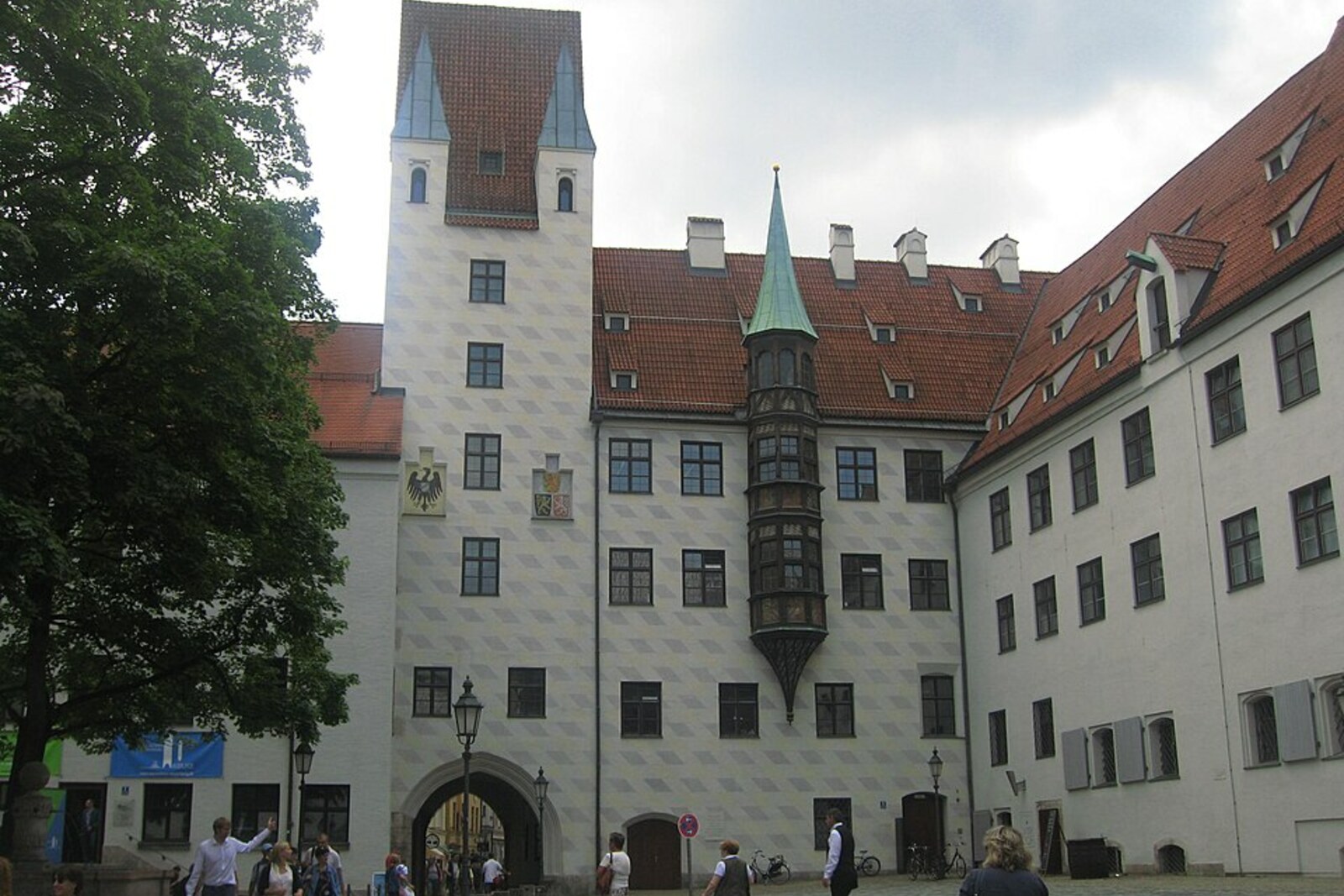
Look around first
What to notice
- Inner courtyard
- Buildings of Alter Hof
The story of the place
The present-day inner courtyard is surrounded on all sides by the buildings of the early Munich residence of the House of Wittelsbach. As Munich expanded, the old fortress ended up far from the city wall and without a convenient exit; the rulers moved the court to another fortress, and government offices were housed here. Since then, this place has been called the Old Court. On the north side of the courtyard stood the court chapel, and immediately beyond the wall stood a Franciscan monastery; the chapel was demolished, and National Theatre Munich took the monastery's place.
At the beginning of thirteen thirty, a fugitive began working at the court based in these buildings. The English Franciscan and philosopher William of Ockham was hiding from the papal court and looking for a patron capable of protecting him from arrest. He found such a patron in Ludwig the Bavarian—the master of Alter Hof, who had himself been living under excommunication for several years.
Their alliance was brought about by a dispute over who had the right to make a man emperor. In thirteen fourteen, the princes of the Holy Roman Empire split: some elected Ludwig, the Bavarian duke, king; others elected his rival Frederick of Habsburg. Both claimed the same throne. After eight years of war, Ludwig defeated Frederick at Mühldorf and took him prisoner, but Pope John the Twenty-Second refused to recognize the victor. The pope demanded that Ludwig relinquish his title and await a decision from Avignon, where the papal court was then located.
Ludwig did not submit. In thirteen twenty-four, John excommunicated him and ordered the clergy in the lands under Ludwig's rule to limit religious services and sacraments. The personal sentence imposed on the ruler affected people who needed weddings, funeral services, and ordinary church services. Four years later, Ludwig came to Rome and accepted the imperial crown without the pope's consent—from representatives of the Romans.
After returning from Italy, he made this Munich fortress his principal residence and seat of government. Ludwig enlarged the residential block and the neighboring wing, while the imperial crown, cross, and other insignia of his rank were kept in the Court Chapel of St. Lawrence on the north side of the courtyard. Alter Hof became an imperial residence precisely because Ludwig needed a place where his title existed in practice, although the pope continued to deny it.
Ockham came here for a similar reason. In Avignon, the theologian was accused of heresy. While studying papal decrees on Franciscan poverty, he concluded that even the head of the Church could be mistaken. In May thirteen twenty-eight, Ockham fled Avignon with the leaders of the order and joined Ludwig. The fugitives were excommunicated and then expelled from the Franciscan order. Ludwig housed them under his protection in a monastery immediately beyond the north wall of Alter Hof.
Ockham and his companions gave the emperor what victory on the battlefield could not give him: a written justification for his right to rule without papal approval. At the Munich court, they composed treatises on the limits of papal authority and on the election of an emperor. These writings spread across Europe. Their beliefs had to be paid for with the rest of his life: Ockham never returned either to England or to the university, and he died in Munich in thirteen forty-six. Ludwig never reconciled with the papal throne; a year later, he died suddenly while hunting, still excommunicated.
The fortress and the monastery were connected by an underground passage. Ludwig could use it to walk unnoticed from Alter Hof to the monastery church and attend Mass. Above the passage were two parts of the same arrangement: imperial regalia were kept in the court chapel, while next door lived excommunicated Franciscans defending the regalia's owner's right to wear the crown.
In Ludwig's time, this place was not yet called the Old Court. After Munich expanded, the fortress ended up far from the city wall and lost its convenient way out. In thirteen eighty-five, Duke John II began building Neuveste—a New Fortress—by the new wall, the predecessor of the present-day Munich Residenz. In the middle of the sixteenth century, Duke William IV finally moved the court there, and government offices were housed here. It was then that the name Alter Hof—the Old Court—became established for the first Munich residence of the House of Wittelsbach.
The Court Chapel of St. Lawrence was demolished in eighteen eighteen. The Franciscan monastery behind it is gone as well: National Theatre Munich stands in its place. From the present-day courtyard, it is no longer possible to follow the route by which the excommunicated emperor went to Mass with the excommunicated monks.
Useful on site
The courtyard itself makes the main impression, so the interior is not essential. If the Münchner Kaiserburg is open, allow separate time for it and check visiting conditions in advance.