 Guide On Map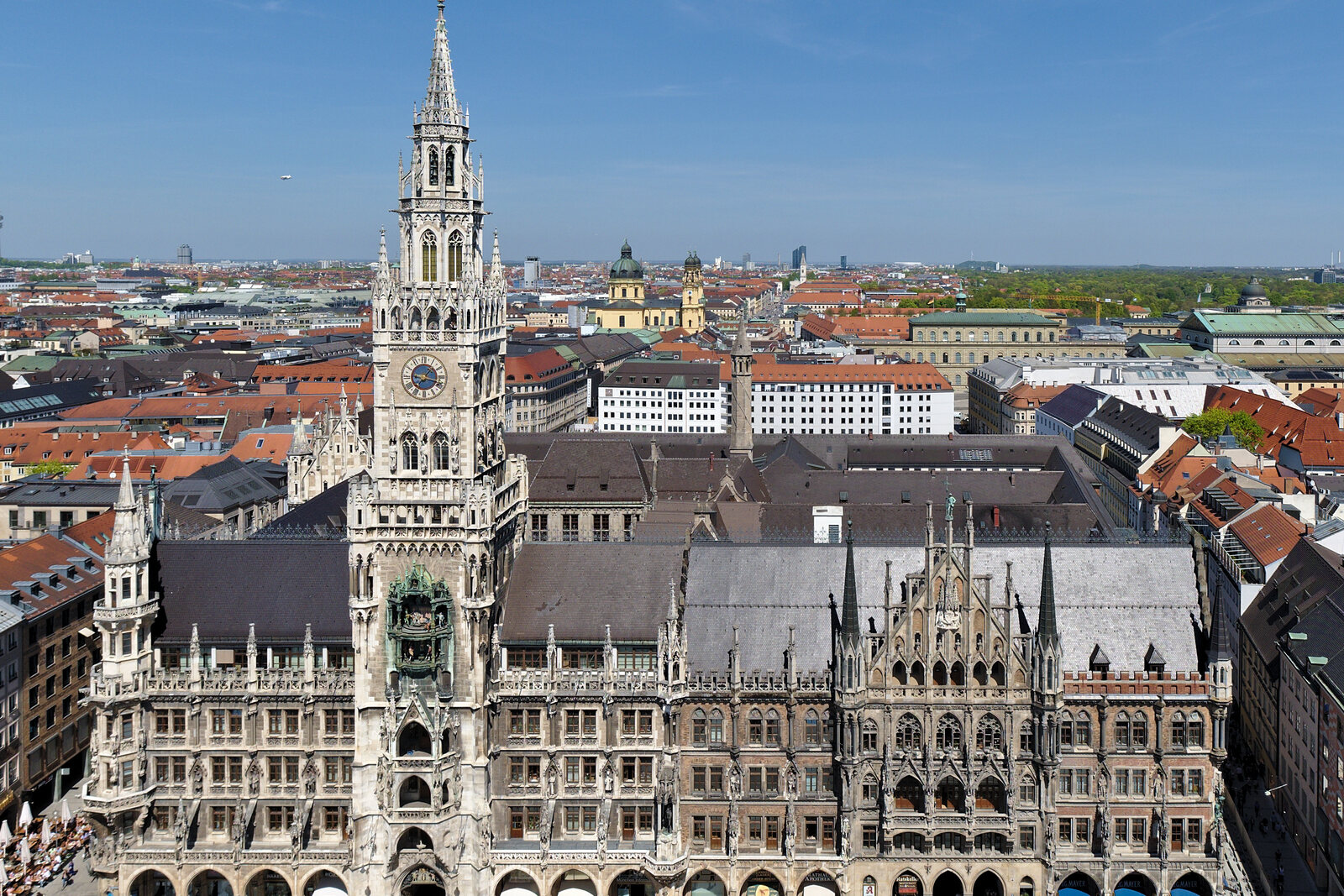
Look around first
What to notice
- Facade of the New Town Hall
- Mariensäule
- Four angels on the pedestal
The story of the place
The gilded bronze figure of Mary rises above the former grain market, and at its foot four angels battle images of war, famine, plague, and heresy. When the grain trade was moved, the square received its current name, associated with the patroness of Bavaria. Copies stand beneath the angels' feet: the original sculptures are kept in the Munich City Museum.
Behind the Gothic Revival facade of the New Town Hall, the Lord Mayor and municipal employees still work today, and the city council meets. It is called “New” in relation to the Old Town Hall at the eastern edge of the square. In the nineteenth century, the former building could no longer accommodate the expanded administration, and the council began building a new house here. Its predecessors once had to decide in this square how much the city was prepared to give for its own salvation.
In the spring of sixteen thirty-two, the army of the Swedish king Gustav II Adolf, one of the main commanders on the Protestant side in the Thirty Years' War, approached Munich. The Bavarian ruler Maximilian I, a Catholic elector—a prince entitled to take part in the election of the emperor—withdrew to fortified Regensburg. There was almost no one to defend his capital. Maximilian allowed the city officials to surrender Munich if resistance would lead only to the deaths of its residents.
The mayors and councilors sought guarantees for the lives, homes, property, and faith of the townspeople. Gustav Adolf agreed to keep the soldiers from arson and looting in exchange for three hundred thousand silver Reichstalers. On May seventeenth, the mayors handed him the keys to the gates. The king entered through Isartor, crossed this marketplace, and continued to the Munich Residenz. Three weeks later, the Swedish army left. The condition of the bargain remained in force.
The townspeople gave cash, jewelry, and silverware, but they did not raise the full sum. The remaining amount had to be secured with people: the Swedes took away forty-two hostages. Among the twenty laypeople were councilors, tavern keepers, a brewer, a mead merchant, gingerbread bakers, tanners, and iron sellers—people whose shops and trades made up the everyday life of the market. Another twenty-two hostages were priests and monks.
The captivity dragged on for almost three years. When one of the hostages escaped, the rest were placed in the marching column of the Swedish army and driven from Augsburg to Nördlingen without food or drink; they were threatened with execution if Munich did not pay the balance. On April third, sixteen thirty-five, thirty-six people returned home. Four died in captivity, one escapee reached Munich earlier, and another changed his faith and was released.
Maximilian explained the preservation of the capital as the fulfillment of his vow to the Virgin Mary—the mother of Jesus, venerated as the patroness of Bavaria. In sixteen thirty-eight, he ordered Mariensäule erected in the middle of the marketplace. The gilded bronze figure was cast as early as the sixteenth century and had previously stood on the high altar of Frauenkirche. Later, four armed angels appeared at its foot: they battle the lion of war, the dragon of famine, the basilisk of plague, and the serpent of heresy. Copies now stand on the pedestal; the originals are kept in the Munich City Museum.
The square was then called Schrannenplatz—the grain-market square. Mary's name became established for it only in eighteen fifty-four. After the grain trade was moved, the city council renamed the square during a cholera epidemic: the councilors hoped to place the city under Mary's protection and stop the disease. Cholera took the lives of more than two thousand Munich residents, but the name remained. In the Latin inscription on the column, Maximilian thanks Mary for preserving the cities, the army, himself, his house, and his hopes. Neither the ransom amount nor the forty-two hostages are named there.
Useful on site
The square is often crowded. For the facade, step away from the tower, and check the current Glockenspiel time in advance; waiting for the performance is not necessary.