 Guide On Map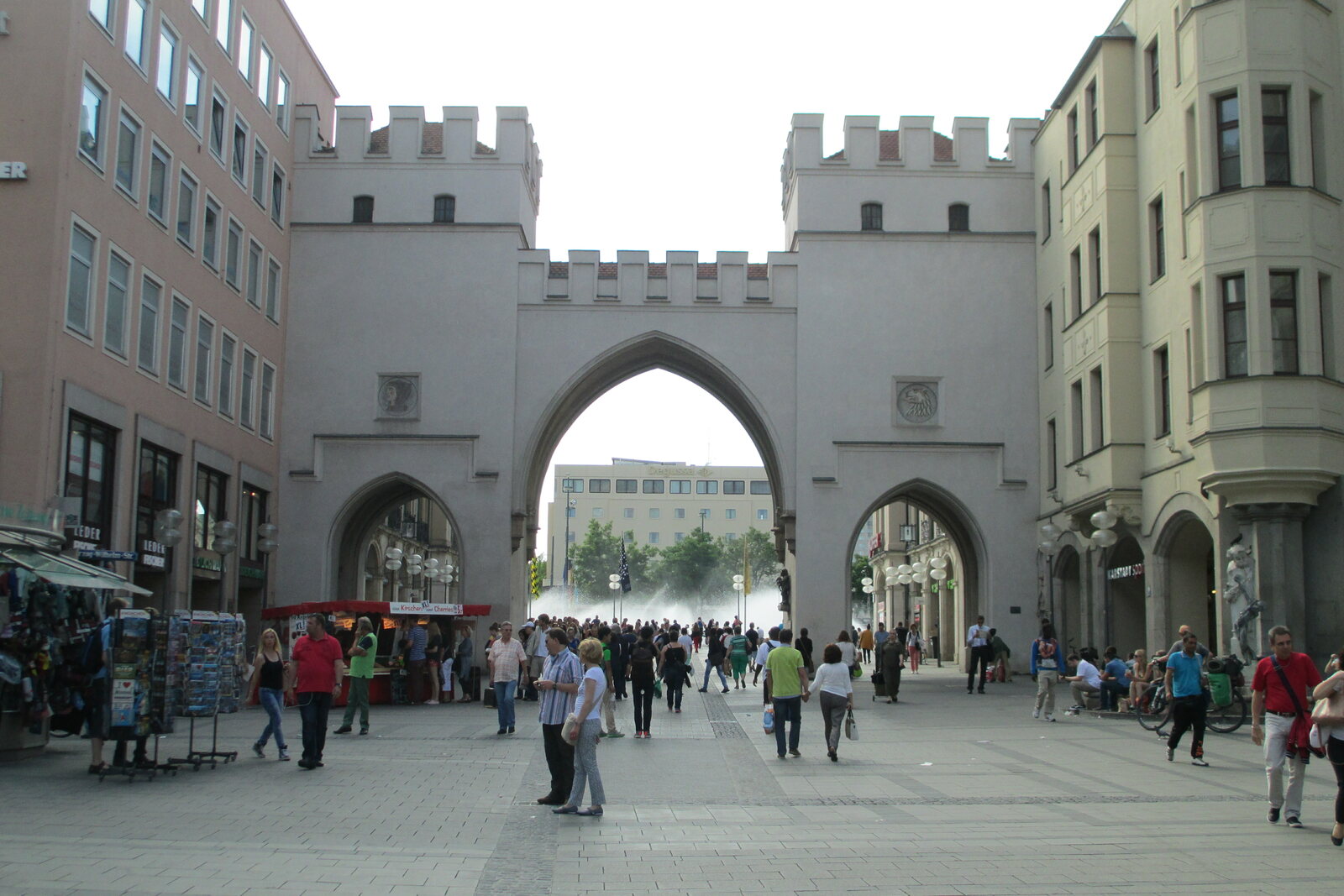
Look around first
What to notice
- Two side towers
- A broad Neo-Gothic archway
- Signs reading “Karlsplatz” and “Stachus”
The story of the place
Two side towers at the edges of a broad Neo-Gothic passage preserve a trace of the western city gate. In the Middle Ages, people arriving from Neuhausen were stopped here, checked, and charged a toll for passage. Later, the gate was given the name of a Bavarian ruler, while residents still call the neighboring square Stachus, in memory of a long-vanished inn. Now people follow the old line of entry from the square onto the pedestrian street.
At half past ten in the evening on September fifteenth, eighteen fifty-seven, gunpowder exploded in a house directly adjoining Karlstor. The house belonged to Oskar Rosenlehner. He made his living trading iron and kept a warehouse here, where a considerable supply of gunpowder was stored along with other goods.
The house was destroyed. Five residents were killed, and at least three were injured. The explosion also damaged the gate’s tall central tower. King Maximilian II permitted its demolition. The architects also proposed dismantling the entire old complex and rebuilding the ceremonial entrance, but the city officials considered the plans too expensive. They kept the two side towers, and Arnold Zenetti joined them with a broad Neo-Gothic archway.
This is how Karlstor acquired its present form in eighteen sixty-one–eighteen sixty-two. The medieval cores remain in the side towers. Where the tall central tower once stood, the main passage is now located. Nothing remains of Rosenlehner’s house or warehouse.
The gate was built on Munich’s western exit as early as the Middle Ages. Arrivals were checked here and tolls were collected; the road led to the village of Neuhausen, so the gate was called Neuhauser Gate. Now people follow the same line from the square onto the pedestrianized Neuhauser Straße.
The gate became Karlstor by order of Karl Theodor. He was Elector of Bavaria—a prince who had a vote in the election of the emperor. Karl Theodor inherited Bavaria in seventeen seventy-seven and moved his court from Mannheim to Munich, which was unfamiliar to him. The new ruler hoped to exchange Bavaria for the Austrian Netherlands, lands roughly corresponding to present-day Belgium, and receive a royal crown there. The deal fell through, but Munich’s residents remembered that their country had been intended for exchange.
In June seventeen ninety-two, Karl Theodor ordered the natural name Neuhauser Gate to be replaced by his own name. Five years later, he also named the new square in front of it Karlsplatz. The name did not catch on in everyday speech. Eustachius Föderl, known as Stachus, ran an inn on the corner, and people continued to call the square Stachus after his establishment.
Föderl’s inn has long been gone. Karl Theodor remains in the gate’s name, and city signs still display the square’s two names side by side: Karlsplatz and Stachus.
Useful on site
The stop can be fully experienced from outside. Under the arch, keep clear of the main flow and look at the heads without blocking the passage.