 Guide On Map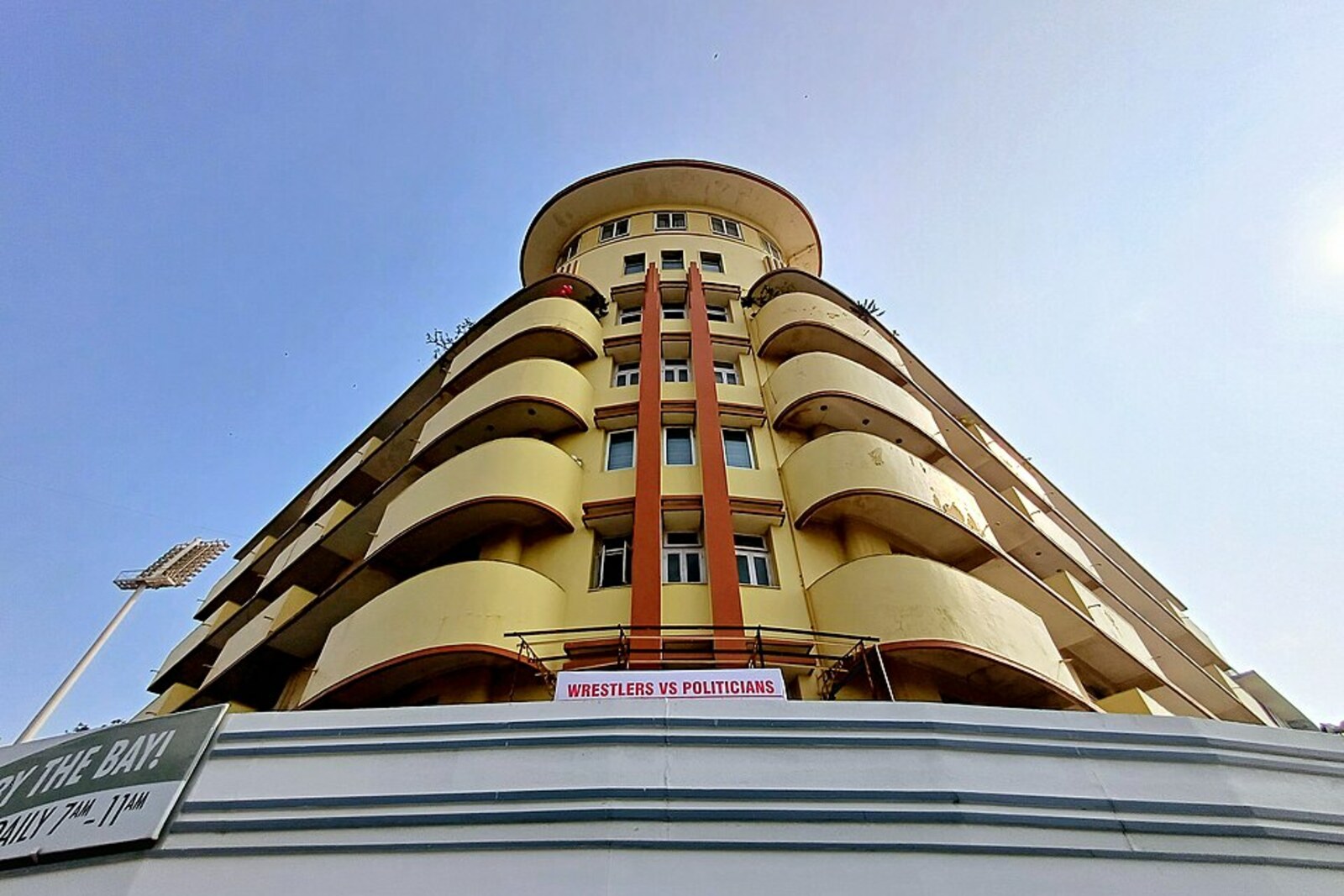
Look around first
What to notice
- Deep rounded balconies
- Circular gallery above the roof
- Old elevator
- Marble lobby
The story of the place
Behind Soona Mahal’s deep rounded balconies are apartments and offices, while a restaurant operates on the ground floor. The circular gallery above the roof was intended as a shared space for residents. The building was constructed in nineteen thirty-seven by Kavasji Fakirji Sidhwa, an entrepreneur who legally traded in locally made spirits. On reclaimed land by the sea, he wanted to build a modern apartment “palace”: that is how the word “mahal” is translated. Soona was the name of his wife, Soona Bai, after whom the building was named.
Two years later, one of Bombay’s few German-Jewish boarding houses opened here. Its owner, Max Lesser, had previously owned an iron and machinery business in Dresden. The Nazis took the business away, and Lesser himself was imprisoned in Buchenwald concentration camp. After his release, relatives in Bombay helped him obtain a visa. In April nineteen thirty-nine, Max arrived here with his wife Elli: they needed a home and an income, while other refugees needed rooms where they could begin life again.
Max and Elli ran the boarding house together every day. They provided lodgers with a room and meals; for single women fleeing German-speaking Europe, such boarding houses were a rare opportunity to live independently, without a local family. Max also took part in the work of the Bombay Jewish Relief Association. One of his lodgers was the writer and editor Willy Haas, who had fled the Nazis via Prague. In June nineteen thirty-nine, an acquaintance met Haas at the port, and his luggage was sent here at once: his first Bombay room was already waiting at the Lessers’ boarding house.
For the owners themselves, rescue did not become a happy ending. On December ninth, nineteen forty-one, Elli took her own life by falling from one of Soona Mahal’s balconies. Surviving accounts describe her death as suicide, but do not allow the act to be reduced to one established cause. Then the British military command requisitioned the boarding house for army officers for two and a half years.
Max returned to the hotel business in nineteen forty-five. Documents from the following year record an income of six thousand eight hundred rupees a month: a businessman deprived of his enterprise and sent through a concentration camp was once again living on his own earnings. In April nineteen forty-seven, he received a British certificate of naturalization, valid at that time in colonial India.
The Lessers’ boarding house is gone. Later, a daughter-in-law of the Sidhwa family again took in lodgers here in the Soona hotel apartments, while the upper floors are now occupied by ordinary residents and offices. The building retains its old elevator, wooden staircases, marble lobby finishes, and deep balconies. The archives do not say which one became Elli’s final place. On the façade remains the name of another woman—Soona Bai, for whom Kavasji Sidhwa named the residential building a palace.
Useful on site
Residential building with a commercial ground floor; the route uses exterior viewing only.
Checked: June 28, 2026. Check the official source before visiting.This is a residential building: view it from the street and do not enter the entrance hall or upper floors without an invitation. The family interiors and furniture collection are not part of the freely accessible route.