 Guide On Map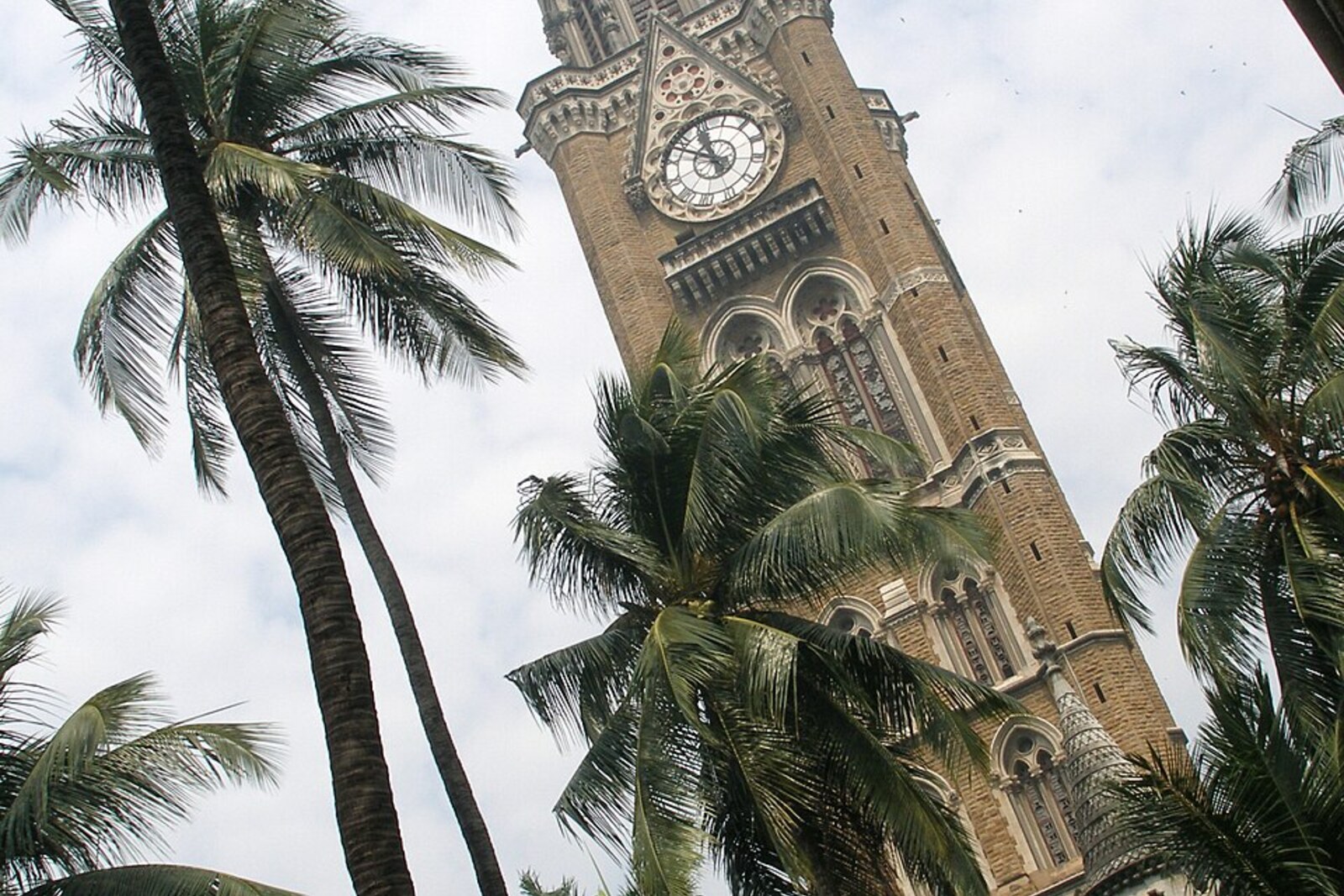
Look around first
What to notice
- Four clock faces
- The university library building
- The bell section of the tower
The story of the place
The clock tower rises above the university library building. Library rooms occupy the lower levels, while the clock and bell mechanism were installed in the upper ones. Four clock faces are visible from outside; sixteen bells once sounded every quarter hour, but now one short melody remains. The weights of the clock and striking mechanism are still raised by hand.
On October sixth, eighteen sixty-four, the Bombay stockbroker Premchand Roychand sent a letter to the colonial administration. He asked it to give the University of Bombay—today's University of Mumbai—two lakhs, or two hundred thousand rupees, “in the name of my good mother Rajabai.” The money was to build a tower with a large clock and a set of “joyful bells.” Roychand wanted to connect it to the university library.
A few weeks earlier, he had already offered another two lakhs for the library itself. That is why the tower stands here, on university grounds: the lower rooms belong to the library, with the clock and bell mechanism raised above them. Roychand was paying for a single building for books, study, and timekeeping.
He made his money from the cotton trade and stock-market dealings. During the American Civil War, supplies of American cotton to England almost stopped, and prices for Indian raw cotton rose severalfold. Roychand grew rich so quickly during this boom that he was called the Cotton King. He promised the university four hundred thousand rupees at the very height of the stock-market boom.
The war ended the very next year, American cotton returned to the market, and Bombay shares collapsed. Companies went bankrupt, Roychand lost most of his fortune, and then built it up again, though on a smaller scale. The university did not turn down the gift. The foundation stone for the library and tower was laid in eighteen sixty-nine, construction was finished nine years later, and readers were admitted to the library in eighteen eighty. Roychand's own name did not appear on the building: the tower was named as he had requested—Rajabai.
A family legend later arose to explain why the son had wanted a clock with bells in particular. Rajabai was a Jain and, according to a religious rule, finished eating before sunset. In old age, she became almost blind and could not check the clock face. According to the legend, the tower clock's chimes were meant to let her tell the time without outside help. The document confirms his mother's name, the large clock, and the requirement to install bells; it says nothing in the letter about blindness or an evening meal, so this part remains a legend.
Sixteen bells and a mechanism capable of playing different melodies were installed in the tower. They sounded every quarter hour, while the clock above additionally struck the full hour. Residents of nearby houses began to complain that the chimes were too loud, and the university switched off some of the bells. The mechanism now plays one short melody, and the weights of the clock and striking mechanism are still raised by hand.
The facade bears no surname of the man who gave money here shortly before his own ruin. What remains is the name he chose for the tower—Rajabai—four clock faces, and the bells for which he wrote his second letter to the university.
Useful on site
Exterior viewing from the maidan side and public approaches; unrestricted entry to the tower and library is not confirmed.
Checked: June 28, 2026. Check the official source before visiting.The tower is easy to view from the open space of the Oval. Do not plan to climb it or visit the university without access confirmed in advance.