 Guide On Map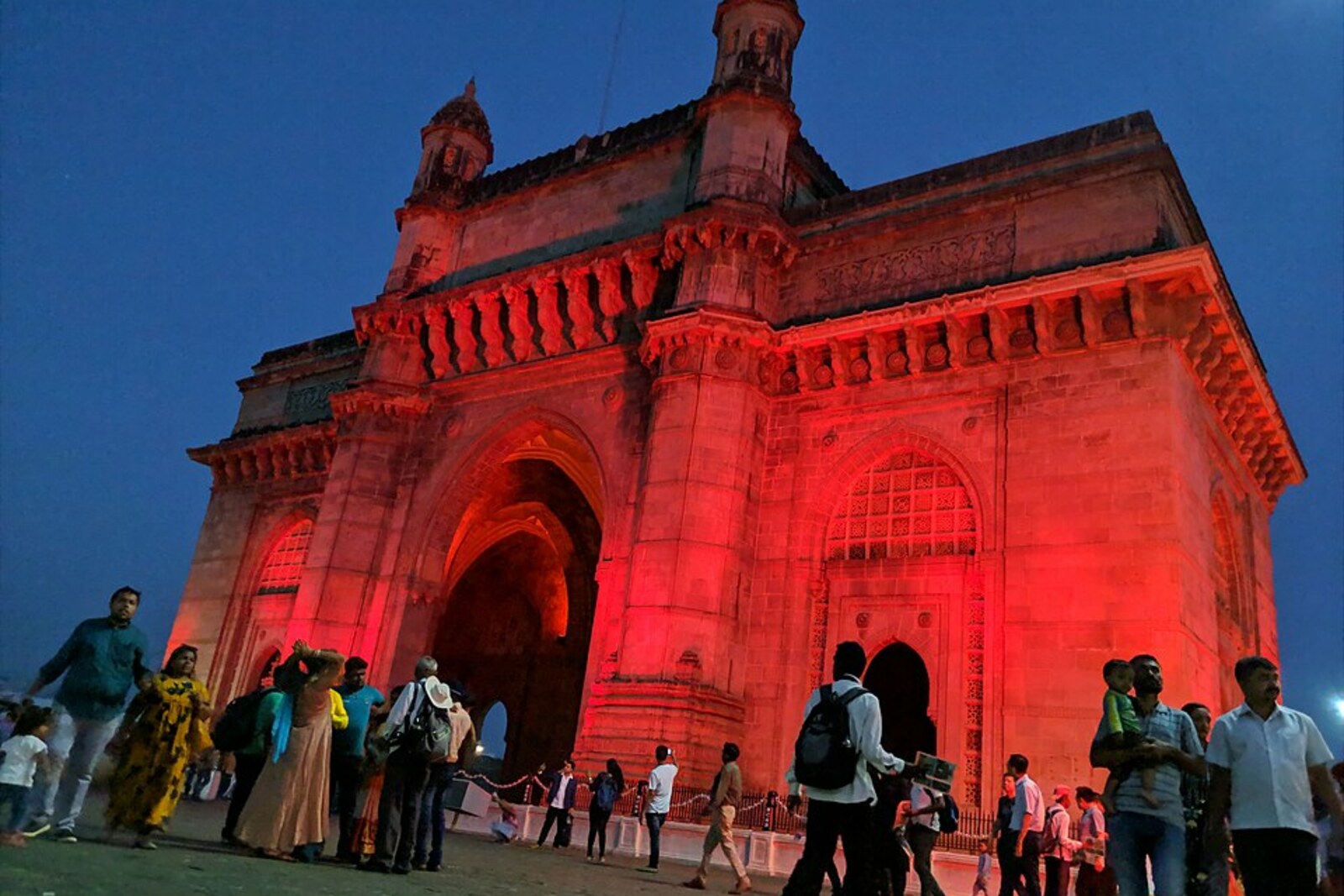
Look around first
What to notice
- Basalt arch
- Central passage
- Side domes
- Piers with passenger vessels
The story of the place
This Gateway was conceived as Bombay's maritime entrance hall: distinguished guests stepping off ships were to enter the city through the central passage of the basalt arch. The side domes frame a space designed for about six hundred invitees—this was where power arriving from the sea was received. The nearby piers still operate, with passenger vessels departing for Elephanta Island.
Before the last British soldiers departed, the Indian Army presented them with a silver replica of the arch beneath which they stood. The gift was intended for the 1st Battalion, Somerset Light Infantry—the last British military unit remaining in India.
For these men, the regiment was a profession and a livelihood. The 1st Battalion spent the Second World War in India and fought in Burma; the regiment's connection with India had been almost unbroken since eighteen twenty-two. After independence was declared in August nineteen forty-seven, British units began to be sent home, but a shortage of sea transport made it impossible to evacuate everyone at once. Major General Lashmer Whistler, who commanded the remaining British forces, was to complete the withdrawal.
On February twenty-eighth, nineteen forty-eight, the battalion marched through Bombay as it was then called—present-day Mumbai—and halted at the Gateway of India. Raja Maharaj Singh, Bombay's first governor after independence, read farewell messages. Indian units provided a guard of honor; Indian and British military bands played the anthems of both countries. The soldiers then lowered the regimental colors in salute, passed through the central arch to the pier, and reached the troop transport RMS Empress of Australia by launch. Whistler left with them. No British military units remained in India.
The silver replica was presented here precisely because of the arch's original purpose. On December second, nineteen eleven, George V, the British king and Emperor of India, and his wife Queen Mary came ashore at the Apollo Bunder pier. George became the first reigning British monarch to visit India. From here he was heading to Delhi, where he was to appear before the Indian princes after his coronation.
The stone gateway did not yet exist. The architect George Wittet built a temporary plaster pavilion for the reception, and the royal couple passed through it. Later, officials commissioned Wittet to turn the landing place into a permanent grand entrance for monarchs, viceroys, and governors arriving by sea. The architect conceived the structure as a reception hall: up to six hundred guests could be accommodated beyond the central passage and side domes. The basalt arch was completed only in nineteen twenty-four—thirteen years after the visit for which it had been commissioned. Its name was literal: for official guests disembarking from ships in Bombay, India began here.
Passenger vessels still depart from the piers beside the full-scale Gateway of India, including ferries to Elephanta Island. The silver replica that the soldiers took away on the last British troop transport is kept in the military museum in the English town of Taunton.
Useful on site
An open square with security screening and heavy crowds. Ferries, queues, temporary barriers, and work at the piers depend on the weather, operators, and city decisions.
Checked: June 30, 2026. Check the official source before visiting.It can be crowded by the water, and the approach may include security screening. You do not need to go to the boats for the thematic finale; plan a ferry trip separately.